Óbidos Castle walls
The medieval walls encircling Óbidos offer expansive views, but they weren't always so accessible.
Full story unlocks in the tour
 Lacobrigo / CC BY-SA 4.0, via Wikimedia Commons
“Beyond the castle walls, a town gifted by kings, nurtured by queens, and shaped by stories.”
Not the postcards. The stories even locals don't know — whispered in your ear, right where they happened.
The medieval walls encircling Óbidos offer expansive views, but they weren't always so accessible.
One of Óbidos' most unusual bookstores occupies a space with a surprising former life.
The local cherry liqueur has a unique serving tradition that involves more than just a glass.
Discover every secret of Óbidos
Every address, every reveal in full — in your ear, right where it happened.
You pick your stops. You walk. The voice reveals what the others miss.
No tours available yet. Check back soon — we're preparing them.
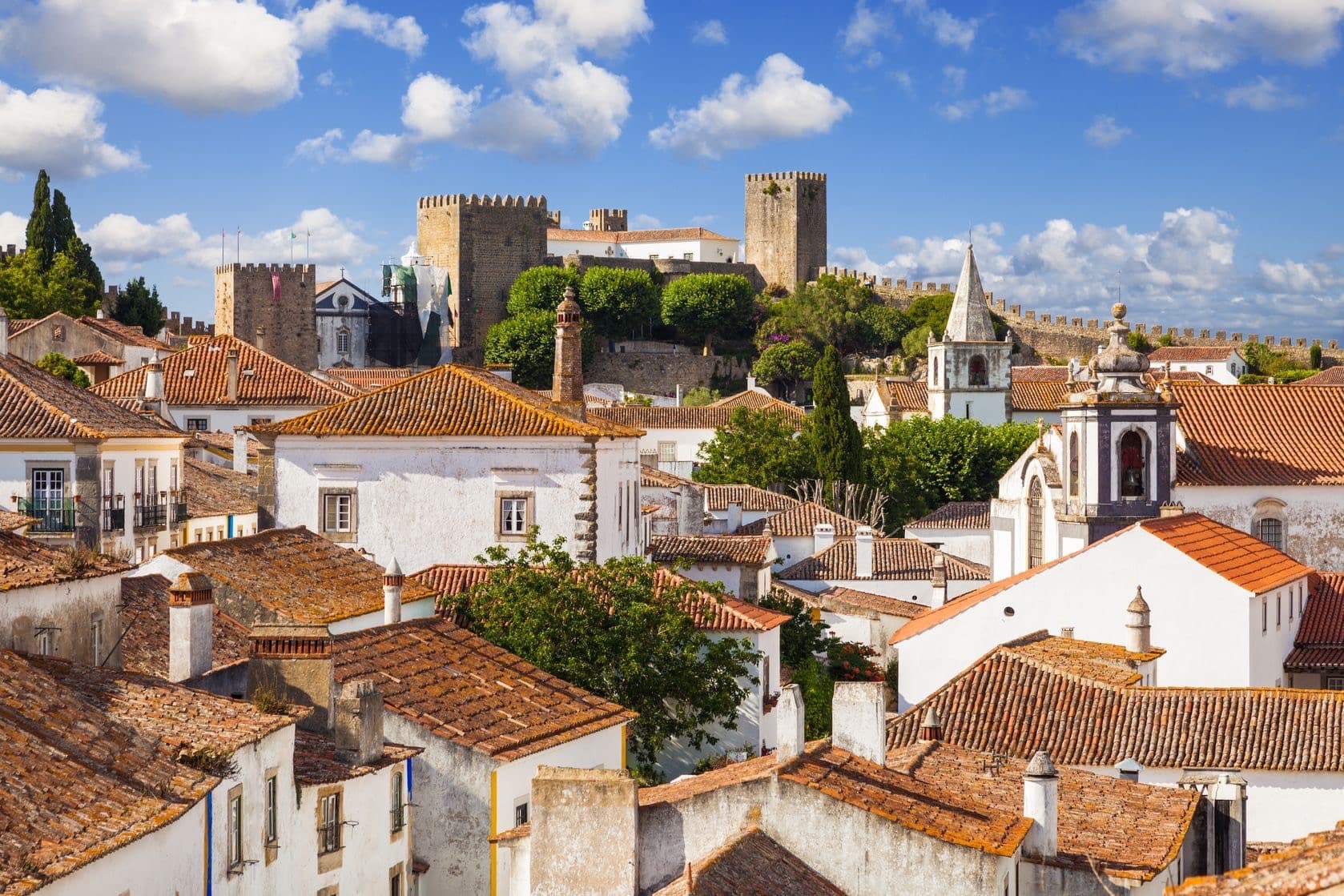
Óbidos, a captivating town in Portugal's Oeste region, feels like a journey into a fairytale. Encased within well-preserved medieval walls, its historic center is a labyrinth of cobbled streets, whitewashed houses adorned with splashes of deep blue and warm yellow, and blooming bougainvillea. Just an hour north of Lisbon, this picturesque settlement, with approximately 3,100 inhabitants, offers a tranquil escape from the bustling capital.
Often called the "Town of Queens" or "Wedding City," Óbidos holds a unique place in Portuguese history, having been a traditional wedding gift from kings to their queens for centuries. This royal patronage contributed to its enduring charm and architectural preservation. In 2015, UNESCO recognized Óbidos as a City of Literature, a testament to its innovative bookshops and thriving cultural scene.
The history of Óbidos stretches back to the late Paleolithic era, with evidence of human habitation extending from the Atlantic coast inland along rivers and lakes. The name "Óbidos" itself is derived from the Latin oppidum, meaning "citadel" or "fortified town," a nod to its strategic importance. Early Celtic tribes established a settlement here, which later became a trading hub for the Phoenicians and a Roman outpost.
Around 713, the Moors established a fortification on the elevated escarpment, shaping the town's layout and leaving an enduring architectural influence. In 1148, Óbidos was reclaimed from the Moors by Afonso Henriques, the first King of Portugal, marking a significant victory in the conquest of the Estremadura Province. The town received its first royal charter in 1195 under King Sancho I.
A pivotal moment in Óbidos' history occurred in 1210 when King Afonso II gifted the town to Queen Urraca. This began a long-standing tradition: in 1282, King Dinis I presented Óbidos to his wife, Queen Isabel, as a wedding gift, a custom that continued with successive queens until the 19th century. This royal patronage, particularly from the queens, led to the town's cultural and economic enrichment, ensuring its preservation and development. The castle and walls were notably remodeled during King Dinis I's reign.
While largely maintaining its medieval character, Óbidos was not untouched by major historical events. The devastating 1755 Lisbon earthquake caused damage to the village walls, several churches, and many buildings, altering some of its Arab and medieval architecture. However, the town has always held strong to its roots, and the walls were fully restored in the early 20th century. In 1951, the castle and the entire village were classified as national monuments, and in 2007, Óbidos Castle was recognized as one of the Seven Wonders of Portugal. The town also played a role in more recent history, serving as a center of government and meeting place during the 1974 Carnation Revolution.
In recent years, Óbidos has embraced a new identity as a UNESCO Creative City of Literature. This initiative, which began in 2011, involved transforming unexpected spaces like churches, former wineries, and markets into unique bookstores. The town now hosts the annual Fólio – International Literary Festival of Óbidos, drawing writers and readers from around the world.
Begin your exploration at the Porta da Vila, the main entrance gate to the town, adorned with 18th-century azulejo tiles. From here, ascend to the fortified walls that encircle the town, offering unparalleled views of the terracotta roofs, whitewashed houses, and the distant Óbidos Lagoon. While walking the entire 1.5 km perimeter takes less than an hour, be mindful that some sections lack railings.
Wander along Rua Direita, the main cobbled street, lined with small shops, cafes, and houses painted with traditional blue and yellow accents. Discover the Igreja de Santa Maria (Church of Saint Mary), the town's main church, which features beautiful blue tiles and Renaissance tombs. Nearby, the Igreja da Misericórdia (Church of Mercy) also showcases tiled walls and art.
Explore the town's distinctive bookshops, a highlight of its UNESCO City of Literature status. The Livraria de Santiago, housed in a former church, is a particularly unique experience. The Óbidos Castle, a national monument and one of Portugal's Seven Wonders, now functions as a pousada (historic hotel), but its courtyard is accessible to visitors. Before leaving, be sure to sample Ginja de Óbidos, the local sour cherry liqueur, often served in a small, edible chocolate cup.
Óbidos is a year-round destination, but the best times to visit for pleasant weather and fewer crowds are spring (April to June) and autumn (September to October). Spring brings mild, dry weather, abundant sunshine, and blooming bougainvillea. Autumn offers mild air, golden light, and a quieter atmosphere once the summer crowds dissipate. July and August are the warmest months, but also the busiest, especially during the Medieval Market festival. Winter is cooler and quieter, ideal for those who prefer empty streets and a slower pace.
Consider aligning your visit with one of Óbidos' popular festivals. The International Chocolate Festival typically takes place in March or April, transforming the town with chocolate sculptures and tastings. The Medieval Market brings the castle and town to life in July and August. The Fólio – Óbidos International Literary Festival is held in September or October.
Óbidos is approximately 85 kilometers (53 miles) north of Lisbon, making it an easy day trip by car or bus, taking about an hour. If driving, parking is available in dirt lots outside the town walls, with one conveniently located across from the main gate. For a more comprehensive experience, consider an organized tour from Lisbon, which often includes other nearby attractions.
While Óbidos can be explored in a few hours, staying overnight allows you to experience the town at its quietest after the day-trippers depart. The town's cobbled streets and stairs can be steep and uneven, so comfortable, sturdy walking shoes are essential. Accessibility may be challenging for those with mobility issues due to the terrain. Within the walls, you'll find numerous shops selling local crafts, ceramics, and the famous Ginja de Óbidos.