Oamaru Blue Penguin Colony
The world's smallest penguins stage a nightly procession, though the colony's beginnings were surprisingly utilitarian.
Full story unlocks in the tour
 Jamie Wang / CC BY-SA 2.0, via Wikimedia Commons
“Where Victorian elegance meets fantastical contraptions, and small penguins march home.”
Not the postcards. The stories even locals don't know — whispered in your ear, right where they happened.
The world's smallest penguins stage a nightly procession, though the colony's beginnings were surprisingly utilitarian.
Oamaru's perfectly preserved Victorian streetscape was not always a source of civic pride.
A prominent war memorial on Oamaru's main thoroughfare shares an unexpected link with a Scottish national figure.
Discover every secret of Oamaru
Every address, every reveal in full — in your ear, right where it happened.
You pick your stops. You walk. The voice reveals what the others miss.
No tours available yet. Check back soon — we're preparing them.
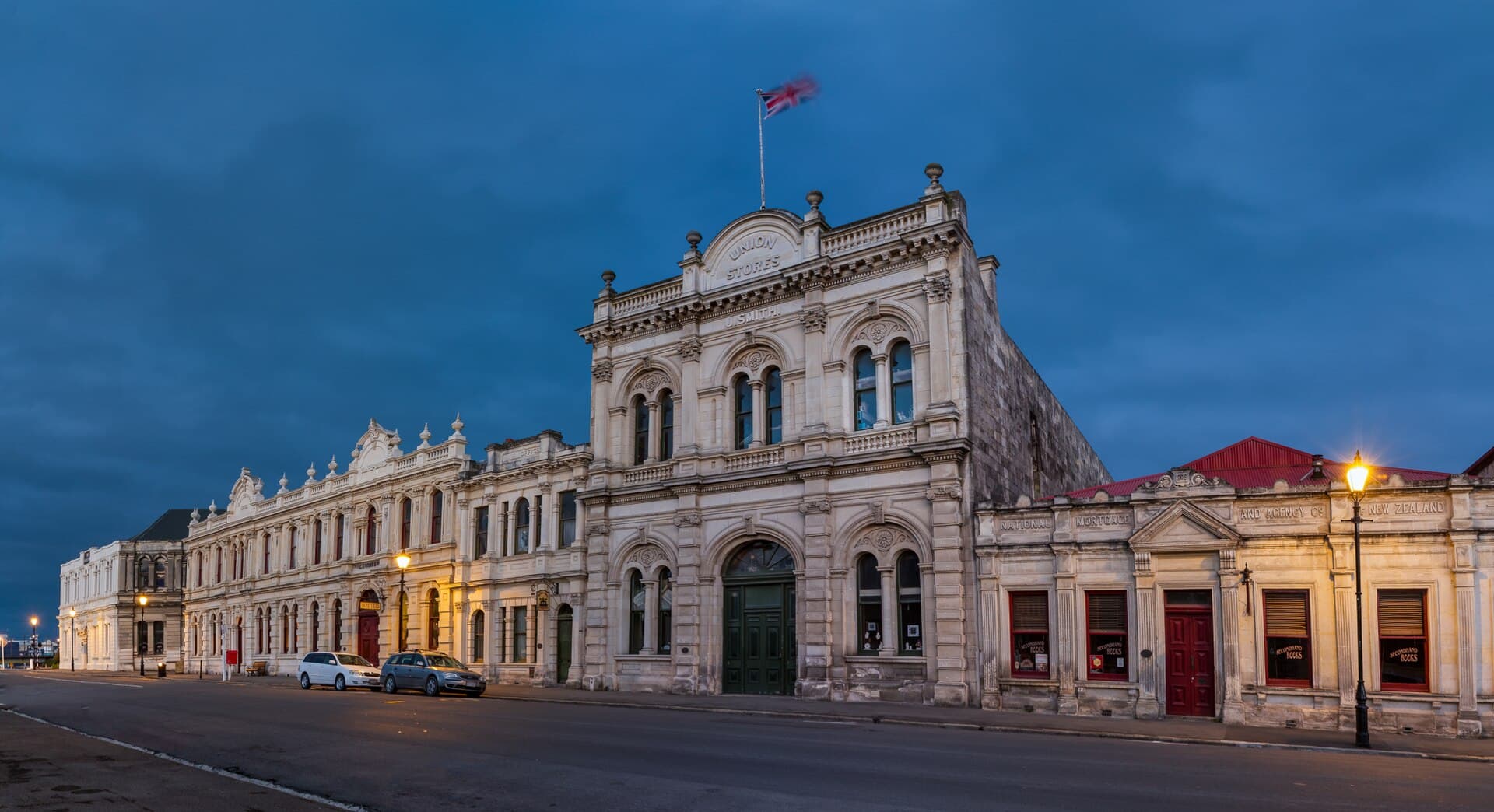
Oamaru, along New Zealand's South Island east coast, is a town that feels like a journey through time, yet with a playful, forward-looking twist. It is celebrated for its extraordinarily preserved Victorian architecture, fashioned from the creamy local Oamaru stone, earning it the moniker 'Whitestone City.' This distinctive aesthetic creates a singular setting for its flourishing arts community and its unexpected identity as the 'Steampunk Capital of the World.'
Beyond its architectural grandeur and retro-futuristic flair, Oamaru offers captivating encounters with nature. The town is home to colonies of both the little blue penguins (kororā), the globe's smallest penguin species, and the more uncommon yellow-eyed penguins (hoiho). Visitors can observe these endearing birds returning from the sea to their nests, crafting a truly memorable experience that intertwines cultural immersion with wildlife observation.
The land surrounding Oamaru holds a long chronicle of human presence, with significant Māori archaeological sites dating back to the Archaic (moa-hunter) phase of Māori culture, around AD 1100. These early communities gathered along the southeast coast, including locations at the Waitaki River mouth and Awamoa. The name Oamaru itself is thought to originate from a Māori term signifying 'a place of sheltered fire,' referencing its protected situation.
European settlers arrived in the Oamaru area in the 1850s, with the town officially designated for settlement in 1860. Oamaru's prosperity in the mid-19th century was largely fueled by its natural harbor, which facilitated the export of wool and grain to Britain. The town experienced a swift expansion between 1865 and 1885, with capital flowing in, leading to the erection of many grand public and commercial structures. These buildings were primarily constructed from locally quarried limestone, known as Oamaru stone or whitestone, which was easily sculpted and lent itself to the elaborate Neo-Classical style popular at the time.
However, this period of rapid expansion was relatively brief. The gold mines that powered much of the region's affluence eventually depleted, and the grain trade diminished with the advent of railways in Western Canada. The port industry further faded in the 1960s and largely ceased operations in 1974. Paradoxically, this economic downturn played a pivotal role in safeguarding Oamaru's Victorian architecture. Unlike other towns that tore down older buildings for modernization, Oamaru lacked the means to do so, leaving its historic precinct remarkably intact. In the 1980s and beyond, dedicated residents began restoring and re-envisioning these beautiful buildings, transforming the once-dilapidated warehouse district into the lively Victorian Precinct visible today. This renewed appreciation for its heritage, coupled with the emergence of the Steampunk movement, has given Oamaru a singular identity and a new vitality as a distinctive travel destination.
Begin your exploration in the Victorian Precinct, an exceptionally preserved collection of 19th-century commercial buildings crafted from Oamaru stone. Wander along Harbour Street and Tyne Street, where former warehouses and banks now house artisan workshops, galleries, antique shops, and cafes. Look for locals in period attire or riding Penny Farthings, especially on Sundays when a market operates from an old wool store.
No journey to Oamaru is complete without immersing yourself in the world of Steampunk HQ. Situated in a historic Oamaru stone grain elevator building, this interactive gallery displays an industrial take on steampunk with contraptions, sculptures, and audiovisual installations. Outside, a modified diesel locomotive exhales fire and smoke.
For those who appreciate wildlife, the Ōamaru Blue Penguin Colony offers an unforgettable experience. Observe the world's smallest penguins, the little blue penguins (kororā), as they return from their day at sea to their nesting sites at dusk. Daytime visits also allow you to see penguins within their nesting boxes. For an opportunity to glimpse the rarer yellow-eyed penguins, proceed to Bushy Beach around dusk, watching from the specially built viewing hide to avoid disturbance.
Enjoy a leisurely walk through the Oamaru Public Gardens, among the oldest public gardens in New Zealand, established in 1876. These expansive gardens feature Victorian-inspired 'rooms,' native plantings, Chinese gardens, and rose plots.
Oamaru experiences a mild and temperate maritime climate, making it welcoming throughout the year. Summers (December to February) are comfortable, with average daytime temperatures around 19-20°C (66-68°F), perfect for exploring on foot. Winters (June to August) are cool but generally gentle, with daytime temperatures ranging from 6-9°C (43-48°F). For observing penguins, Little Blue Penguins are present all year, returning to their burrows each night. However, the breeding season (September to February) offers a greater chance of spotting them, with November to December seeing around 250 birds returning. Yellow-eyed penguins are most active between November and March.
Oamaru is readily accessible by car, situated on State Highway 1, approximately 90 minutes north of Dunedin and three hours south of Christchurch. The town center and its historic precinct are best explored on foot. Public transportation within the city is limited, so a rental car is advisable for excursions to areas like Bushy Beach or supermarkets.
Accommodation options span from heritage hotels within the Victorian Precinct to inviting bed-and-breakfasts, suiting various budgets. Layered clothing is recommended throughout the year due to changeable coastal weather; even in summer, evenings can be cool. If attending an evening penguin viewing, bring warm layers, a hat, and a scarf. New Zealand Dollars (NZD) are the local currency, with card payments widely accepted. It is prudent to carry some cash for places like the Sunday Farmers' Market or smaller artisan stalls.