Norwich Castle
Norwich Castle was constructed by the Normans as a royal palace, yet few Norman monarchs ever resided within its walls.
Full story unlocks in the tour
 Tanya Dedyukhina / CC BY 3.0, via Wikimedia Commons
“Where ancient lanes meet contemporary spirit.”
Not the postcards. The stories even locals don't know — whispered in your ear, right where they happened.
Norwich Castle was constructed by the Normans as a royal palace, yet few Norman monarchs ever resided within its walls.
This historic merchant's house carries a secret within its name, connected to an unexpected influx of European residents.
Beyond its colorful stalls, this ancient market possesses an unsettling connection to a rather scandalous event.
Discover every secret of Norwich
Every address, every reveal in full — in your ear, right where it happened.
You pick your stops. You walk. The voice reveals what the others miss.
No tours available yet. Check back soon — we're preparing them.
Norwich, a city in Norfolk, England, is a place where centuries of human narrative are visibly woven into the urban fabric. Known as England's most complete medieval city, it offers ancient buildings, and a narrative that stretches back to Anglo-Saxon times. The city's particular allure lies in its ability to preserve its past while fostering a contemporary culture, earning it the designation of England's first UNESCO City of Literature in 2012.
Situated along the River Wensum, Norwich presents a blend of historical exploration and modern leisure. From its imposing Norman Cathedral and Castle to the lively, colorful Norwich Market, there's a tangible sense of continuity. The city also serves as an entry point to the Norfolk Broads, a national park offering a different kind of natural beauty just a short distance away.
Norwich's geographical isolation meant that until the railway arrived in 1845, it was often quicker to travel to Amsterdam by boat than to London, contributing to its distinct character and development. Today, it's a city that invites exploration, whether you're delving into its literary heritage, enjoying its independent shops and eateries, or simply absorbing the atmosphere of its ancient lanes.
The origins of Norwich can be traced back to the Anglo-Saxon period, when the village of Northwic, meaning 'northern settlement' or 'northern trading place,' was established on a gravel terrace above the River Wensum. By 1004, it had already become an important market centre, though it faced raids and burning by Viking King Sweyn Forkbeard. The Vikings later established a settlement called 'Norvic,' further solidifying its role as a trading hub in the Danelaw.
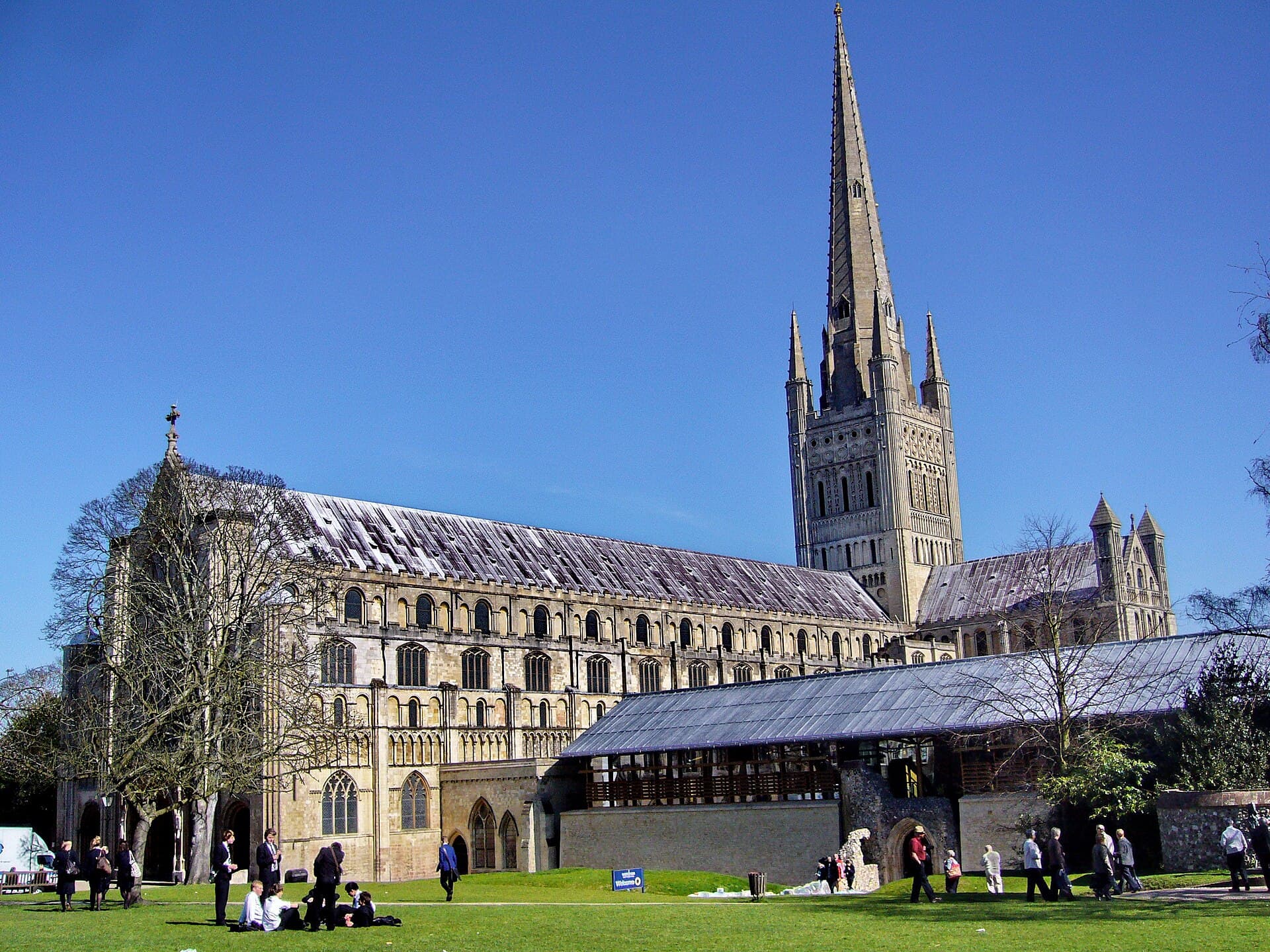
Following the Norman Conquest in 1066, Norwich underwent significant transformation. William the Conqueror ordered the construction of Norwich Castle around 1067, demolishing 98 Saxon homes to make way for it. The wooden fort was later replaced by a formidable stone keep between 1094 and 1121, designed to assert Norman authority. The Normans also moved the Saxon marketplace to the Mancroft area, where Norwich Market has operated for over 900 years, making it one of England's oldest and largest open-air markets. The magnificent Norwich Cathedral, a masterpiece of Norman Romanesque architecture, was also founded during this period, with its construction beginning shortly after the Conquest.
Medieval Norwich flourished, becoming one of the largest and wealthiest cities in England, second only to London for much of the second millennium. Its prosperity was largely based on the wool trade, a thriving textile industry bolstered by the arrival of Flemish weavers in the 14th century, and further by immigrants from the Low Countries during Elizabeth I's reign. The city was granted a royal charter in 1158, establishing its self-governing status. The city walls, constructed between 1280 and 1340, enclosed a larger area than the City of London, with 12 defensive gates. This period also saw the construction of numerous medieval churches, with 32 still standing within the historic city walls today.
While Norwich experienced a period of decline relative to the new industrial centres of the north from the 18th century onwards, it developed as a major centre for footwear manufacturing. The city has a history of political and religious nonconformity and was the only English city to be excommunicated by the Pope after a riot between citizens and monks in 1274.
In the 20th century, Norwich continued to evolve. The Art Deco City Hall was completed in 1938, and in 1963, the Brutalist University of East Anglia (UEA) opened, bringing new architectural styles to the city. The late 20th and early 21st centuries saw significant redevelopment, including the construction of The Forum, a modern public building that replaced the old Norwich Central Library after it was destroyed by fire in 1994. Today, Norwich embraces its heritage while looking to the future, as evidenced by its UNESCO City of Literature status and its role as a cultural hub in East Anglia.
Begin your exploration at Norwich Cathedral, a nearly 1,000-year-old Norman structure with England's second-tallest spire and second-largest cloisters. Walk through its expansive Cathedral Close, one of the largest in Europe. Nearby, discover Pull's Ferry, a 15th-century gatehouse along the River Wensum.
Dominating the city's skyline is Norwich Castle, a Norman fortification now housing a museum and art gallery with diverse exhibits. Afterwards, wander through the Royal Arcade, an opulent covered walkway from 1899, leading to the lively Norwich Market. This open-air market, with its distinctive striped stalls, has been a trading hub for over 900 years, offering everything from fresh produce to international street food.
Delve into medieval Norwich by strolling along Elm Hill, a street lined with Tudor buildings and independent shops. Explore Strangers' Hall, a beautifully preserved 14th-century merchant's house showcasing centuries of domestic life. For a modern contrast, visit The Forum, a striking glass and brick building that houses the Norfolk and Norwich Millennium Library and hosts various public events. Art enthusiasts should consider a trip to the Sainsbury Centre for Visual Arts, located at the University of East Anglia, which features a diverse collection ranging from Roman sculptures to contemporary art.
The best time to visit Norwich for pleasant weather and outdoor activities is from late June to early September. During these summer months, average daytime temperatures range from 20.2°C to 23.9°C, with highs reaching 28.2°C in July. While the weather is generally warm, it's advisable to bring an umbrella and a light sweater for cooler evenings or unexpected rain.
To avoid larger crowds, consider visiting between September and April. During this period, you might also experience clearer views of the region's wildlife due to less foliage. Norwich experiences consistent precipitation throughout the year, with an average of 10 to 13 rainy or snowy days per month, so being prepared for rain is always a good idea.
Norwich is well-connected and easy to navigate. Regular inter-city trains run from London Liverpool Street, and the A11 provides a direct road link. Once in the city, Norwich is compact enough for walking and cycling, and a monthly bus pass is available if you plan on using public transport frequently. Several multi-storey and surface car parks are available in the city centre, including at Castle Quarter, Chantry Place, and The Forum.
For visitor information, the VisitNorwich website offers comprehensive details on accommodation, dining, and attractions. While there is no longer a physical Tourist Information Centre, Norwich City Hosts in blue 'Here to Help' tabards are available in the city centre from Monday to Saturday to answer questions. If you require specific accessibility information, The Forum provides details on assistance dogs, induction loops, lifts, and wheelchair-accessible toilets.