Piazza San Benedetto
The grand statue of Saint Benedict in Norcia's main square holds a secret about its creation.
Full story unlocks in the tour
 Hagai Agmon-Snir حچاي اچمون-سنير חגי אגמון-שניר / CC BY-SA 4.0, via Wikimedia Commons
“Where ancient stones meet the scent of truffles and resilience.”
Not the postcards. The stories even locals don't know — whispered in your ear, right where they happened.
The grand statue of Saint Benedict in Norcia's main square holds a secret about its creation.
The term 'norcineria,' now used throughout Italy for a pork butcher's shop, has a surprising origin tied directly to Norcia's past.
Norcia's prized black truffles, often called 'Nero di Norcia,' have a history far older than most might guess.
Discover every secret of Norcia
Every address, every reveal in full — in your ear, right where it happened.
You pick your stops. You walk. The voice reveals what the others miss.
No tours available yet. Check back soon — we're preparing them.
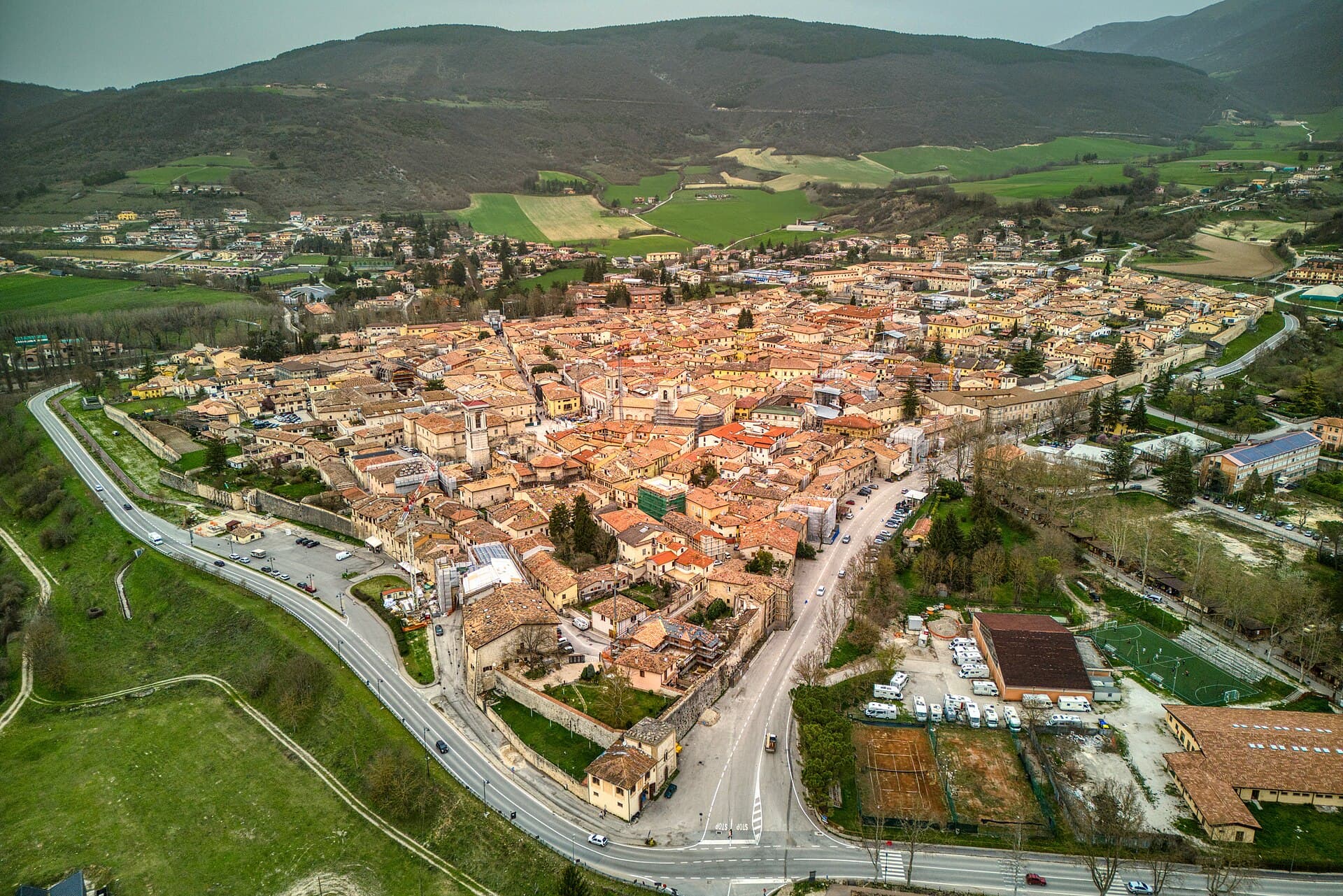
Norcia, a town in Umbria, Italy, is a place of profound character, where the architecture tells stories of devotion and endurance. It is a community deeply connected to its land, known for its culinary traditions that celebrate the bounty of the earth and the skill of its artisans. The air often carries the earthy perfume of truffles and cured meats, a testament to centuries of expertise.
Life here unfolds with a rhythm shaped by the seasons and the enduring spirit of its people. The town's very fabric, from its sturdy walls to its venerable churches, speaks of a place that has weathered time and change with an unwavering sense of identity. Visitors arrive to find not just a destination, but an experience rooted in authenticity and a deep respect for tradition.
Norcia's story begins long before the Roman Empire, with evidence suggesting settlements in the area by the Umbri and later the Sabines. The town, then known as Nursia, became a significant Roman municipality, its strategic position in the Apennine mountains making it a key point for trade and defense. This early period laid the groundwork for its enduring character, a blend of agricultural prowess and a strong sense of community.
The 5th century brought forth its most celebrated son, Saint Benedict, whose monastic rule profoundly shaped Western Christianity. His birthplace transformed Norcia into a pilgrimage site, drawing scholars and devotees. The Benedictine influence is still palpable, woven into the town's spiritual and architectural landscape, reflecting centuries of devotion and intellectual pursuit.
During the Middle Ages, Norcia developed as a free commune, asserting its independence amidst the turbulent political landscape of central Italy. Its fortified walls, many of which still stand, speak of a period marked by both prosperity and conflict. The town's reputation for skilled artisans, particularly in the curing of meats, began to solidify during this era, a tradition that continues to define its culinary identity.
Norcia has faced numerous earthquakes throughout its history, each event testing the resolve of its inhabitants. The most recent significant tremors in 2016 caused extensive damage, yet the town's spirit of reconstruction and preservation has shone brightly. The meticulous efforts to restore its historic buildings and cultural heritage underscore a profound commitment to its past and future. This ongoing process of rebuilding is not merely about bricks and mortar, but about reaffirming the town's identity and its enduring connection to its traditions.
Walk through the Piazza San Benedetto, where the Basilica of Saint Benedict stands as a testament to the town's patron saint. Though damaged in recent earthquakes, its façade and spirit remain. Explore the Castellina, a fortress designed by Vignola, which now houses the Civic Museum, displaying artifacts from Norcia's long past. Wander the town's ancient walls, observing the gates and towers that have guarded the community for centuries. Seek out the local 'norcinerie,' traditional pork butcher shops, to experience a culinary tradition that defines the region. The surrounding Sibilline Mountains offer trails for those seeking the quiet grandeur of nature, with views that stretch across the Umbrian landscape.
Spring and autumn offer the most agreeable weather for exploring Norcia and its surroundings. In spring, the countryside awakens with greenery, and the air is fresh. Autumn brings cooler temperatures and the renowned truffle season, a time when the town celebrates its prized culinary produce. Summers are warm and sunny, suitable for outdoor activities, while winters can be cold, with occasional snow, lending a quiet, contemplative atmosphere.
Norcia is accessible by car, with parking available outside the historic center. Public transport options include buses connecting to larger towns like Spoleto, which has a train station. Within the town, walking is the primary mode of transport. Many businesses operate on traditional Italian schedules, with closures in the early afternoon. English is spoken in tourist-oriented establishments, but a few Italian phrases are always appreciated. Consider booking accommodations and any desired truffle hunting experiences in advance, especially during peak seasons.