Nitra Castle
The castle's oldest surviving part, the Romanesque Church of St. Emmeram, holds a secret that predates its documented 11th-century construction.
Full story unlocks in the tour
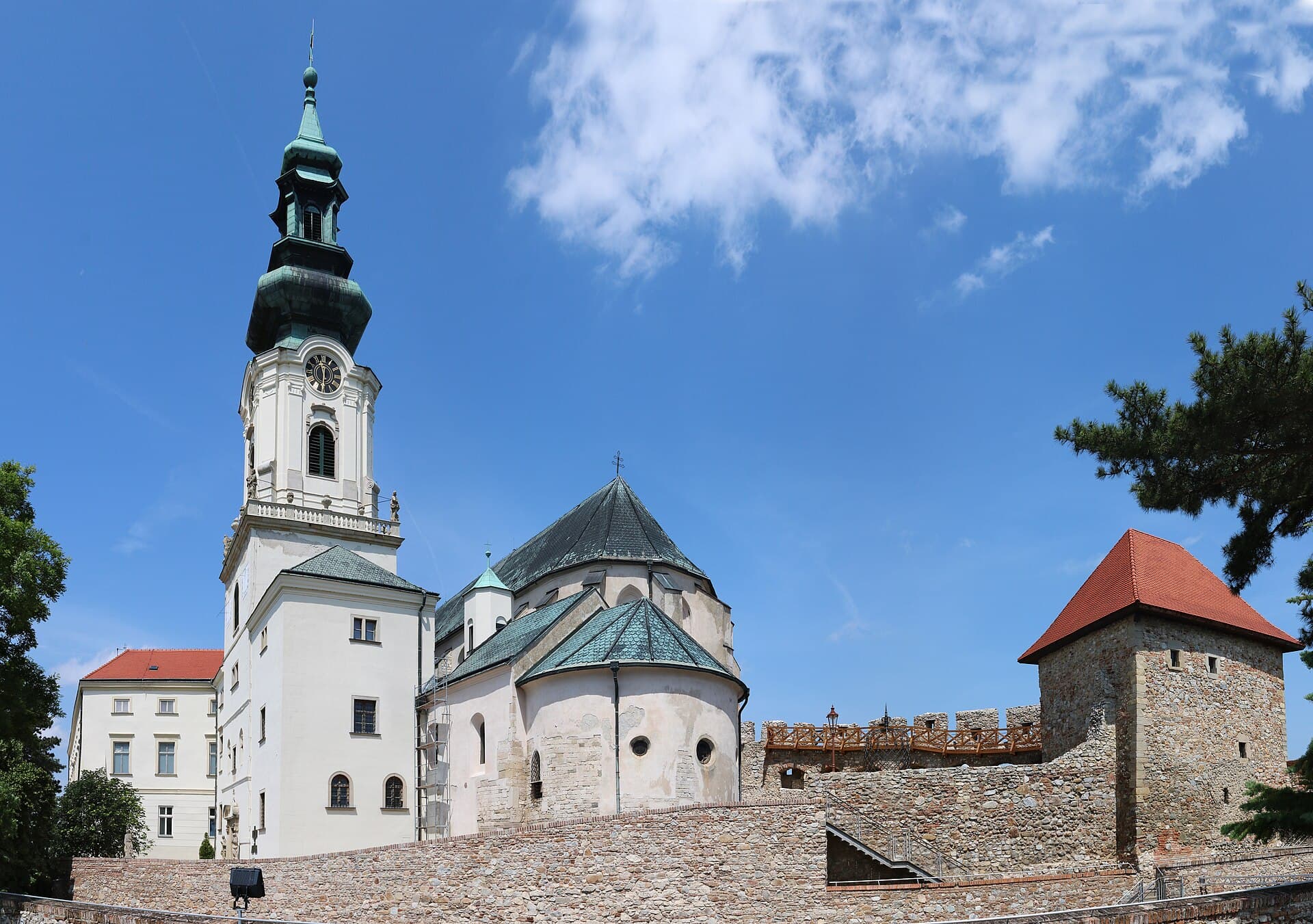 Ingo Mehling / CC BY-SA 4.0, via Wikimedia Commons
“Where ancient history breathes beneath seven green hills.”
Not the postcards. The stories even locals don't know — whispered in your ear, right where they happened.
The castle's oldest surviving part, the Romanesque Church of St. Emmeram, holds a secret that predates its documented 11th-century construction.
This striking Moorish-Byzantine synagogue, now a cultural center, once housed a prominent Jewish community with a surprising connection to a powerful historical figure.
Beyond its scenic hiking trails, Zobor Hill holds the remains of Slovakia's oldest monastery, with a unique spiritual energy.
Discover every secret of Nitra
Every address, every reveal in full — in your ear, right where it happened.
You pick your stops. You walk. The voice reveals what the others miss.
No tours available yet. Check back soon — we're preparing them.
Nitra, one of Slovakia's most ancient cities, unfolds across seven verdant hills, with the Nitra River flowing through its heart. This picturesque urban area, home to approximately 78,000 residents, harmonizes its deep past with the natural beauty of its setting. Nitra once served as the core of the Principality of Nitra, a duchy of profound historical weight, and later became a pivotal component of Great Moravia. It is a city where enduring landmarks, a lively cultural scene, and a strong academic presence—with two universities—converge.
Often called the "Mother of Slovak towns," Nitra's strategic position at the crossroads of ancient routes, coupled with its fertile agricultural land, has shaped its lasting importance. The city offers an arresting vista from every direction, framed by Zobor Hill, the initial mountain range from Slovakia's southern expanse. From its Bronze Age settlements to its role in the Great Moravian Empire and the Kingdom of Hungary, Nitra's narrative is etched into its very foundations.
The history of Nitra reaches back to approximately 30,000 BCE, with evidence of prehistoric inhabitants. The earliest discoveries in the area date from 25,000 to 30,000 years ago, and people have continuously resided here for the last 5,000 to 7,000 years. Around 1600 BCE, the Madarovce culture constructed the first fort on Castle Hill. Later, during the Iron Age, a substantial hillfort was built on Zobor Hill, complemented by smaller forts nearby. Celts occupied the area from the 5th to 1st centuries BCE, even minting their own silver coins, known as Nitra type coins.
Slavic tribes arrived in the region in the late 400s and early 500s CE, establishing settlements primarily in low-lying areas near rivers, many of which were in the Nitra vicinity. By the 8th century, Nitra had become a significant Slavic center and the main city of the Principality of Nitra. In 833, Prince Pribina, who had built the first Christian church in what is now Slovakia around 830, was ousted by the Moravian prince Mojmír I. This event led to the unification of both regions into the early medieval empire of Great Moravia. During the 9th century, Nitra was one of Central Europe's largest agglomerations, comprising fortified centers and over twenty non-fortified villages. The Slavs constructed a substantial castle on Castle Hill, covering an area of 8.5 hectares.
After the fall of Great Moravia, Nitra was incorporated into the Kingdom of Hungary. In 1248, the settlement was granted the privileges of a free royal city, though these were rescinded in 1288. The city faced various conflicts, including damage from wars with Czechia in 1271-1272 and Hussite incursions in the 15th century. The 16th and 17th centuries saw Nitra besieged multiple times by the Ottoman Empire. In 1708, an uprising against the Habsburgs further damaged the city, which was subsequently restored in the Baroque style.
Nitra played a significant role in the Slovak autonomist movement in 1933, when Pribina's Celebration became the largest demonstration against Czechoslovakism. During the First Slovak Republic (1939-1945), the Jewish population of Nitra suffered greatly, with an estimated 90% exterminated in German concentration camps. After World War II and the subsequent Communist period (1948-1989), which saw the oppression of the Catholic church, Nitra experienced extensive growth and the annexation of surrounding villages. Following the Velvet Revolution of 1989 and the dissolution of Czechoslovakia, Nitra became part of the newly established Slovakia and the seat of the Nitra Region in 1996. Today, Nitra is recognized as the agricultural capital of Slovakia, owing to its long farming tradition and favorable climate.
Dominating the city skyline, Nitra Castle rises, built upon the foundation of an earlier Slavic fort. Its complex includes the impressive St. Emmeram's Cathedral, a fusion of Romanesque, Gothic, and Baroque styles, alongside the Bishop's Palace and robust fortifications. The castle offers sweeping views of the city and its surroundings. A short walk from the city center, the Nitra Synagogue, constructed in a Moorish-Byzantine style between 1908 and 1911, now functions as a concert hall and hosts an exhibition on Slovak Jews.
For a glimpse into early Romanesque architecture, visit the Dražovce church (Kostol sv. Michala archanjela), one of Slovakia's most ancient churches, dating from the 11th century. It is no longer in use but remains an important archaeological site. The Marian Column, a High Baroque sculpture from 1750, stands on the southern slope of the castle hill, commemorating plague epidemics. For a unique architectural experience, seek out the Slovak Agricultural University building, a brutalist masterpiece from the 1960s, designed by Vladimir Dedecek. Finally, the Nitra Calvary, dating from the turn of the 18th and 19th centuries, offers both a pilgrimage site and a place for active relaxation with views from its prominent rocky hill.
Nitra offers charm throughout the year, but the most agreeable weather for exploring outdoor attractions and engaging in warm-weather activities occurs from early June to mid-September. During these months, average daytime temperatures range from a comfortable 23°C to 29°C (73°F to 84°F). July is typically the warmest month, with an average high of 27°C (80°F). While June experiences the most rainfall, with an average of 80mm, there are still many sunny days. The clearest skies are usually in July, making it ideal for sightseeing. Autumn also presents beautiful scenery with changing foliage.
Nitra is situated in southwestern Slovakia, approximately 90 km (56 miles) east of Bratislava. The most convenient way to arrive in Nitra is by bus, with frequent connections from Bratislava taking a little over an hour. While train travel is an option, it often involves changes and can be longer and more expensive than the bus. The bus and train stations in Nitra are conveniently located adjacent to each other, about a 20-minute walk from the main square, Svätoplukovo námiestie. Nitra maintains a good public transport system, primarily operated by buses, which connect the city center with various points of interest. All bus stops are request stops, meaning you need to signal if you wish to board or alight. The local currency is the Euro (€), and the official language is Slovak. Nitra also has a small airport, Nitra Airfield (ICAO: LZNI), located about 5 km southeast of the town, primarily used for sport flying and international gliding competitions. For international arrivals, Bratislava (BTS) is the nearest major airport, about 67.3 km away, followed by Vienna (VIE) and Budapest (BUD).