Tianyi Pavilion
China's oldest private library was constructed with a clever architectural secret, designed to safeguard its invaluable collection from its greatest adversary.
Full story unlocks in the tour
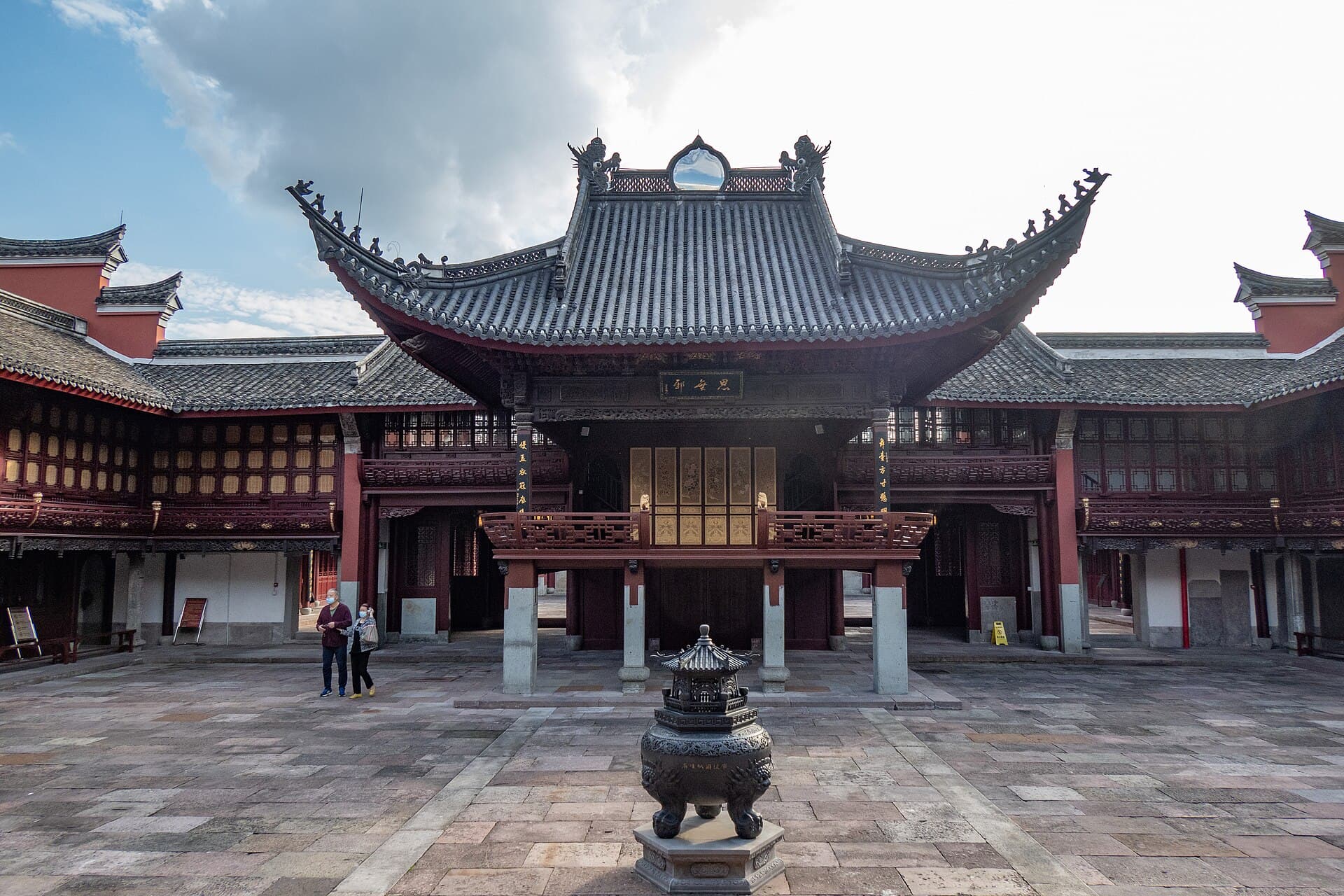 Siyuwj / CC BY-SA 4.0, via Wikimedia Commons
“Where ancient scholarship meets modern dynamism, along tranquil waves.”
Not the postcards. The stories even locals don't know — whispered in your ear, right where they happened.
China's oldest private library was constructed with a clever architectural secret, designed to safeguard its invaluable collection from its greatest adversary.
Before Shanghai's iconic waterfront, another Chinese Bund already thrived as a bustling center for international trade, its origins less widely known.
A thousand-year-old pagoda in the region holds a singular architectural marvel that illuminates a deeper layer of its spiritual meaning.
Discover every secret of Ningbo
Every address, every reveal in full — in your ear, right where it happened.
You pick your stops. You walk. The voice reveals what the others miss.
No tours available yet. Check back soon — we're preparing them.
Ningbo, a port city in China's Zhejiang province, offers a compelling blend of ancient heritage and modern vitality. Its name, meaning 'serene waves,' hints at the city's calm atmosphere, despite its status as one of the world's busiest ports. Situated on the East China Sea, south of Shanghai across Hangzhou Bay, Ningbo has been a crucial economic and cultural crossroads for millennia. From its origins as a trade city on the Silk Road to its current role as a major manufacturing and shipping center, Ningbo's history is deeply intertwined with global exchange.
The city presents a diverse landscape, from the European-style architecture of the Old Bund to the tranquil gardens of Tianyi Pavilion, China's oldest private library. Beyond its urban core, Ningbo is encircled by picturesque mountains, lakes, and forests, providing opportunities for both cultural immersion and natural escapes. Whether exploring ancient temples, sampling local seafood, or simply strolling along a riverside promenade, Ningbo provides a rich and multifaceted experience for visitors.
Ningbo's history stretches back over 7,000 years, with evidence of the Jingtou Mountain Culture in 6300 BCE and the Hemudu culture in 4800 BCE, making it one of China's oldest cities. Its strategic location at the confluence of the Yong, Fenghua, and Yuyao rivers, flowing into the East China Sea, destined it to become a vital port. As early as two millennia ago, Ningbo was a significant trade city on the Silk Road.
During the Tang Dynasty (618–907 AD), Ningbo, then known as Mingzhou, rose to prominence as a major port for foreign trade, alongside Yangzhou and Guangzhou. This maritime activity continued to flourish, and by the 11th century, it became a central hub for coastal trade. Its importance further escalated when the Nan Song dynasty established its capital at Hangzhou in 1127, directing overseas trade through Ningbo. The city experienced rapid growth throughout the Song (960–1279) and Yuan periods, attracting Arab traders and even a Jewish community.
The early Ming Dynasty (1368–1644) brought setbacks due to government restrictions on overseas trade. However, Ningbo regained its commercial standing, and by the 17th and 18th centuries, Ningbo merchants played a national role as bankers. In 1842, at the conclusion of the First Opium War, Ningbo became one of the first five Chinese treaty ports opened to Western trade, leading to the establishment of the Old Bund, a waterfront area with European-style architecture. Though its prominence as a port was later eclipsed by Shanghai, Ningbo remained an important transportation terminus. The city has continued to evolve, becoming a major manufacturing and economic hub, while still preserving its deep cultural roots.
Begin your exploration at the Tianyi Pavilion Museum, China's oldest private library, established in 1561. Stroll through its tranquil gardens and historic halls, which house hundreds of thousands of ancient books and offer insights into Chinese literary heritage, calligraphy, and even the origins of Mahjong. The Ningbo Old Bund (Laowaitan) offers a glimpse into the city's treaty port past, with well-preserved European-style buildings now housing cafes, bars, and restaurants. It's an animated area for a daytime stroll or an evening out.
For a taste of local life and traditional snacks, head to Nantang Old Street, lively by day and beautifully lit at night. Escape to nature at Dongqian Lake, Zhejiang's largest natural freshwater lake. Here, you can cycle along the lakeside, take a boat ride, or discover quiet temples amidst picturesque landscapes. The Ningbo Museum, designed by Pritzker Architecture Prize winner Wang Shu, is an architectural marvel built from recycled materials, offering a deep dive into the city's history, culture, and customs. Do not miss Tiantong Temple, a renowned Zen Buddhist temple situated at the foot of Taibai Mountain, offering a serene place for reflection.
The best times to visit Ningbo are during spring (March to May) and autumn (late September to early November). Spring offers warm, pleasant weather and blooming countryside. Autumn brings mild temperatures and clear skies, ideal for exploring. Summers (June to August) are hot and humid, with June being the rainiest month. Typhoons are possible from June to early November, particularly in late summer and early autumn. Winters (December to February) are quite cold, cloudy, and dry, with occasional light snow.
Ningbo Lishe International Airport (NGB) serves as the primary air gateway, with connections from major Chinese cities and some international flights. High-speed trains offer convenient access from cities like Shanghai and Hangzhou. Within the city, Ningbo offers a rapidly expanding metro system, with English announcements and signs, making navigation straightforward for international travelers. Taxis and local buses are also readily available. While Mandarin is the predominant language, the local Ningbo dialect (a variation of Wu Chinese) is also widely spoken. Basic Mandarin phrases or translation apps can be helpful, as multilingualism is not widespread.
When it comes to currency, while mobile payment platforms like Alipay are common, street vendors and rural temples may prefer cash. ATMs are available for withdrawals. It's advisable to avoid major Chinese holidays like Golden Week (early October) due to large crowds. Be mindful of local customs, such as not sticking chopsticks upright in rice, which resembles funeral incense.