Church of the Holy Cross
This small 9th-century church holds a secret beyond its sacred purpose.
Full story unlocks in the tour
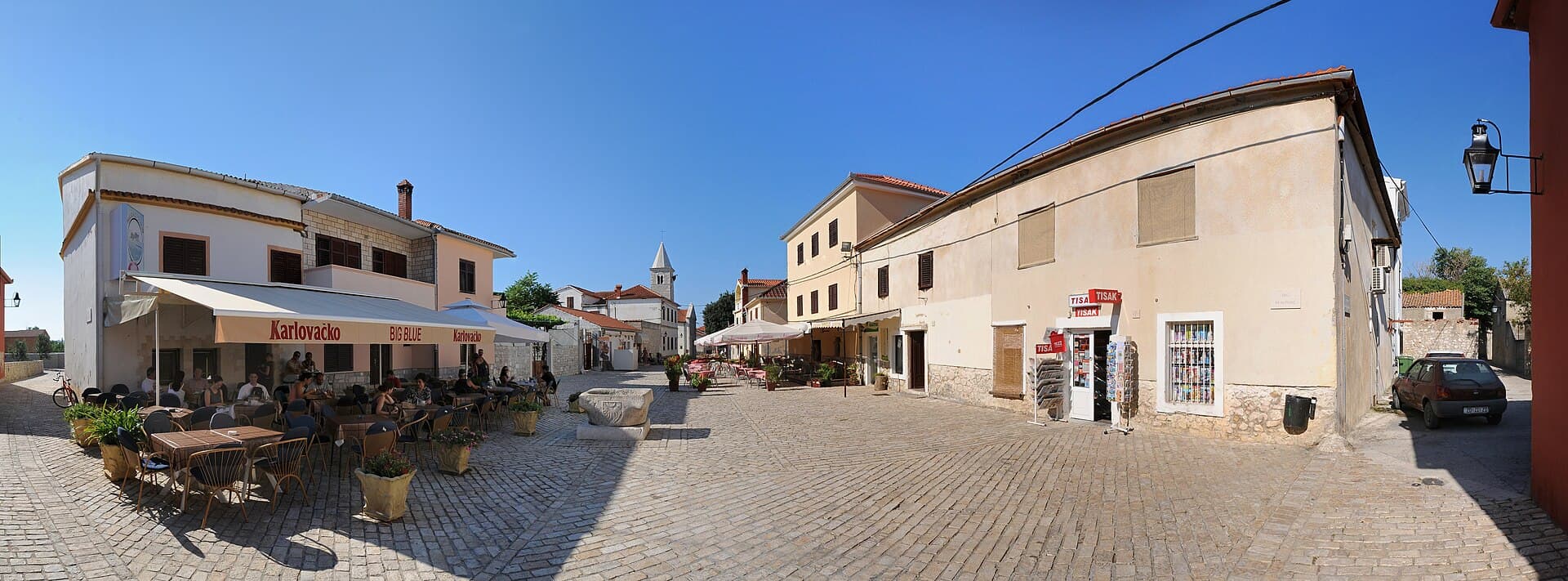 Böhringer Friedrich / CC BY-SA 2.5, via Wikimedia Commons
“Where ancient stones meet the restorative embrace of the sea.”
Not the postcards. The stories even locals don't know — whispered in your ear, right where they happened.
This small 9th-century church holds a secret beyond its sacred purpose.
Many who visit Nin make a point of touching a specific part of this prominent statue.
The traditional method of harvesting salt here has an unexpected, ancient connection.
Discover every secret of Nin
Every address, every reveal in full — in your ear, right where it happened.
You pick your stops. You walk. The voice reveals what the others miss.
No tours available yet. Check back soon — we're preparing them.
Nin, a small town on Croatia's Dalmatian coast, invites a journey through millennia of history, all set against a backdrop of shallow lagoons and wide, sandy beaches. Its old town rests on a small circular island, connected to the mainland by two 16th-century stone bridges. Only 17 kilometers from Zadar, Nin provides a quieter, more intimate experience than its larger coastal neighbors.
Often called the "cradle of the Croatian state," Nin was the first political, religious, and cultural heart of medieval Croatia. This heritage is palpable in its ancient streets, where remnants of Roman forums and early Croatian churches stand as enduring testaments to its significance. Beyond its historical weight, Nin is also recognized for its singular natural environment, including expansive sandy beaches and a lagoon celebrated for its medicinal mud.
Nin's origins extend back over 3,000 years, establishing it as one of the oldest towns on the eastern Adriatic. The area was first settled by the Illyrian tribe of Liburnians in the 9th century BC, who established a community known as Aenona. During Roman rule, Nin prospered as an important municipality and seaport, with a large harbor constructed in the area of the present-day Zaton Holiday Resort. Evidence of this era can still be observed in the ruins of Roman houses, mosaics, and the remains of a substantial Roman temple.
Following the fall of the Roman Empire, Croatian tribes occupied the area. In the 9th century, Nin became the seat of the first Croatian bishop and played a crucial role in the formation of the Croatian state. It served as the first Croatian royal town, a permanent or occasional seat for various dukes and kings, including Višelav, Branimir, Tomislav, Petar Krešimir IV, and Zvonimir. Seven Croatian kings were reportedly crowned at the Church of St. Nicholas, just beyond the town's edge.
Nin endured destruction multiple times throughout its long existence. In 1646, Venice sacrificed Nin to protect the fortress of Zadar from Turkish invasion. Despite these challenges, the town has safeguarded its cultural heritage, with many monuments restored in recent years, drawing visitors eager to explore its profound historical importance.
Begin your exploration at the Church of the Holy Cross (Crkva svetog Križa), a 9th-century Croatian Pre-Romanesque Catholic church often referred to as "the smallest cathedral in the world." Its unique design also functions as an ancient sundial and calendar. Nearby, in the town center, stands the imposing bronze Statue of Gregory of Nin (Grgur Ninski), a significant figure in 10th-century Croatian ecclesiastical politics. A local tradition suggests touching its big toe for good fortune.
Discover the remnants of Nin's Roman past at the Roman Temple ruins, once the largest Roman temple on the eastern Adriatic coast. For a deeper immersion into the town's extensive history, visit the Museum of Nin Antiquities and the Nin Saltworks Museum. The saltworks themselves, with their traditional harvesting methods, offer a glimpse into a centuries-old industry.
Just outside the town, the small, crooked Church of St. Nicholas holds immense historical importance as the coronation site for seven Croatian kings. Finally, relax at Queen's Beach (Kraljičina plaža), a three-kilometer sandy expanse known for its shallow, clear waters and the nearby medicinal mud.
The ideal time to visit Nin for general outdoor activities spans from mid-May to early August and from early August to early October, with a peak in the second week of September. For hot-weather activities and swimming, late June to late August is perfect, when temperatures average between 75°F and 90°F (24-32°C). The shoulder seasons of May, June, and September offer pleasant weather, fewer crowds, and potentially lower prices for accommodation. July is the warmest month, with an average high of 86°F (30°C).
Nin is approximately 15-20 kilometers north of Zadar, making it an easy drive or bus ride for a day trip or longer stay. If driving, paid parking is available near the Tourist Information Center, close to the Lower Bridge, which leads into the pedestrian-only old town. The old town itself is small, about 500 meters in diameter, and easily explored on foot. Stone streets wind through the town, offering restaurants, souvenir shops, and ice cream vendors.
Accommodation options include renting apartments within the town to experience local life. Nin also supports sustainable tourism initiatives and encourages responsible travel. The region is generally safe, though some older land-mine warning signs may be observed in certain karst landscapes between Paklenica National Park and Nin, which locals often disregard due to their age and location near homes.