Po Nagar Cham Towers
These ancient towers, dedicated to a revered goddess, maintain a surprising contemporary use.
Full story unlocks in the tour
 Chris Lewis / CC BY 3.0, via Wikimedia Commons
“Where ancient Cham echoes meet the rhythm of the South China Sea.”
Not the postcards. The stories even locals don't know — whispered in your ear, right where they happened.
These ancient towers, dedicated to a revered goddess, maintain a surprising contemporary use.
The foundation for this grand Gothic-style church was laid with an unexpected, explosive method.
A street in a fishing village transforms into a tunnel of intense color, though it was not conceived for visitors.
Discover every secret of Nha Trang
Every address, every reveal in full — in your ear, right where it happened.
You pick your stops. You walk. The voice reveals what the others miss.
No tours available yet. Check back soon — we're preparing them.
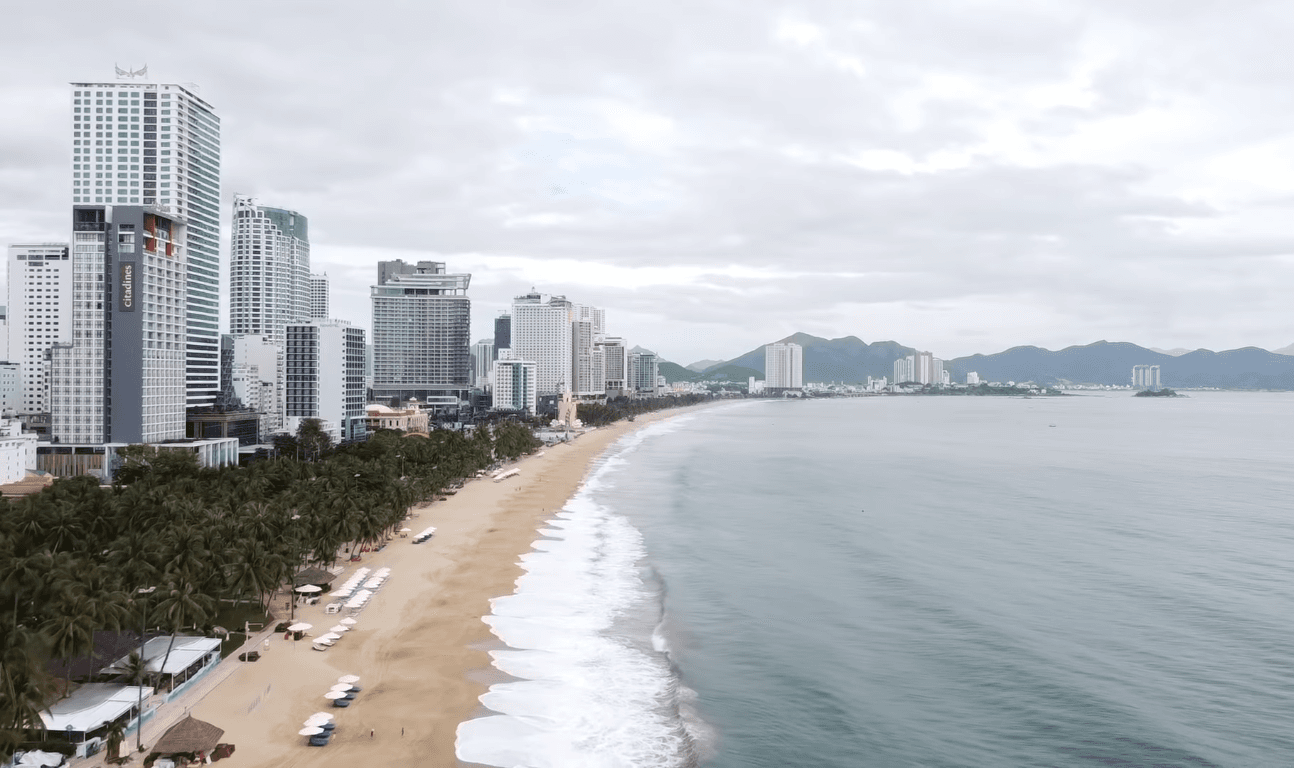
Nha Trang, a coastal city on Vietnam's South Central Coast, offers a convergence where the allure of sandy stretches meets a rich cultural and historical landscape. The city is defined by its expansive beach, extending for miles and lined with palm trees, providing ample space for repose. Beyond the shore, Nha Trang Bay is scattered with 19 islands and islets, inviting exploration and aquatic pursuits.
While often recognized as a prime holiday location, Nha Trang also serves as a portal to understanding Vietnam's diverse heritage. The city's contours meld contemporary structures with ancient Cham architecture, French colonial influences, and lively Buddhist traditions. This distinctive blend creates a multifaceted experience, from sun-drenched days by the sea to quiet moments of contemplation at historic locations.
Nha Trang's appeal extends to those seeking both tranquility and adventure. It is acknowledged as a premier location for diving in Vietnam, with opportunities to observe corals and marine life. The city's culinary offerings, particularly its fresh seafood, further enrich the visitor's journey.
The story of Nha Trang reaches back to the 3rd century CE, when it was identified as Kauthara, a principality within the ancient Champa kingdom. The Cham people, influenced by Malayo-Polynesian and Indian cultures, established a significant Hindu-Buddhist maritime civilization in the region. The enduring impact of this era is most apparent in the Po Nagar Cham Towers, a complex constructed between the 7th and 12th centuries and dedicated to the goddess Yan Po Nagar. This location functioned as a vital religious and administrative hub for the Kauthara principality.
By 1653, the territory of Nha Trang was incorporated into the Nguyen rulers' domain in southern Vietnam, eventually becoming part of the Vietnamese kingdom after 1802. For an extended period, Nha Trang remained a small fishing village. However, its transformation commenced in the late 19th and early 20th centuries under French Indochina rule. The French administration recognized Nha Trang's appealing beaches and favorable climate, initiating the development of leisure infrastructure and the construction of villas. In 1895, the distinguished French-Swiss bacteriologist Alexandre Yersin established a branch of the Pasteur Institute in Nha Trang for tropical disease research, further underscoring the city's growing importance.
Nha Trang was officially granted city status in 1937, solidifying its administrative and economic significance. During the Vietnam War (1965–1972), the city and its environs hosted a major US airbase. Following the war's conclusion and the reunification of Vietnam in 1975, Nha Trang embarked on a new phase of peaceful development and reconstruction, evolving into the tourism center it is today. The city's cultural environment also mirrors this fusion of influences, with Buddhist temples like Long Son Pagoda appearing in the 19th century and the Gothic-style Nha Trang Cathedral completed in 1933, displaying both local traditions and Western architectural styles.
Nha Trang presents a range of sights, blending ancient history with contemporary attractions. The Po Nagar Cham Towers are an essential visit, an impressive complex constructed between the 7th and 12th centuries by the Cham people. These towers, dedicated to the goddess Yan Po Nagar, exhibit intricate Cham architecture and remain an active place of worship. For a distinct spiritual encounter, Long Son Pagoda, established in 1886, features a grand white Buddha statue that provides expansive city views from its elevated position. The pagoda complex itself stands as a testament to traditional Vietnamese temple architecture.
Another architectural landmark is the Nha Trang Cathedral, also known as Christ the King Cathedral or the Stone Church. This Gothic Revival structure, completed in 1933, rests atop Hoang Lan Hill and is notable for its stained-glass windows and 38-meter bell tower. For a pause from historical sites, Tran Phu Beach is the city's primary draw, a long sandy expanse ideal for sunbathing and water sports. Beyond the mainland, consider an island-hopping tour to locations like Hon Mun Island, Vietnam's sole protected marine reserve, excellent for snorkeling and diving. For family amusement, VinWonders Nha Trang on Hon Tre Island offers an amusement park, waterpark, and aquarium, accessible by cable car.
The optimal period to experience Nha Trang is during its dry season, which extends from January to August. Throughout these months, the weather is consistently warm and bright, with clear skies and minimal rainfall, making it perfect for beach activities, water sports, and exploring the islands. February to April offers particularly mild temperatures and lower humidity, providing a comfortable setting for sightseeing. While May to August is prime beach season with calm seas, temperatures can rise, with July and August being the warmest months, sometimes reaching 34°C. The rainy season occurs from September to December, bringing heavier rainfall and the possibility of tropical storms, which may limit outdoor activities.
Nha Trang is well-connected and relatively simple to navigate. Cam Ranh International Airport (CXR) is the closest airport, situated approximately 30-35 km from the city center, with taxis and airport shuttles available for the 30-45 minute journey. The city also lies on the main railway line between Hanoi and Ho Chi Minh City, offering a picturesque train ride. Long-distance buses link Nha Trang to other significant Vietnamese cities.
Within Nha Trang, taxis from respected companies like Mai Linh or Vinasun are dependable, and motorbike taxis (xe om) offer a swift option for shorter distances. Renting a motorbike is favored for independent exploration, typically costing around 100,000-150,000 VND per day. The city center and primary beach area are walkable, but motorbikes are practical for reaching sights beyond the central district. Accommodation options cater to all budgets, from hostels to luxury resorts. The local currency is Vietnamese Dong (VND), and while English is spoken in tourist areas, knowing some basic Vietnamese phrases can be beneficial.