Ducal Palace of Nevers
This grand Renaissance palace, often called the first of the Loire castles, holds a secret in its very foundations.
Full story unlocks in the tour
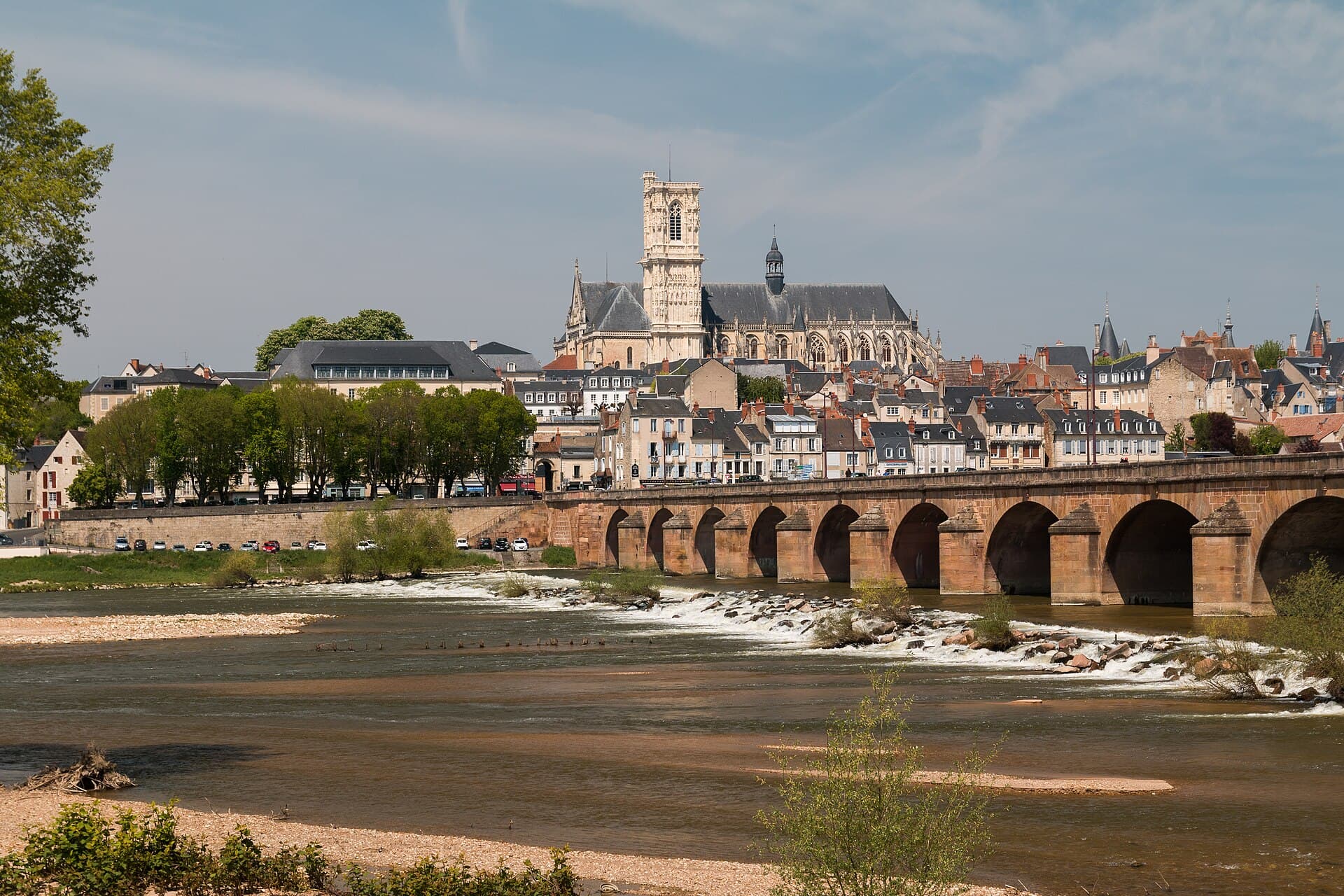 Daniel VILLAFRUELA. / CC BY-SA 4.0, via Wikimedia Commons
“Where ancient pathways meet artistic traditions on the Loire.”
Not the postcards. The stories even locals don't know — whispered in your ear, right where they happened.
This grand Renaissance palace, often called the first of the Loire castles, holds a secret in its very foundations.
The distinctive blue pottery of Nevers, celebrated across Europe, has an unexpected origin story that traces back to a specific Italian family.
Thousands of pilgrims visit Nevers to see the perfectly preserved body of Saint Bernadette, but few realize the unexpected circumstances of its discovery.
Discover every secret of Nevers
Every address, every reveal in full — in your ear, right where it happened.
You pick your stops. You walk. The voice reveals what the others miss.
No tours available yet. Check back soon — we're preparing them.
Nevers, a city in central France, rests at the confluence of the Loire and Nièvre rivers, serving as the administrative and cultural heart of the Nièvre department. This historic city, often called the "City of Art and History" and the "City of the Dukes," offers a blend of ancient character and cultural depth. Its strategic location on the Loire has shaped its identity since Celtic and Gallo-Roman times, when it was a significant center for trade and politics.
Today, Nevers invites travelers to explore its winding lanes, uncover its architectural heritage, and experience its peaceful atmosphere away from larger urban centers. From the imposing Ducal Palace to the singular cathedral and its celebrated faience pottery, Nevers presents a compelling narrative of French history and artistry. It also holds spiritual significance as a pilgrimage site, being the final resting place of Saint Bernadette Soubirous.
Nevers' history stretches back to antiquity, initially a Celtic settlement known as Noviodunum within the territory of the Aedui tribe. A pivotal moment in its early records occurred in 52 BCE when Julius Caesar established it as a key logistics base for the Roman army, storing provisions, the treasury, and hostages. The city later adopted the Latin name Nevirnum, associated with the Nièvre River, which eventually evolved into its modern name. Its strategic position on high ground at the confluence of the Loire and Nièvre rivers provided natural defenses and control over crucial river crossings, fostering its growth as a significant regional center.
By the end of the 5th century, Nevers became the seat of a bishopric, further solidifying its importance. The county of Nevers dates back to at least the early 10th century. In the Middle Ages, the city experienced an eventful history, changing hands among various powerful European families. The construction of the Cathedral of Saint-Cyr-et-Sainte-Julitte began in the early 11th century, a monumental undertaking that wouldn't be completed until the 16th century.
The 16th century marked a significant turning point when the Gonzaga family of Mantua acquired Nevers. This Italian influence ushered in a period of cultural flourishing, most notably with the remodeling of the Ducal Palace in a Renaissance style, considered one of the first Loire castles. The Gonzaga family also introduced the manufacture of ceramics to Nevers in 1565, a craft that would bring the city international renown. Nevers faience, characterized by its distinctive blue, became a major industry, employing thousands during its golden age in the 17th and 18th centuries.
While the prestige of Nevers faience gradually declined after the early 19th century, the tradition saw a revival in the 1880s, and a few potteries continue the craft today. The city's architectural landscape continued to evolve, with buildings like the Romanesque Church of Saint-Étienne, consecrated in the late 9th century and praised for its elegant proportions. In the 20th century, Nevers gained new prominence as a place of pilgrimage. Saint Bernadette Soubirous, known for her apparitions of the Virgin Mary in Lourdes, spent the last 13 years of her life in the convent of Saint Gildard in Nevers, where her body remains perfectly preserved in a glass casket, drawing hundreds of thousands of pilgrims annually. Today, Nevers is a charming city that embraces its past, with a historic center featuring old half-timbered houses, and imposing churches. It also benefits from the nearby Magny-Cours auto-racing track, adding a modern dimension to its historical appeal.
Begin your exploration at the Ducal Palace of Nevers (Palais Ducal), a striking 15th-century residence considered one of the first Renaissance castles of the Loire. Today, it serves as the town hall and houses the tourist office, offering exhibition rooms and a permanent exhibition on Nevers' history. From its esplanade, take in wide views of the Loire River and the city's rooftops.
A short walk leads to the Cathedral of Saint-Cyr-et-Sainte-Julitte, a UNESCO World Heritage site known for its unique architectural blend of two opposing choirs—one Romanesque and one Gothic—and its extensive collection of contemporary stained-glass windows. Ascend the 285 steps of the 52-meter-high Tour Boyer for expansive city views.
Discover Nevers' artistic heritage at the Musée de la Faïence et des Beaux-Arts, located in a former Benedictine monastery. This museum displays a significant collection of Nevers faience, the city's celebrated tin-glazed pottery, along with other fine arts.
For a spiritual experience, visit the Sanctuary of Saint Bernadette Soubirous at the Espace Bernadette Soubirous. Here, in the chapel of the former convent of Saint Gildard, rests the perfectly preserved body of Saint Bernadette in a glass casket, drawing pilgrims from around the world. The site also includes a museum detailing Bernadette's life and a replica of the Grotto of Massabielle from Lourdes.
Stroll along the banks of the Loire River, a picturesque setting ideal for walking or cycling, with parts of the famous "Loire à Vélo" route passing through Nevers. Do not miss the Porte du Croux, a 14th-century fortified gate that once protected the city and now houses an archaeological museum.
Nevers experiences a temperate and mild climate, making it accessible throughout the year. The best time for warm-weather activities and general outdoor tourism is from mid-June to early September, with July and August offering average daytime temperatures around 21-26°C (70-79°F). These summer months are also the driest, with fewer rainy days. Spring and autumn provide pleasant transitional weather, though with a higher chance of rain. Winters are cool but rarely drop below freezing, with average daytime temperatures around 4-6°C (39-43°F), though this is the wettest period.
Nevers is well-connected and easily reachable. By train, direct services from Paris Gare de Lyon take approximately two hours. For those driving, Nevers is about 230 km from both Paris and Lyon, making it a convenient stopover. The A77 highway provides good road access. The nearest airport for flights is Clermont-Ferrand Auvergne Airport (CFE), about 134 km away, or Orly Airport (ORY) in Paris, approximately 202 km from Nevers.
Within Nevers, many main attractions are compactly located, allowing for leisurely walks to explore the city's historic core. The local tourist office, located within the Ducal Palace, can provide information on guided tours and local events. Accommodations range from hotels within the city to idyllic options just outside, some catering specifically to cyclists on the Loire à Vélo route.