Trimbakeshwar Temple
The Trimbakeshwar Jyotirlinga presents a form unlike any other of the twelve sacred Jyotirlingas.
Full story unlocks in the tour
 Savitr1915 / CC BY-SA 4.0, via Wikimedia Commons
“Where ancient devotion meets modern vintages, a city etched by faith and the earth's bounty.”
Not the postcards. The stories even locals don't know — whispered in your ear, right where they happened.
The Trimbakeshwar Jyotirlinga presents a form unlike any other of the twelve sacred Jyotirlingas.
Sula Vineyards didn't just place Nashik on the global wine map; it introduced entirely new grape varieties to India's soil.
Nashik's name carries a profound mythological origin, yet it underwent a significant renaming during a pivotal historical period.
Discover every secret of Nashik
Every address, every reveal in full — in your ear, right where it happened.
You pick your stops. You walk. The voice reveals what the others miss.
No tours available yet. Check back soon — we're preparing them.
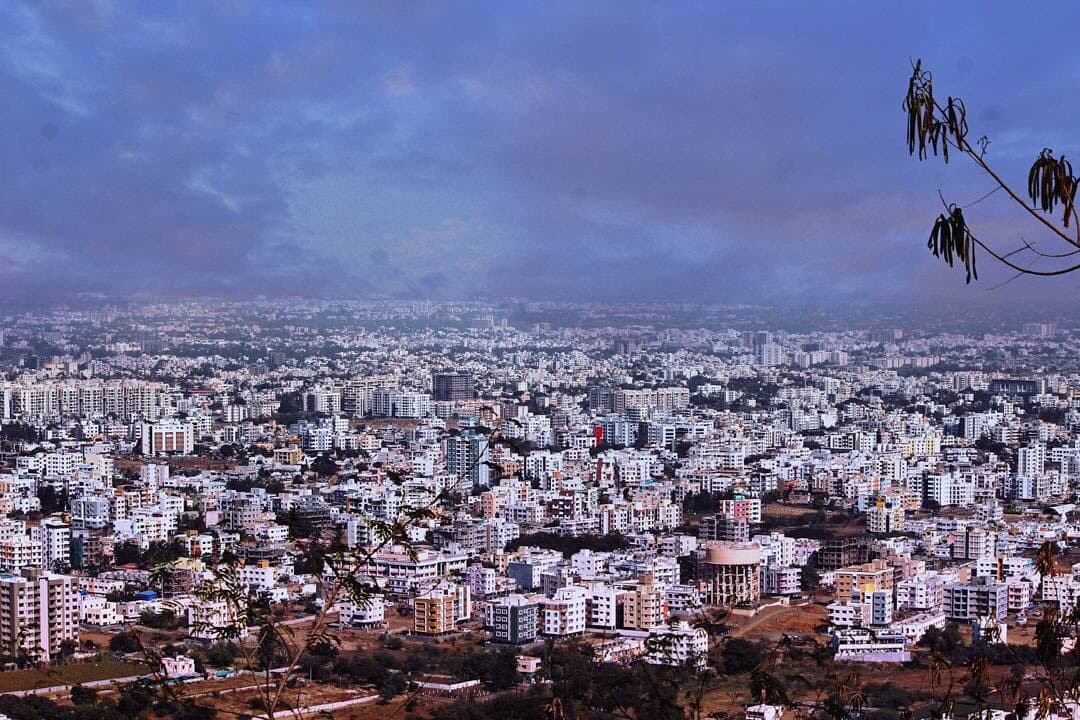
Nashik, a city in the northwestern expanse of Maharashtra, India, offers a compelling fusion of ancient spirituality and contemporary allure. Situated along the sacred Godavari River, it stands as one of the four revered sites that host the Kumbh Mela, a Hindu festival that gathers millions of devotees every twelve years, all seeking spiritual purification.
Beyond its profound religious significance, Nashik has earned the designation of "Wine Capital of India," home to more than half of the nation's vineyards and wineries. This dual identity—a pilgrimage destination intertwined with Hindu mythology and a burgeoning center for viticulture—creates a unique array of experiences for visitors. From ancient caves carved into hillsides to the serene banks of the Godavari, Nashik invites exploration of its diverse landscapes and enduring cultural legacy.
The city's foundations are deeply intertwined with the Hindu epic Ramayana, with legends suggesting that Lord Rama, Goddess Sita, and Lakshmana spent a portion of their exile in Panchavati, an area within present-day Nashik. This historical and mythological depth, combined with its natural splendor of hills, lakes, and waterfalls, positions Nashik as a multifaceted destination for spiritual seekers, history enthusiasts, nature lovers, and wine connoisseurs alike.
Nashik's history stretches back to the Stone Age, with archaeological findings confirming early human occupation. In ancient times, the city was known by various names, including Padmanagar in the Satya Yuga, Trikantak in the Treta Yuga, and Janasthana in the Dvapara Yuga, before becoming Navashikh or Nashik in the Kali Yuga. Its most famous mythological association comes from the Hindu epic Ramayana. Legend states that during their 14-year exile, Lord Rama, his consort Sita, and brother Lakshmana resided in the Panchavati area. It was here that Lakshmana, at Rama's command, cut off the nose (nashika or naak) of the demoness Shurpanakha, sister of Ravana, giving the city its present name. The abduction of Sita by Ravana is also believed to have occurred from Panchavati.
Historically, Nashik was part of Emperor Ashoka's Mauryan Empire in the 3rd century BCE. It later flourished under the Satavahana Empire (3rd BCE - 3rd CE), becoming a prosperous center due to its strategic location on a trade route connecting Paithan in Maharashtra to Bharuch in Gujarat. The Satavahana rulers, along with subsequent dynasties like the Western Kshatrapas and Abhirs, made significant contributions, including the establishment of 24 Buddhist caves carved between the 1st century BCE and 3rd century CE. The famous 'Nashik Prashasti,' a eulogy for Gautamiputra Satakarni, considered the greatest Satavahana ruler, is found in Cave No. 3 of these Pandavleni Caves.
Under the Mughals, the city was renamed 'Gulshanabad' in the 16th century, a name it retained until the Marathas gained control in 1752 and restored the name 'Nashik.' This period saw a surge in construction, with palaces, wadas (traditional mansions), gardens, vineyards, and temples being built. Notable constructions from the Maratha period include the Rameshwara temple by Chieftain Naroshankar Raje Bahadar, the Kapaleshwara temple in 1738, and the Sundar Narayana temple in 1756 by Chieftain Chandrachud.
Nashik surrendered to the British on April 19, 1818. The Nashik Municipality was formed in 1864, and the district was officially established in 1869. The construction of railway tracks around this time further boosted its commercial significance. In the modern era, Nashik has evolved into a prominent hub for wine production, earning it the title of "Wine Capital of India." It also continues to be a significant pilgrimage site, hosting the Kumbh Mela and housing one of the twelve Jyotirlingas, the Trimbakeshwar Temple. The city has also contributed to India's freedom struggle, being the birthplace of freedom fighters like Veer Savarkar and Anant Laxman Kanhere.
Nashik offers a diverse range of attractions, catering to spiritual seekers, history enthusiasts, and those who appreciate the outdoors. A primary pilgrimage site is the Trimbakeshwar Temple, one of the twelve Jyotirlingas dedicated to Lord Shiva, located approximately 28 km from Nashik. This ancient temple, reconstructed in the 18th century, also marks the origin of the sacred Godavari River.
For those interested in ancient history, the Pandavleni Caves are an essential visit. These rock-cut caves, predominantly Buddhist monasteries, date back between the 2nd century BCE and the 3rd century CE and feature intricate carvings and inscriptions. Another site with mythological significance is Panchavati, believed to be where Lord Rama, Sita, and Lakshmana spent part of their exile. Here, you can find the Sita Gufa (Sita's Cave), where Sita is said to have worshipped Lord Shiva, and the Kalaram Temple, dedicated to Lord Rama.
Nashik is also recognized as the "Wine Capital of India," with Sula Vineyards being a prominent attraction. Visitors can enjoy wine-tasting tours, grape-stomping experiences (during harvest season), and expansive views of the vineyards. Other natural and historical sites include Anjaneri Hill, believed to be the birthplace of Lord Hanuman, offering trekking opportunities, and Ramshej Fort, a historic hill fort with wide-ranging views. For a tranquil experience, the Ramkund along the Godavari River is a sacred ghat where devotees perform rituals and witness the peaceful Goda Aarti at dusk.
The ideal time to visit Nashik is during the winter season, from October to March. During these months, the weather is cool and agreeable, with temperatures ranging from approximately 10°C to 28°C, making it perfect for exploring and outdoor activities. This period is also suitable for vineyard tours and grape stomping, especially from January to March during the harvest season.
The monsoon season (July to September) brings verdant landscapes and misty views, which can be appealing for nature lovers and trekkers, though heavy rainfall might limit some outdoor activities. Summers (April to June) can be quite warm, with temperatures reaching up to 40°C, making it the least advisable time for extensive exploration, though fewer crowds and potential deals on accommodations might be available.
Nashik is well-connected by air, road, and rail. Nashik's Ozar Airport offers domestic flights to cities like Ahmedabad, Bengaluru, New Delhi, and Bhopal. Alternatively, Mumbai's Chhatrapati Shivaji Airport, which handles both domestic and international flights, is about 166 km away, with frequent buses and cabs available to Nashik. Nashik Road Railway Station, located approximately 10 km from the city center, has good connections to major Indian cities. For road travel, inter- and intra-state buses operate from various cities, and the drive from Mumbai via NH160 takes about 3.5 hours.
Within Nashik, local buses, auto-rickshaws, and app-based cabs (Ola/Uber) are readily available for getting around. "Nashik Darshan" buses also ply on important tourist routes, offering a convenient way to visit key attractions. When visiting religious sites, dress modestly by covering shoulders and knees, and remember to remove your shoes before entering temples. Nashik is generally considered safe for tourists, including solo female travelers, but it's always wise to exercise caution in poorly lit or secluded areas at night. Marathi is the local language, but Hindi and English are widely understood in tourist areas.