Sennen-ji Temple
Beyond the temple's main hall, two unassuming rocks hold a curious legend.
Full story unlocks in the tour
 Chensiyuan / CC BY-SA 4.0, via Wikimedia Commons
“Step into a meticulously preserved Edo-era post town, where time slows and ancient stories linger in the wooden eaves.”
Not the postcards. The stories even locals don't know — whispered in your ear, right where they happened.
Beyond the temple's main hall, two unassuming rocks hold a curious legend.
This museum, though small, offers a glimpse into local life that goes beyond the Edo period.
One temple in Narai holds a secret above your head, revealed by a generous local.
Discover every secret of Narai
Every address, every reveal in full — in your ear, right where it happened.
You pick your stops. You walk. The voice reveals what the others miss.
No tours available yet. Check back soon — we're preparing them.
Narai-juku, a beautifully preserved post town in Nagano Prefecture, offers a rare journey back to Japan's Edo period (1603-1868). As one of the 69 post towns along the historic Nakasendo highway, which connected Kyoto and Tokyo, Narai-juku flourished as a vital rest stop for feudal lords, merchants, and travelers navigating the mountainous terrain. Its designation as an Important Preservation District for Groups of Historic Buildings in 1978 has ensured that its original Edo-era architecture and atmosphere remain largely intact.
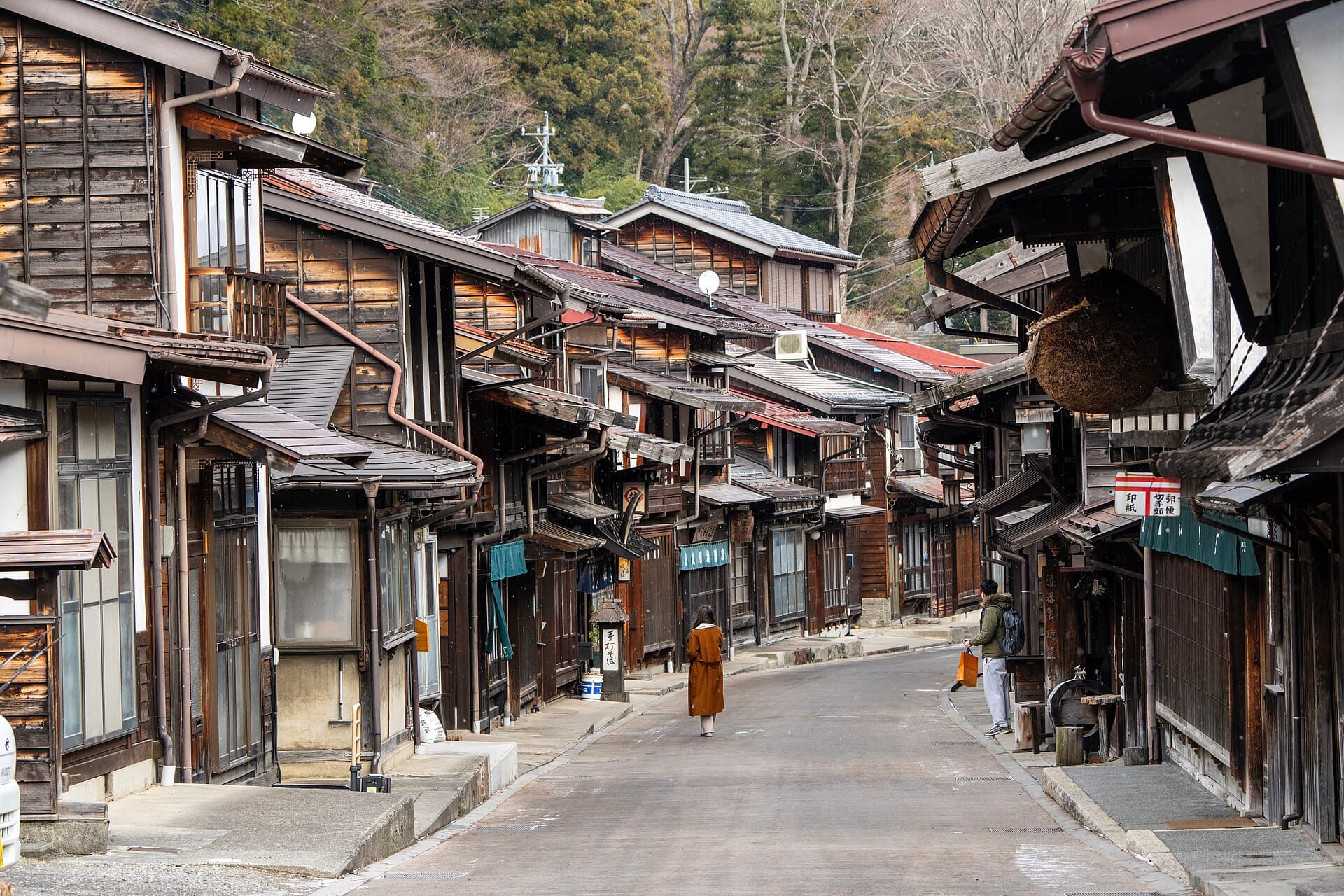
A stroll through Narai-juku's main street, which stretches for over a kilometer, feels like stepping into a living museum. The street is lined with traditional wooden machiya houses, once serving as inns, restaurants, and shops, characterized by their dark wooden facades, projecting second stories, and distinctive eaves. This authentic townscape, set against a backdrop of the scenic Kiso Valley, provides a tranquil escape and a tangible connection to Japan's past.
Narai-juku's prominence stems from its strategic location as the 34th of 69 post towns on the Nakasendo highway and the second of eleven along the Kisoji. Situated at the highest elevation of all the Kisoji post towns, at 940 meters above sea level, it served as a crucial stopping point before the challenging Torii Pass. This strategic position led to its immense prosperity, earning it the moniker 'Narai of a Thousand Houses' (Narai Senken) due to its numerous inns and businesses catering to weary travelers.
During the Edo period, the Nakasendo was a major inland route through the mountains, used by samurai, merchants, and officials traveling between Edo (present-day Tokyo) and Kyoto. Narai-juku provided essential lodging, food, supplies, and entertainment, contributing significantly to its wealth and development. The town's unique architectural style, known as 'Deurabezukuri,' with its outward-extending second floors, was developed to protect travelers from rain and snow, a testament to its mountainous environment.
While some other Kiso Valley post towns, like Tsumago-juku, have preserved their honjin and wakihonjin (main inns for high-ranking samurai), Narai-juku's were not retained. However, the town's commitment to preserving its overall Edo-period streetscape led to its designation as a National Important Preservation District for Groups of Traditional Buildings in 1978. This recognition, supported by government grants, has allowed Narai-juku to maintain its historic character, with many original structures from the 1600s and 1700s still standing. Beyond its role as a post town, Narai-juku also became a center for Kiso lacquerware (Kiso shikki), a tradition that continues today, thanks to the favorable climate and abundant local timber.
Narai-juku's primary appeal lies in its 1-kilometer-long main street, a continuous stretch of Edo-period wooden architecture. Take your time to wander, observing the details of the traditional machiya houses, many of which now host shops, cafes, and restaurants.
Key historical sites include the Nakamura Residence, an Edo-period merchant house showcasing the lifestyle of wealthy residents with displays of traditional architecture and artifacts. The Kamidonya Shiryokan Museum, a former wholesaler's home, also offers insights into the town's history and culture. Do not overlook the Kiso Ohashi bridge, a modern wooden arch bridge crafted from cypress wood, spanning the Narai River and offering picturesque views.
Explore the Shizume-jinja Shrine at the northern end of town, a quiet spot that marks the beginning of the Torii Pass hiking trail. Along the main street, you will also find stone-lined public water troughs where fresh, drinkable water still flows. For a deeper dive into local life, the Narakawa History and Folklore Museum displays tools and artifacts from various eras. Keep an eye out for the original notice board, where the Tokugawa shogunate once posted decrees.
Narai-juku is captivating year-round, but the most striking times to visit are late May for fresh greenery and mid-October for autumn foliage. These seasons offer vivid natural backdrops to the historic townscape. During warmer months, between May and October, most shops are open, and the town enjoys a livelier atmosphere. Early mornings, around 8:00 AM, are ideal for experiencing the quiet character of the streets before shops fully open and crowds gather. Winter visits can be very cold, with temperatures potentially dropping significantly, but also offer a unique, quiet beauty with snow-covered scenes.
Narai-juku is accessible by train via the JR Chuo Main Line, with Narai Station just a few minutes' walk from the historic main street. From Tokyo, take the Limited Express Azusa to Shiojiri, then transfer to a local JR Chuo Line train to Narai. The journey is covered by the Japan Rail Pass. If driving, five parking lots are available around the village, with free options a short walk from the main street. Cars are not permitted on the historic 1-kilometer street itself.
Most visitors spend 2-4 hours exploring the town, allowing time for walking, visiting museums, and enjoying local specialties like gohei mochi (skewered rice patties with sweet miso) and soba noodles. Some shops, restaurants, and museums may be closed on Mondays, Tuesdays, or Wednesdays, so check opening hours if visiting early in the week. Comfortable walking shoes are recommended for exploring the stone-paved streets.