Place Stanislas
The central statue of Stanislas Leszczyński, former King of Poland and Duke of Lorraine, isn't just a tribute; his outstretched arm holds a subtle message.
Full story unlocks in the tour
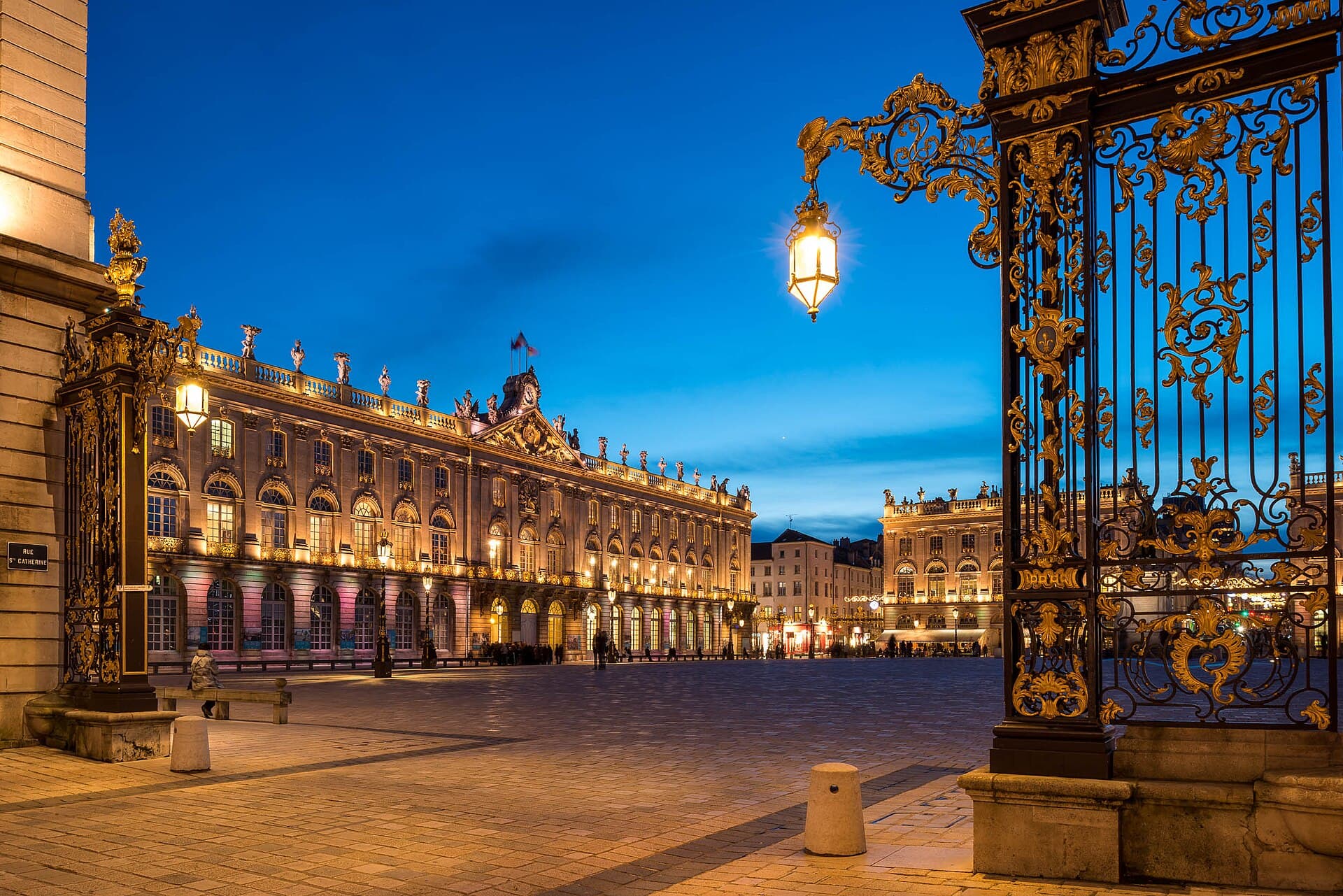 Nicolas Cornet / CC BY-SA 4.0, via Wikimedia Commons
“Where gilded grandeur meets organic artistry.”
Not the postcards. The stories even locals don't know — whispered in your ear, right where they happened.
The central statue of Stanislas Leszczyński, former King of Poland and Duke of Lorraine, isn't just a tribute; his outstretched arm holds a subtle message.
This Art Nouveau landmark, a short distance from the train station, concealed a rather exotic secret behind a mirror for decades.
While admiring the exquisite Art Nouveau pieces within this former private residence, you might notice a curious lack of photography.
Discover every secret of Nancy
Every address, every reveal in full — in your ear, right where it happened.
You pick your stops. You walk. The voice reveals what the others miss.
No tours available yet. Check back soon — we're preparing them.
Nancy, the historic capital of the Duchy of Lorraine in northeastern France, presents a captivating blend of 18th-century classical grandeur and the flowing, organic forms of Art Nouveau. The city's most iconic feature is the UNESCO World Heritage-listed ensemble of Place Stanislas, Place de la Carrière, and Place d'Alliance, a testament to ambitious urban planning. This harmonious collection of squares, with its gilded wrought-iron gates and elegant architecture, offers a glimpse into a royal past.
Beyond its classical heart, Nancy reveals another artistic soul: the birthplace of the French Art Nouveau movement. The École de Nancy, a collective of artists and architects, transformed the city at the turn of the 20th century, leaving behind a legacy of exquisite buildings, decorative arts, and furniture. With a spirited student population and a comprehensive cultural scene, Nancy combines its historical depth with a dynamic contemporary energy, offering an authentic French experience without the crowds of larger tourist destinations.
Whether you're drawn to the golden gates of its royal square, the intricate details of its Art Nouveau masterpieces, or the lively atmosphere of its cafés and parks, Nancy provides a sophisticated and walkable destination. It's a city that invites exploration, where every corner can reveal an unexpected architectural detail or a moment of quiet charm.
The origins of Nancy trace back to at least 800 BCE, with early settlers drawn to the easily mined iron ore in the Meurthe River. However, a significant fortified town, Nanciacum, was only established around 1050 by Duke Gerard of Lorraine. The city faced destruction in 1218 during the War of Succession of Champagne but was subsequently rebuilt and expanded. Nancy grew in importance, becoming the capital of the Duchy of Lorraine, a position it held for centuries.
A pivotal moment in Nancy's history occurred in 1477 with the Battle of Nancy, where Charles the Bold, Duke of Burgundy, was defeated and killed by Duke René II of Lorraine. This victory solidified Lorraine's independence. The 15th and 16th centuries saw Nancy flourish, with new fortifications and the embellishment of the city. The Ducal Palace, a blend of Gothic and Renaissance styles, began construction under René II and was further developed by his son Antoine, who drew inspiration from Blois Castle. The porterie (gatehouse portal) of the Ducal Palace, constructed between 1511 and 1512, showcases elaborate Flamboyant Gothic elements mixed with early Renaissance motifs, including an equestrian statue of Duke Antoine.
The 18th century brought a dramatic transformation to Nancy under Stanislas Leszczyński, the former King of Poland and father-in-law to King Louis XV of France. Granted the Duchy of Lorraine in 1737, Stanislas embarked on an ambitious urban planning project to connect the medieval old town with the 17th-century new town. The result was the magnificent ensemble of Place Stanislas, Place de la Carrière, and Place d'Alliance, designed by architect Emmanuel Héré. These squares, completed in 1755, were intended to honor Louis XV and are celebrated as masterpieces of 18th-century urban design, featuring gilded wrought-iron gates by Jean Lamour and Rococo fountains by Barthélémy Guibal. Upon Stanislas's death in 1766, the Duchy of Lorraine became part of France.
The late 19th and early 20th centuries marked another significant period for Nancy with the emergence of the Art Nouveau movement. Following the Franco-Prussian War in 1870-71, Nancy remained French while Alsace and Metz were ceded to Germany, leading to an influx of French-speaking intellectuals and industrialists. This surge in population and capital fueled a cultural golden age, culminating in the formation of the École de Nancy in 1901. This collective of artists, architects, and craftsmen, including figures like Émile Gallé and Louis Majorelle, made Nancy a leading center for Art Nouveau in France, characterized by organic forms and nature-inspired designs in architecture, furniture, and decorative arts.
Begin your exploration at the heart of Nancy, the UNESCO-listed Place Stanislas. This grand 18th-century square, with its opulent buildings, gilded wrought-iron gates by Jean Lamour, and elegant fountains, is an architectural marvel. Adjacent to it, discover Place de la Carrière and Place d'Alliance, forming a harmonious urban ensemble.
Walk through the Arc Héré, a triumphal arch, to enter the older part of the city. Here, the Ducal Palace, now home to the Musée Lorrain, showcases the history and art of Lorraine. Admire its Flamboyant Gothic and early Renaissance portal. Nearby, the Porte de la Craffe, a 14th-century medieval gate, stands as a remnant of the city's ancient fortifications. The 19th-century Neo-Gothic Saint-Epvre Basilica also merits a visit for its impressive façade and stained-glass windows.
Delve into Nancy's Art Nouveau heritage at the Musée de l'École de Nancy, housed in a former private residence, which displays furniture, ceramics, and metalwork from the movement. Visit the iconic Villa Majorelle, the first entirely Art Nouveau house in Nancy, designed by Louis Majorelle and Henri Sauvage. Wander through the city center to discover Art Nouveau architectural details on commercial buildings, such as the former Génin Louis seed store and the Brasserie Excelsior. For a green escape, Parc de la Pépinière, bordering Place Stanislas, offers 57 acres of parkland with rose gardens and a mini-zoo.
The best time to visit Nancy is from May through September, when temperatures are comfortable, typically ranging from 60-75°F (15-24°C). This period is ideal for exploring the city's squares, museums, and outdoor cafés. Summer brings lively street life, festivals, and the spectacular sound-and-light show, 'Rendez-Vous Place Stanislas.' While winters offer fewer crowds and potentially lower rates, temperatures can be cold, and some attractions may have reduced hours. Autumn also offers a spirited atmosphere with events like the Nancy Jazz Pulsations festival in October.
Nancy is easily accessible by train, with high-speed TGV connections from Paris (approximately 1.5 hours). The city center is compact and highly walkable, making it easy to explore key attractions on foot. For those planning to visit multiple museums and use public transport, consider a Nancy City Pass. While many attractions are centrally located, some Art Nouveau villas are a short bus ride or a 30-minute walk from the center. When visiting public pools in France, men are required to wear speedo-style swimming trunks. While Nancy is generally a safe city, it's always wise to take standard precautions, especially at night, and stick to well-lit streets.