Shengjin Tower
A thousand-year-old pagoda in Nanchang holds a secret beneath its foundation.
Full story unlocks in the tour
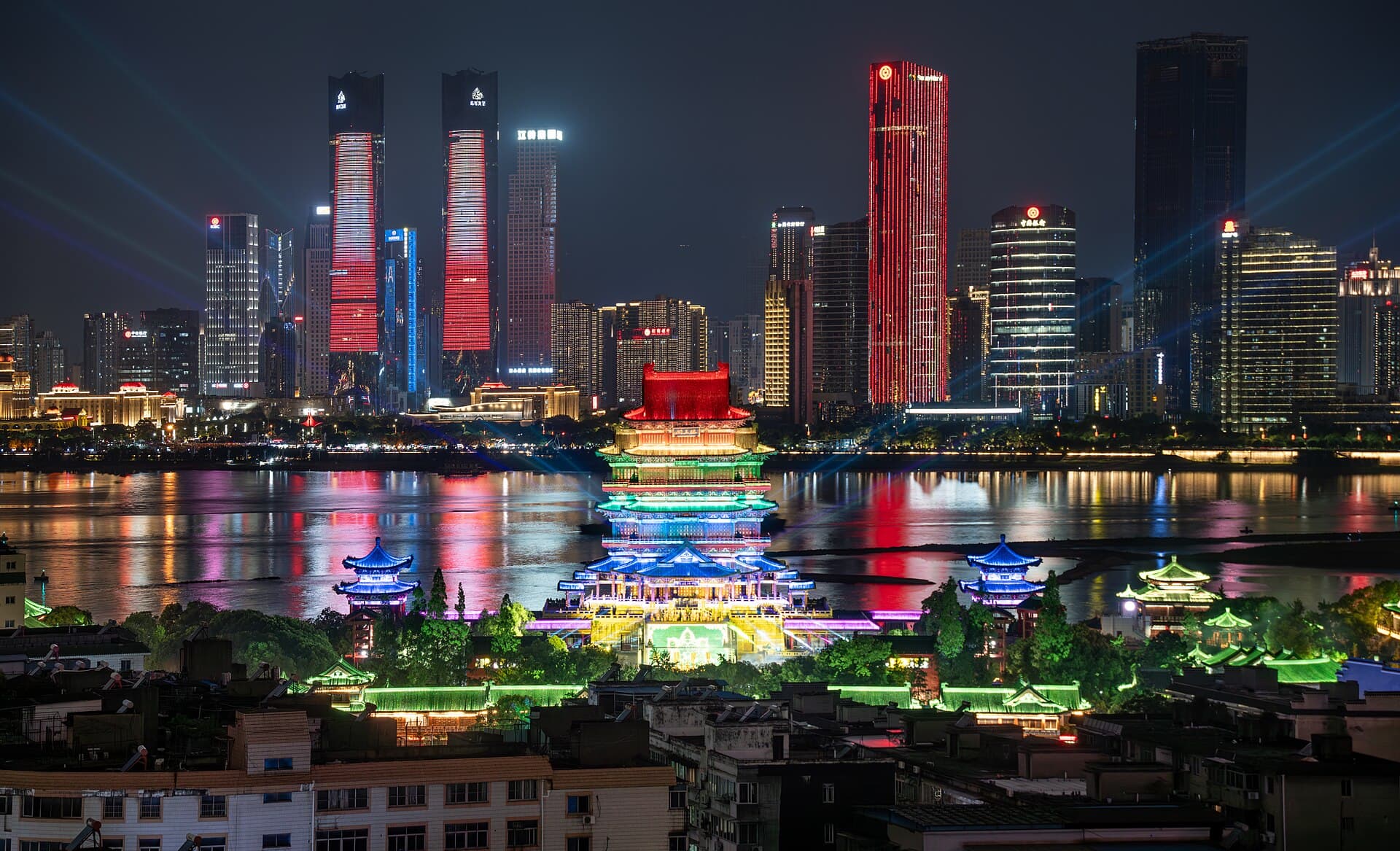 Akira CA / CC BY-SA 4.0, via Wikimedia Commons
“Where ancient pavilions meet revolutionary spirit and modern marvels.”
Not the postcards. The stories even locals don't know — whispered in your ear, right where they happened.
A thousand-year-old pagoda in Nanchang holds a secret beneath its foundation.
This towering Ferris wheel offers a slow, continuous ride, but there's a reason you don't stop to get on or off.
This iconic pavilion has been rebuilt nearly 30 times, but its enduring fame rests on the words of a young poet.
Discover every secret of Nanchang
Every address, every reveal in full — in your ear, right where it happened.
You pick your stops. You walk. The voice reveals what the others miss.
No tours available yet. Check back soon — we're preparing them.
Nanchang, the capital of Jiangxi Province, is a city where over 2,200 years of history converge with a contemporary identity. Positioned on the right bank of the Gan River, just south of its confluence with Poyang Lake, Nanchang has long been a strategic center for culture, trade, and military history. Known as the 'City of Heroes,' it holds a pivotal place in China's revolutionary narrative as the birthplace of the People's Liberation Army.
Beyond its revolutionary past, Nanchang offers a diverse array of experiences, from ancient architectural marvels like the Tengwang Pavilion, one of the 'Three Great Pavilions of China,' to contemporary attractions such as the Star of Nanchang Ferris Wheel. The city's subtropical monsoon climate provides abundant sunshine and rainfall, fostering verdant landscapes. Visitors can explore historical sites, immerse themselves in local culture, and savor the distinctive spicy flavors of Jiangxi cuisine, particularly Nanchang's famous rice noodles.
The history of Nanchang stretches back over 2,200 years, with its origins in the Han Dynasty. Founded as a fortified settlement in 202 BC, it was initially named Gan, later becoming Yuzhang, serving as an administrative center. The city received its modern name, Nanchang, meaning 'Southern Prosperity' or 'prosperity of the southern borders,' in 959 AD during the Southern Tang regime, signifying its growing importance.
Nanchang's strategic location on the Ganjiang River, near Poyang Lake, transformed it into a vital hub for water trade routes connecting China's northern and southern regions. This led to rapid growth, and by the 12th century, Jiangxi had become the most populous province in China, with Nanchang at its core. The city also flourished as a cultural center, particularly during the Tang and Song Dynasties, with the construction of the iconic Tengwang Pavilion in 653 AD.
In the 16th century, Nanchang emerged as a center of philosophical thought, influenced by the prominent Neo-Confucian Wang Yangming. However, it is Nanchang's role in modern Chinese history that truly defines its 'heroic' moniker. On August 1, 1927, the city became the site of the Nanchang Uprising, an armed resistance led by Communist forces, including key figures like Zhou Enlai, He Long, Ye Ting, Zhu De, and Liu Bocheng. This event is celebrated as the founding day of the Chinese People's Liberation Army (PLA) and marked the beginning of the Communist Party of China's independent armed struggle. Although the uprising itself lasted only a few days, it provided the core troops and organizational methods from which the PLA later developed. After the founding of the People's Republic of China in 1949, Nanchang became the capital of Jiangxi Province and underwent extensive industrialization, becoming a major producer of cotton textiles, paper, and processed foods.
The Tengwang Pavilion is an essential stop, a majestic nine-story structure originally built in 653 AD and rebuilt numerous times, most recently in 1989 in the architectural style of the Song Dynasty. It stands 57.5 meters tall and offers sweeping views of the Ganjiang River and the city. Inside, you'll find exhibitions of ancient calligraphy, paintings, porcelain, and murals.
For a glimpse into Nanchang's revolutionary past, visit the August 1st Nanchang Uprising Memorial Hall and Bayi Square. The memorial hall is a 4A Tourist Attraction commemorating the pivotal 1927 uprising. Bayi Square, one of China's largest city squares, features the August 1st Nanchang Uprising Monument.
Another significant historical site is Shengjin Tower, a brick and timber pagoda dating back to the late Tang Dynasty (904-907 AD). This seven-story structure, with a concealed extra layer, stands over 50 meters tall and showcases traditional Southern Chinese architecture. At night, the tower is illuminated with colorful lights.
For panoramic city views, ride the Star of Nanchang Ferris Wheel, which stands 160 meters tall. It was once the world's tallest and offers a 30-minute rotation in one of its 60 air-conditioned gondolas. Nearby, Qiushui Square features Asia's largest musical fountain, with water jets reaching up to 128 meters.
The Jiangxi Provincial Museum houses a collection of nearly 60,000 items, including ancient lacquerware, primitive porcelain, and revolutionary cultural relics.
The best times to visit Nanchang are during the mild spring (March to May) and autumn (September to November) seasons. During these months, the weather is pleasant, with comfortable temperatures averaging 15-25°C (59-77°F), and less rainfall, making it ideal for exploring outdoor attractions. Autumn, in particular, offers dry weather and lower humidity. Summers (June to August) are hot and humid, often exceeding 35°C (95°F), with heavy rainfall and thunderstorms. Winters (December to February) are cold and damp, with temperatures averaging 5-10°C (41-50°F).
Nanchang has a well-developed transportation infrastructure. Nanchang Changbei International Airport (KHN) offers flights to major domestic cities and Hong Kong. The city is a significant rail hub, with Nanchang Railway Station and Nanchang West Railway Station providing connections to cities like Beijing, Shanghai, Xi'an, and Guangzhou, including high-speed rail services.
Within the city, an extensive and economical bus system covers almost all attractions. The Nanchang Metro is modern and efficient, with signage and announcements in both Chinese and English, making it easy to navigate. Taxis are generally safe and affordable, operating on meters, with ride-hailing apps like Didi (which has an English version) also available. Mandarin is the official language, though the local dialect is Gan. Translation apps can assist with language barriers.