The Inferno Race
Mürren hosts a ski race that's not just long, but legendary.
Full story unlocks in the tour
 Chensiyuan / CC BY-SA 4.0, via Wikimedia Commons
“Where the Alps meet the sky, and silence is the soundtrack.”
Not the postcards. The stories even locals don't know — whispered in your ear, right where they happened.
Mürren hosts a ski race that's not just long, but legendary.
The revolving restaurant atop the Schilthorn holds a cinematic secret.
Just a short cable car ride or hike away, a neighboring village operates on an unusual principle.
Discover every secret of Mürren
Every address, every reveal in full — in your ear, right where it happened.
You pick your stops. You walk. The voice reveals what the others miss.
No tours available yet. Check back soon — we're preparing them.
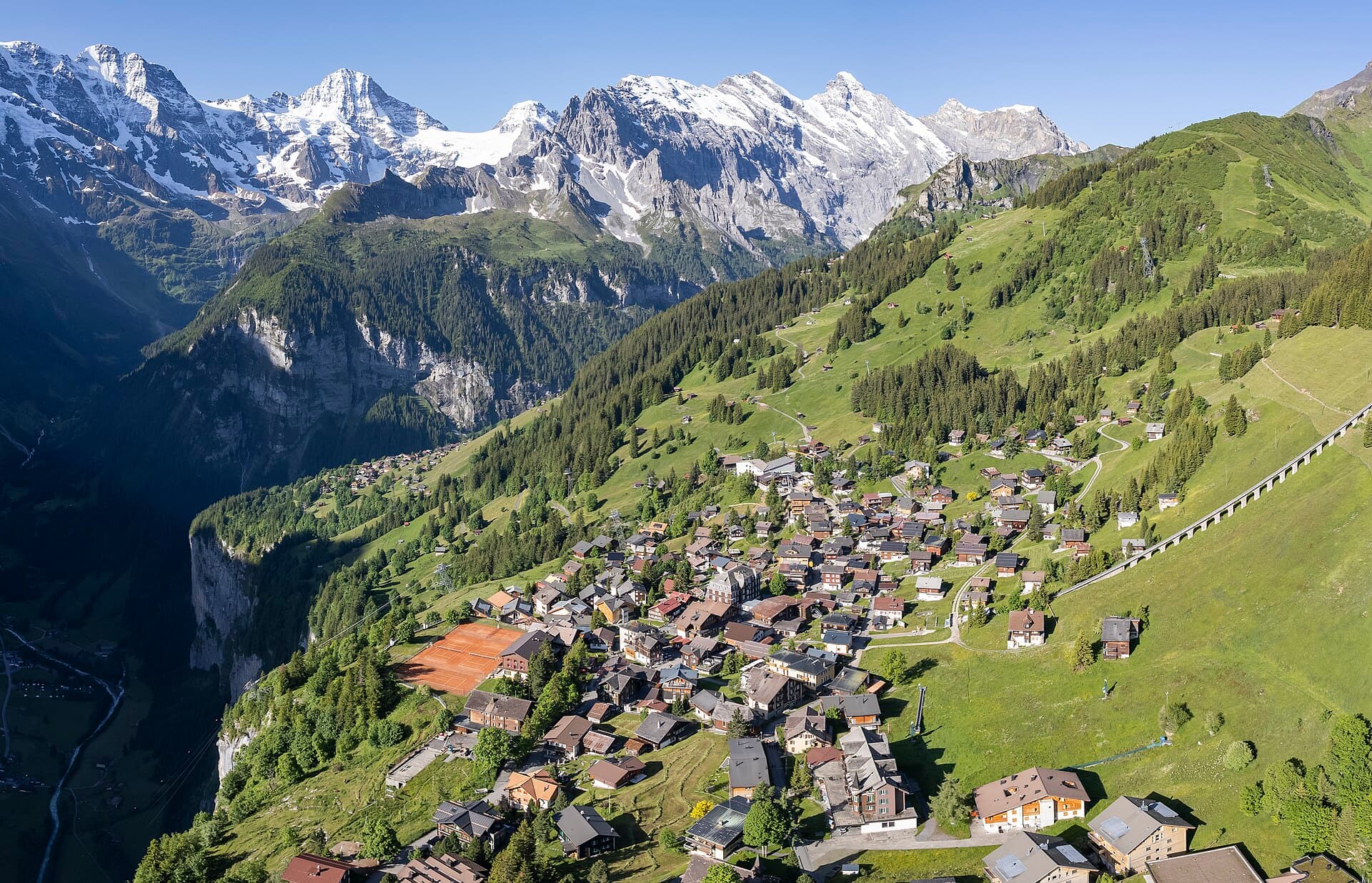
Mürren, a traditional Walser mountain village in the Bernese Highlands of Switzerland, offers a retreat from the everyday. Situated at an elevation of 1,638 meters (5,374 feet) above sea level, it stands on a natural terrace overlooking the dramatic Lauterbrunnen Valley, with views of the Eiger, Mönch, and Jungfrau mountains. This car-free village, with a year-round population of around 430, maintains a peaceful atmosphere, accessible only by cable car or on foot.
Life in Mürren unfolds at a different pace. The absence of public roads preserves its traditional character, with stone and timber chalets that evoke a sense of timelessness. Whether blanketed in snow during winter or surrounded by wildflower meadows in summer, Mürren provides a serene base for alpine adventures, from extensive hiking trails to world-class ski slopes.
Mürren's story begins in the 13th century, first mentioned in 1257 as "Mons Murren," likely an alpine pasture. The village was settled by Walser people from the Valais shortly after 1300. For centuries, residents relied on endurance, often leading mules three hours down into the valley to gather essentials.
The mid-19th century marked the dawn of tourism in Mürren. The first hotel, the "Silberhorn" inn, was built by the local farming cooperative, the Bäuert, in 1857. By 1870, the Grand Hotel and Kurhaus were established, and by 1879, Mürren experienced its first heyday, attracting aristocrats, politicians, painters, and scholars seeking relaxation. The British played a significant role in Mürren's early tourism, with an Anglican church erected for them as early as 1878.
Infrastructure improvements in the late 19th century transformed access to the village. The Lauterbrunnen–Mürren Mountain Railway opened in 1891, providing a vital link from the valley floor. This railway also began operating in winter by 1910, and the Allmendhubel funicular railway followed in 1912. Winter sports quickly became central to Mürren's identity, with the first British winter tourists arriving in 1911. Mürren gained international recognition as a birthplace of modern skiing, hosting the first slalom race in 1922 and the Alpine World Ski Championships in 1931.
Post-World War II developments further propelled Mürren into global prominence. The Schilthorn cableway, with construction beginning in 1965 and reaching the summit in 1967, dramatically opened up high-altitude terrain. In 1969, the revolving Piz Gloria restaurant atop the Schilthorn served as a filming location for the James Bond film On Her Majesty's Secret Service, cementing the village's worldwide visibility. Recent upgrades, such as the new Schilthornbahn, which began full operation in December 2024, have further enhanced accessibility and capacity to the region.
Begin your exploration with a stroll through the car-free village, admiring the traditional wooden chalets and enjoying the close-up views of the Eiger, Mönch, and Jungfrau peaks. For an iconic experience, take the Schilthorn cable car to Piz Gloria, the revolving restaurant at 2,970 meters (9,744 feet). Here, you'll find a 360-degree panorama of over 200 mountain peaks, including the Mont Blanc massif and the Black Forest on clear days, along with the interactive Bond World 007 museum. On your way up or down, stop at the Birg intermediate station for the Thrill Walk, a metal walkway clinging to the rock face with sections of glass floor.
Another essential excursion is the funicular ride to Allmendhubel, Mürren's local mountain at 1,907 meters. This spot offers a Panorama Restaurant with a sun terrace and is the starting point for scenic walks like the Flower Trail, which features labeled alpine flowers, and the Northface Trail. For those seeking more adrenaline, the Via Ferrata from Mürren to Gimmelwald offers a challenging climbing path with rope bridges and inspiring views.
Do not overlook the powerful Mürrenbach Falls, Switzerland's highest waterfall with a drop of 417 meters, visible from hiking trails or the cable car. You can also explore the Lauterbrunnen Valley below, known for its 72 waterfalls, including the impressive Staubbach Falls.
Mürren welcomes visitors in both summer and winter, with each season offering distinct experiences. The best months for pleasant to warm weather are May through October, ideal for hiking and outdoor activities. July and August are the busiest, with nearly all mountain transport operational and temperatures suitable for hiking, mountain biking, and paragliding. September offers good weather, fewer crowds than peak summer, and verdant greenery. For winter sports, late December to early March provides the best chance for snow in the village, with skiing and snowboarding until well into March. November and early December are considered low season, with some mountain transportation partially closed.
Mürren is a car-free village, meaning you'll need to leave your vehicle at Lauterbrunnen or Stechelberg. From Lauterbrunnen, the most common route involves a cable car to Grütschalp, followed by a narrow-gauge train to Mürren, a journey taking about 20 minutes. Alternatively, from Stechelberg, you can take a bus and then a series of cable cars via Gimmelwald to Mürren, which takes approximately 30 minutes.
For those traveling by public transport, Interlaken Ost station is a key hub, with trains to Lauterbrunnen. Swiss Travel Passes are valid to Lauterbrunnen and Mürren, and regional passes can offer discounts on mountain transport. Luggage transport services are available from Swiss railway stations directly to select hotels. The village has essential facilities, including a cash machine at the Schilthorn cableway station and medical services at the Alpine Sports Centre. Mobile network coverage is generally good, and many restaurants offer free Wi-Fi.