Hôtel de Ville (Town Hall)
The 16th-century Town Hall in Mulhouse displays vivid murals on its facade, yet a closer look reveals a curious detail about historical punishments.
Full story unlocks in the tour
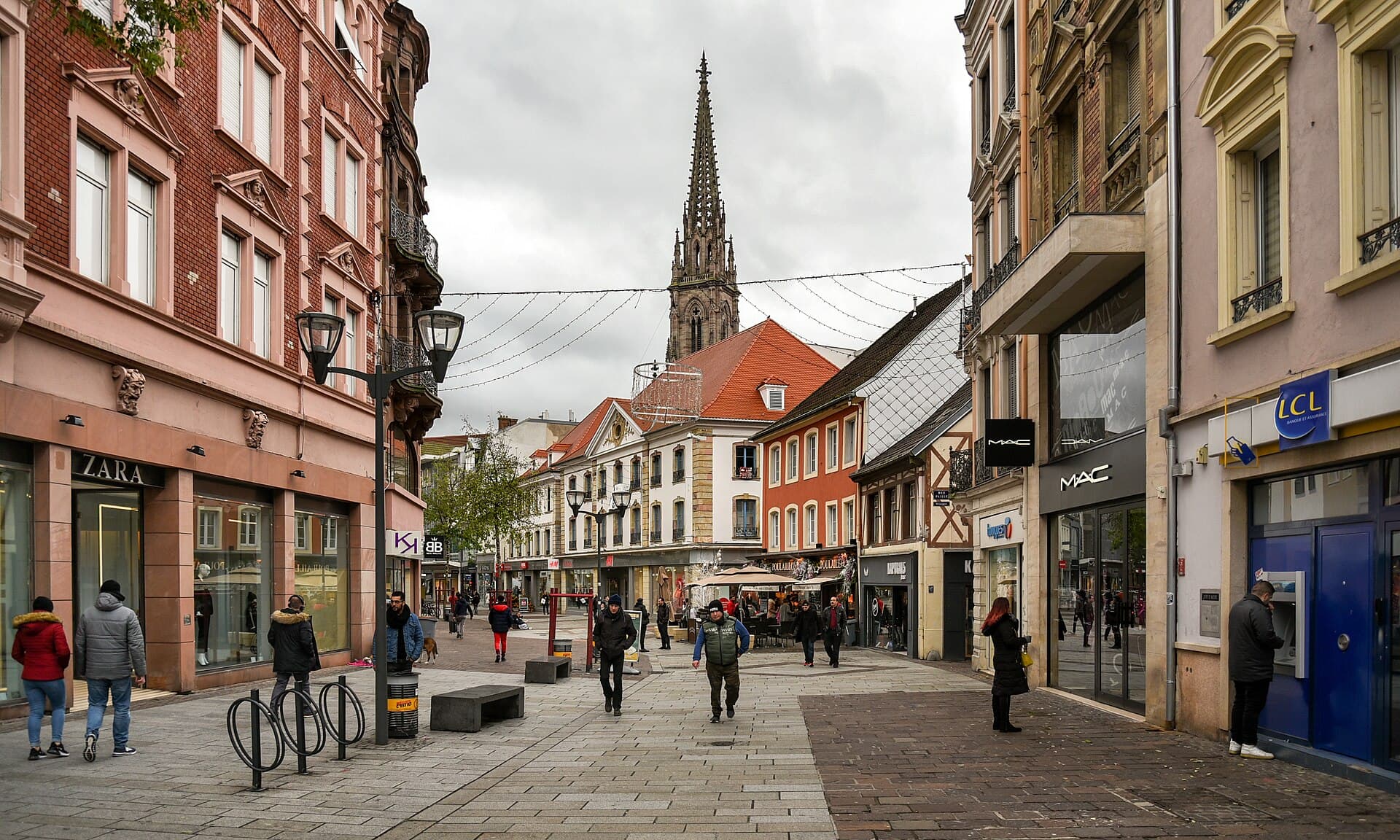 Jorge Franganillo from Barcelona, Spain / CC BY 2.0, via Wikimedia Commons
“Where the echoes of industry meet the brushstrokes of urban art and unexpected green sanctuaries.”
Not the postcards. The stories even locals don't know — whispered in your ear, right where they happened.
The 16th-century Town Hall in Mulhouse displays vivid murals on its facade, yet a closer look reveals a curious detail about historical punishments.
Mulhouse once led the world in printed fabrics, but the industry faced an unusual challenge that ultimately gave the city a distinct advantage.
This expansive park offers refuge to wildlife and plants, but its origins disclose a surprising motivation beyond mere conservation.
Discover every secret of Mulhouse
Every address, every reveal in full — in your ear, right where it happened.
You pick your stops. You walk. The voice reveals what the others miss.
No tours available yet. Check back soon — we're preparing them.
Mulhouse, a city in France's Grand Est region, occupies a singular juncture near the Swiss and German borders, a position that has shaped its culture, language, and cuisine. Historically recognized as an industrial force—known as 'the French Manchester' or 'the city with a hundred chimneys'—Mulhouse has undergone a profound metamorphosis. While its industrial past is evident in its architecture and world-class museums, the city has reimagined itself, embracing a lively street art movement and a renewed appreciation for its heritage.
Beyond its industrial foundations, Mulhouse presents a surprisingly welcoming atmosphere with a delightful historic center, featuring colorful Renaissance-style buildings and pedestrian avenues. The city serves as a nexus for art, with numerous museums, temporary installations, and sculptures complementing its extensive street art. Mulhouse also provides an excellent base for exploring the broader Alsace region, with its scenic wine country and proximity to other significant Alsatian cities like Colmar and Strasbourg.
## From Roman Influences to Free Imperial City Mulhouse's story extends back to pre-Roman eras, with a clash between Julius Caesar's Roman army and Germanic peoples occurring west of the town in 58 BCE. The earliest written accounts of Mulhouse surface in the 9th century, with the town's name, meaning 'mill house' in German, reflecting its beginnings around a watermill, an emblem still visible on its coat of arms.
By 1308, Mulhouse had attained the status of a free imperial city. To safeguard its autonomy, it forged defensive alliances with the Swiss in the 16th century, even becoming an associate member of the Swiss Confederation in 1515. This alliance meant Mulhouse was not absorbed by France with the rest of Sundgau in 1648, retaining its identity as an independent Calvinist republic.
## Industrial Revolution and French Identity The 18th century marked a pivotal moment for Mulhouse with the pioneering of cotton cloth manufacturing and fabric printing. By the close of the century, 15 textile factories operated in the city, laying the groundwork for its industrial ascent. In 1798, following a vote by its citizens, Mulhouse joined the French Republic, integrating into France 150 years after much of Alsace. This unification coincided with formidable economic development, seeing the population swell from 6,000 to 60,000 by 1866. Mulhouse earned the designations 'French Manchester' and 'city with a hundred chimneys' due to its flourishing textile, chemical, and engineering industries.
## Shifting Borders and Modern Reinvention The Franco-German War of 1870-71 saw Mulhouse annexed by the German Empire, a period that endured until its return to France after World War I in 1918. It was briefly occupied by German forces again during World War II before being restored to France in 1945. The latter half of the 20th century brought a decline in heavy industry, particularly textiles and potash extraction, leading to economic difficulties. However, Mulhouse has actively pursued a renaissance, transforming former factories into creative centers and establishing itself as a city of art and history, recognized for its world-class museums and dynamic urban landscape.
Begin your exploration in the city's core at Place de la Réunion, a broad square framed by historic structures. Here, you will find the 16th-century Hôtel de Ville (Town Hall) with its distinctive mural paintings. Nearby, the 19th-century Protestant Temple Saint-Étienne showcases original 14th-century stained-glass windows. Take time to observe the Maison Mieg, another notable building on the square with its turret and trompe l'oeil details, or the historic Pharmacie au Lys, one of Europe's oldest pharmacies still in operation.
Mulhouse is celebrated for its impressive museums. Car enthusiasts will find the Cité de l'Automobile (National Automobile Museum) a compelling visit, housing the world's largest private collection of automobiles, including over 400 vintage cars and numerous Bugattis. Equally engaging is the Cité du Train (National Railway Museum), Europe's largest railway museum, presenting two centuries of French rail history. Delve into the city's textile heritage at the Musée de l'Impression sur Étoffes (Museum of Printed Textiles), which preserves millions of textile samples and chronicles the history of fabric printing.
For a change of pace, the Parc Zoologique et Botanique de Mulhouse offers a sprawling 25-hectare green expanse with over 1,200 animals and 3,500 plant varieties, including endangered species and a 'Remarkable Garden' designation. The city's dedication to art extends to its streets, with numerous murals and street art installations to discover, particularly around the Quai des Pêcheurs and Graffitipolis. For expansive views, ascend the Tour du Belvédère (Belvedere Tower), offering panoramas reaching as far as Colmar and the Black Forest.
Mulhouse welcomes visitors throughout the year, with each season offering a different appeal. For warm-weather activities and outdoor exploration, the period from mid-June to early September is ideal, when temperatures are pleasant, averaging around 18–20°C (64–68°F), with highs reaching 24–25°C (75–77°F). Spring (March–May) and autumn (September–November) provide milder temperatures, ranging from 6–16°C (43–61°F), making them comfortable for sightseeing. Autumn is particularly inviting for wine enthusiasts, aligning with the harvest season in the Alsace wine region. Winters (December–February) are cool, with average temperatures between 2.5–4.3°C (36–40°F), and the city comes alive with festive Christmas markets.
Mulhouse is generally considered a secure city, though it is always prudent to be aware of your surroundings, especially in crowded areas. French is the predominant language, but Alsatian, a German dialect, is also spoken, and many locals, particularly in tourist zones, may understand German.
The city offers an efficient public transportation network managed by Soléa, encompassing buses, tramways, and a tram-train line, making navigation straightforward. Tram stations feature automatic ticket machines accepting bank cards and coins, and a City Pass is available for discounted access to attractions and transport. For those driving, Mulhouse provides various parking options, including surface, outdoor, and underground facilities, with mobile applications available for remote payment. The currency used is the Euro (€).