Jacquemart Tower
The Jacquemart Tower doesn't just tell time; it tells a story with its unique bell-ringers.
Full story unlocks in the tour
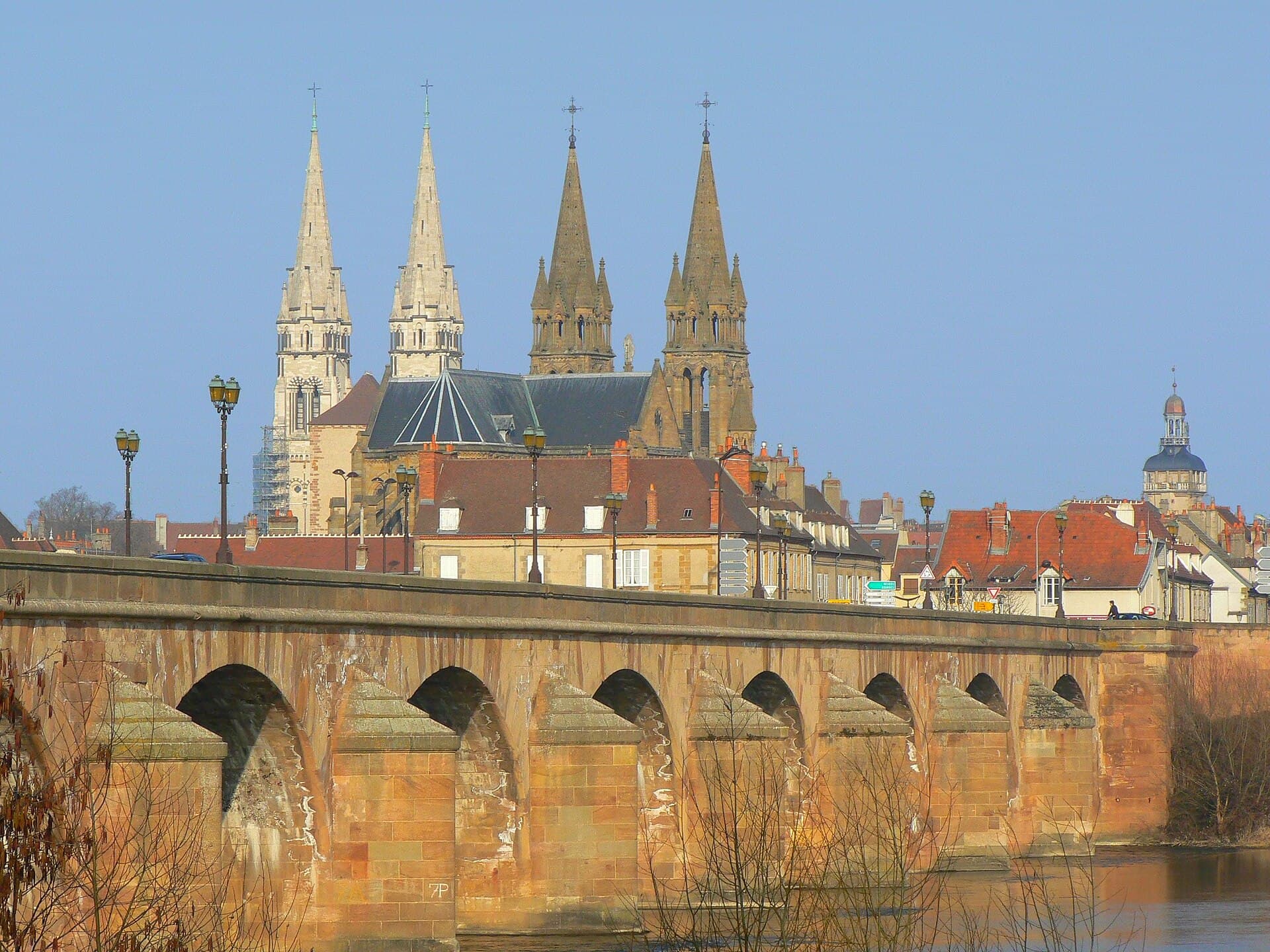 Alphanumeric / CC BY-SA 4.0, via Wikimedia Commons
“Where Bourbon history and theatrical artistry converge.”
Not the postcards. The stories even locals don't know — whispered in your ear, right where they happened.
The Jacquemart Tower doesn't just tell time; it tells a story with its unique bell-ringers.
Step inside Maison Mantin, and you'll find a perfectly preserved 19th-century home, as if its eccentric owner just stepped out.
The Mal Coiffée Tower, a remnant of the Bourbon dukes' castle, carries a name with a darker, more poignant meaning than it first suggests.
Discover every secret of Moulins
Every address, every reveal in full — in your ear, right where it happened.
You pick your stops. You walk. The voice reveals what the others miss.
No tours available yet. Check back soon — we're preparing them.
Moulins, the historic capital of the Allier department in central France, is a city woven with threads of heritage and cultural depth. Situated on the right bank of the Allier River, the town's name itself, meaning 'mills,' harkens back to the many mills that once lined its waterways. Once the seat of the powerful Dukes of Bourbon, Moulins today proudly carries its 'City of Art and History' label, inviting visitors to uncover layers of medieval and Renaissance architecture alongside a contemporary arts scene.
This appealing city offers a captivating blend of past and present, from its well-preserved half-timbered houses and grand churches to its pedestrian-friendly streets and lively markets. Whether you're drawn to its royal connections, its unique museums, or simply its relaxed ambiance, Moulins provides a tranquil escape infused with culture and appeal. It serves as an excellent base for exploring the wider Allier region, with its ancient forests and picturesque villages just a short journey away.
Moulins, literally meaning 'mills' in French, owes its name to the numerous mills that once operated along the Allier River. The town's documented history stretches back to at least 990 AD. A local legend attributes its founding to Archambault, Sire de Bourbon, who, after a day of hunting, found refuge at a miller's house and was so captivated by the area that he built a hunting lodge, which eventually grew into a castle.
In 1232, Archambaud VIII, Sire de Bourbon, granted a franchise to Moulins' inhabitants, a move that spurred its economic growth and population. The town's prominence truly began to flourish in 1327 when Charles IV elevated Louis I de Clermont to Duke of Bourbon, establishing Moulins as the capital of the Bourbonnais province. The Dukes of Bourbon ruled from Moulins from 1327 to 1527, leaving an indelible mark on its architecture and cultural landscape.
The late 15th century marked a golden age for Moulins, particularly under the reign of Pierre II de Bourbon and Anne de Beaujeu, the eldest daughter of King Louis XI. Anne, a powerful figure, managed the regency of the Kingdom of France twice from Moulins, attracting a cosmopolitan court of artists, musicians, and poets to the city. This era saw the construction of significant buildings, including the expansion of the ducal castle and the erection of the collegiate church, which would later become the cathedral. Anne de Beaujeu also commissioned the first Renaissance-style building in France, a royal wing in the Italian style, which now houses a museum.
It was during this period that the renowned Triptych of the Master of Moulins, a masterpiece of 15th-century French medieval art, was created, further solidifying the city's artistic legacy. The Edict of Moulins, an important royal ordinance addressing justice administration and feudal privileges, was also enacted here in February 1566.
While the Bourbon castle was largely destroyed by fire in 1755, its imposing keep, known as the 'Mal Coiffée,' still stands today, a poignant reminder of its ducal past. In the 19th century, Moulins continued to evolve, with the cathedral's nave and two spires added in a Neo-Gothic style. The city also became the birthplace of operatic baritone and art collector Jean-Baptiste Faure.
The 20th century saw Coco Chanel attend school in Moulins as an orphan before she moved to Paris and became a revolutionary fashion designer. Today, Moulins maintains its identity as a cultural and administrative center, proudly preserving its historical treasures while embracing modernity.
Moulins offers a wealth of sights that speak to its deep past. The Cathédrale Notre-Dame-de-l'Annonciation is a masterpiece of Gothic and Renaissance architecture, housing the celebrated 15th-century Triptych of the Master of Moulins and intricate stained-glass windows. The Jacquemart Tower, a 15th-century clock tower, stands as an iconic landmark with animated figures that chime the hours. A climb to its observation deck provides sweeping views of the city.
For a unique cultural experience, visit the Centre National du Costume de Scène (CNCS), a museum dedicated to theatrical costumes, housed in an 18th-century cavalry barracks. It showcases an impressive collection from opera, ballet, and theater. The Maison Mantin offers a fascinating glimpse into 19th-century bourgeois life, preserved in its original state. Adjacent to it, the Musée Anne-de-Beaujeu, located in France's first Renaissance building, features medieval Bourbonnais sculptures and 19th-century paintings.
Stroll through the Old Town to admire the half-timbered houses and historic mansions. The Allier River Promenade provides a tranquil setting for a walk, and the Iron Bridge, a rehabilitated railway bridge, now offers pedestrian and cycling access with views of the town. The Grand Café, a historic brasserie, captivates with its Belle Époque decor.
The best times to visit Moulins are spring (April to June) and autumn (September to October), when the weather is mild and the crowds are thinner. Average daytime temperatures range from 18°C to 28°C during these periods. Summer (mid-June to early September) brings a lively atmosphere with outdoor events and festivals, though it can be warmer, with July highs averaging 27°C (80°F). Winter offers a quieter, more intimate experience, with February being the coldest month, averaging 8°C (46°F) during the day. Moulins' cultural attractions, many of which are indoors, make it a viable destination year-round.
Moulins is easily accessible by train, car, and bus. Regular trains connect Moulins-sur-Allier station to Paris (approximately 2.5 hours) and other major cities like Lyon and Clermont-Ferrand. If driving, the A71 motorway provides convenient access. Parking is straightforward, with several options near the city center and main attractions.
The city center is pedestrian-friendly, and most major sights are within walking distance. A bus network also serves tourist sites from Monday to Saturday, every half hour. Consider purchasing the Moulins CityPass, available at the tourist office, for unlimited access to museums and city tours, along with free bus access.
Moulins offers a varied culinary scene with local and regional specialties. Look for dishes like truffade (a potato and cheese dish) and aligot, and be sure to sample the local Saint-Pourçain wine and Charolais beef. The Maison Les Palets d'or is a renowned chocolatier, celebrated for its dark chocolates.