Underneath St. Stephen's church tower
Motovun is said to be a place of powerful positive energy.
Full story unlocks in the tour
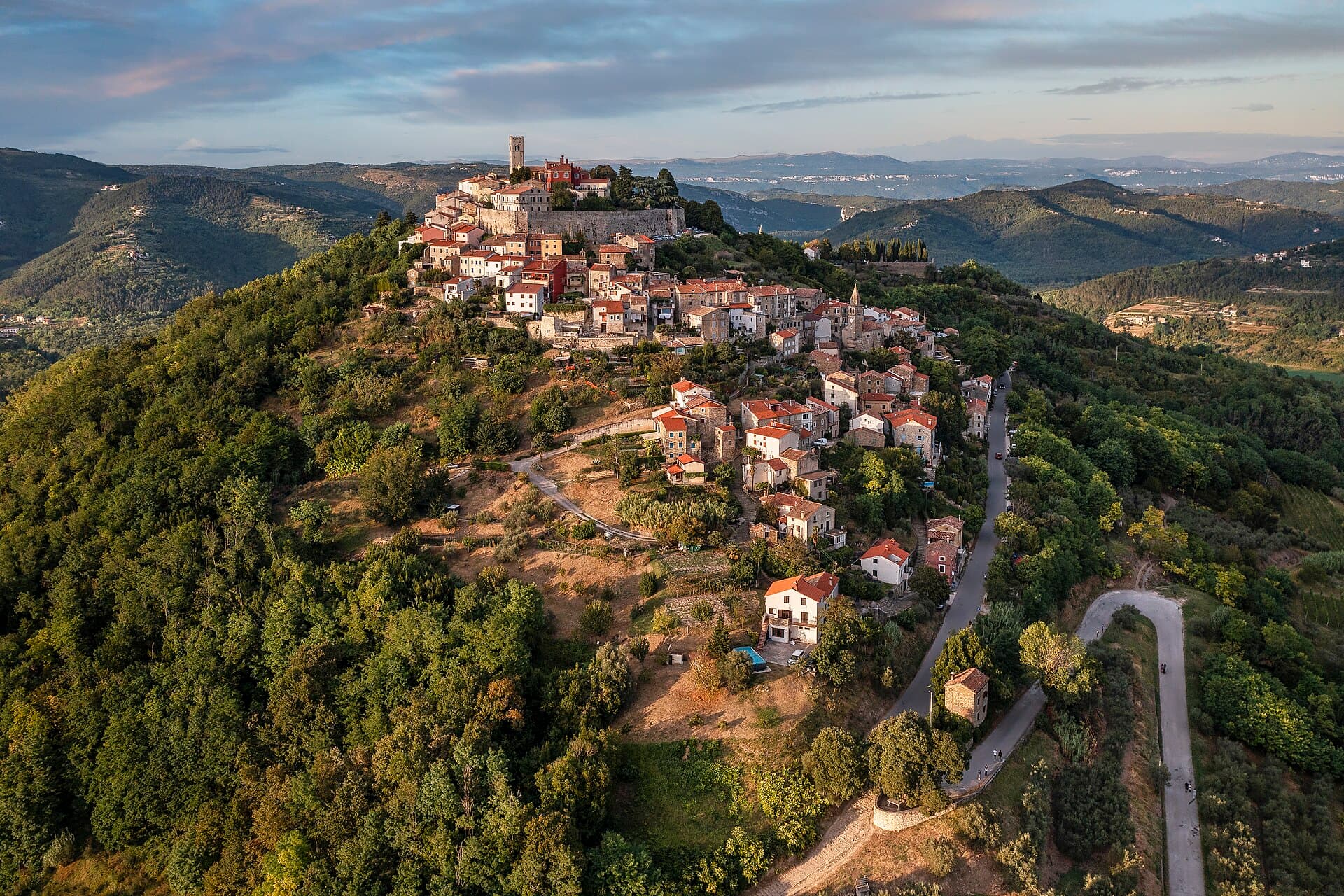 Ekaterina Polischuk / CC BY-SA 4.0, via Wikimedia Commons
“Where medieval stone meets mystical forests and the scent of truffles lingers.”
Not the postcards. The stories even locals don't know — whispered in your ear, right where they happened.
Motovun is said to be a place of powerful positive energy.
The world's largest truffle wasn't found just anywhere.
A legendary racing driver's early days involved a different kind of speed.
Discover every secret of Motovun
Every address, every reveal in full — in your ear, right where it happened.
You pick your stops. You walk. The voice reveals what the others miss.
No tours available yet. Check back soon — we're preparing them.
Resting on a cone-shaped hill 277 meters above the Mirna River Valley, Motovun is a medieval town in central Istria, Croatia. Its distinctive silhouette, with ancient stone walls encircling the hilltop, offers expansive views of rolling vineyards, dense forests, and other small villages. The town's name itself is of Celtic origin, derived from "Montona," meaning "a town in the hills."
Motovun is a place where history, legend, and culinary delights intertwine. It’s a destination that captivates with its preserved medieval architecture, cobbled streets, and a palpable sense of timelessness. While it can be explored in half a day, many visitors find themselves lingering, drawn by the allure of its famous truffles, local wines, and the serene beauty of the Istrian countryside.
## From Ancient Fortresses to Venetian Stronghold Motovun's history stretches back to ancient times, with both Celts and Illyrians establishing fortresses on this strategically advantageous hilltop. The Romans also had a settlement here, and Roman gravestones from the 1st century can still be found within the town's inner walls.
During the 10th and 11th centuries, Motovun was under the control of the Bishop of Poreč. A pivotal shift occurred in 1278 when the Republic of Venice took over the village and the surrounding region. The Venetians significantly fortified Motovun, constructing the thick stone walls that largely define its medieval character today. The earliest preserved sections of these walls date back to the 11th and 12th centuries, with further fortifications and towers added in the 12th and 13th centuries. By the 15th century, Motovun had evolved into a Gothic stronghold with new town gates. The defensive system was further enhanced in the 16th century with additional bulwarks and the integration of a Servite convent. Notably, some parts of the walls were dismantled in the 17th century due to a peace treaty between Austria and Venice. Motovun's well-preserved medieval characteristics have earned it a place on UNESCO's World Heritage Tentative List.
## Echoes of Giants and Inventors Beyond its architectural heritage, Motovun is rich in local folklore. Legend has it that giants once inhabited the Mirna River valley and even built some of the local villages, including Motovun. As humans populated the area, most giants disappeared, but one, Veli Jože, remained. This friendly giant became the subject of a famous 1908 tale by Croatian author Vladimir Nazor, and he is commemorated in Motovun with a street named after him and a mural.
Motovun has also been home to notable historical figures. Andrea Antico, a prominent Renaissance music printer and composer, was born here in 1480. Josef Ressel, the inventor of the ship's propeller, lived and worked in Motovun from 1835 to 1843, and the lower town square is named in his honor. These layers of history, from ancient settlements to Venetian rule and the tales of its unique inhabitants, contribute to Motovun's enduring allure.
A visit to Motovun is best begun by walking its ancient city walls. These well-preserved fortifications, some dating back to the 11th and 12th centuries, offer spectacular 360-degree views of the Mirna Valley, with its vineyards, forests, and distant villages. The walk along the walls is a journey through history, allowing you to appreciate the strategic importance and architectural evolution of the town.
In the heart of Motovun, you'll find the Church of St. Stephen, a Renaissance church designed by students of the renowned Venetian architect Andrea Palladio and built between 1580 and 1614. Adjacent to the church stands the 13th-century Romanesque-Gothic bell tower, which originally served as an observation post. Climbing the bell tower provides another excellent vantage point for sweeping views of the town and surrounding landscape.
Explore the town's main square, named after Andrea Antico, the Renaissance music printer born in Motovun. Here, you can also find the Municipal Palace, the best-preserved Romanesque public building in Istria and Croatia, with its original Romanesque bifore windows still visible. Wander through the narrow, stone streets, where you'll encounter charming shops, art galleries, and local craft studios. Do not miss the opportunity to sample local products, especially the region's famous truffles and wines, at one of the many konobas (traditional taverns) or specialty shops.
Motovun offers a distinct experience throughout the year. For pleasant weather and fewer crowds, spring and autumn are ideal. The months of May, June, September, and October are particularly recommended. During these times, you can enjoy exploring the town and its surroundings in comfortable temperatures.
Summer, from late May to August, brings a more lively atmosphere, especially during the Motovun Film Festival, which traditionally takes place in late July or early August. While popular, July and August can be crowded with day-trippers. If you prefer a more peaceful visit, consider avoiding these peak summer months. Motovun is generally a great destination all year round.
The most convenient way to reach Motovun is by car, as public transport options are limited and infrequent. There is parking available at the foot of the hill leading up to the town. From there, you can either take a shuttle bus or enjoy a pleasant 15-minute uphill walk through the stone streets to the town center. Parking is paid, but free during December, January, and February, or if you arrive before the parking lot's operating hours, typically 9 or 10 AM.
While Motovun can be explored in half a day, spending a full day or even two is recommended to fully immerse yourself in the town's offerings, including truffle tastings, winery visits, and simply enjoying the views. Consider staying overnight to experience the town in its quieter morning and evening hours. Many local businesses, especially those offering truffle hunting tours and wine tastings, require advance booking. The local currency is the Euro (€).