The lowest terrace of Moray
Imagine standing at the very bottom of Moray's deepest depression. The air around you feels different, noticeably cooler than the rim. This isn't just a trick of the mind.
Full story unlocks in the tour
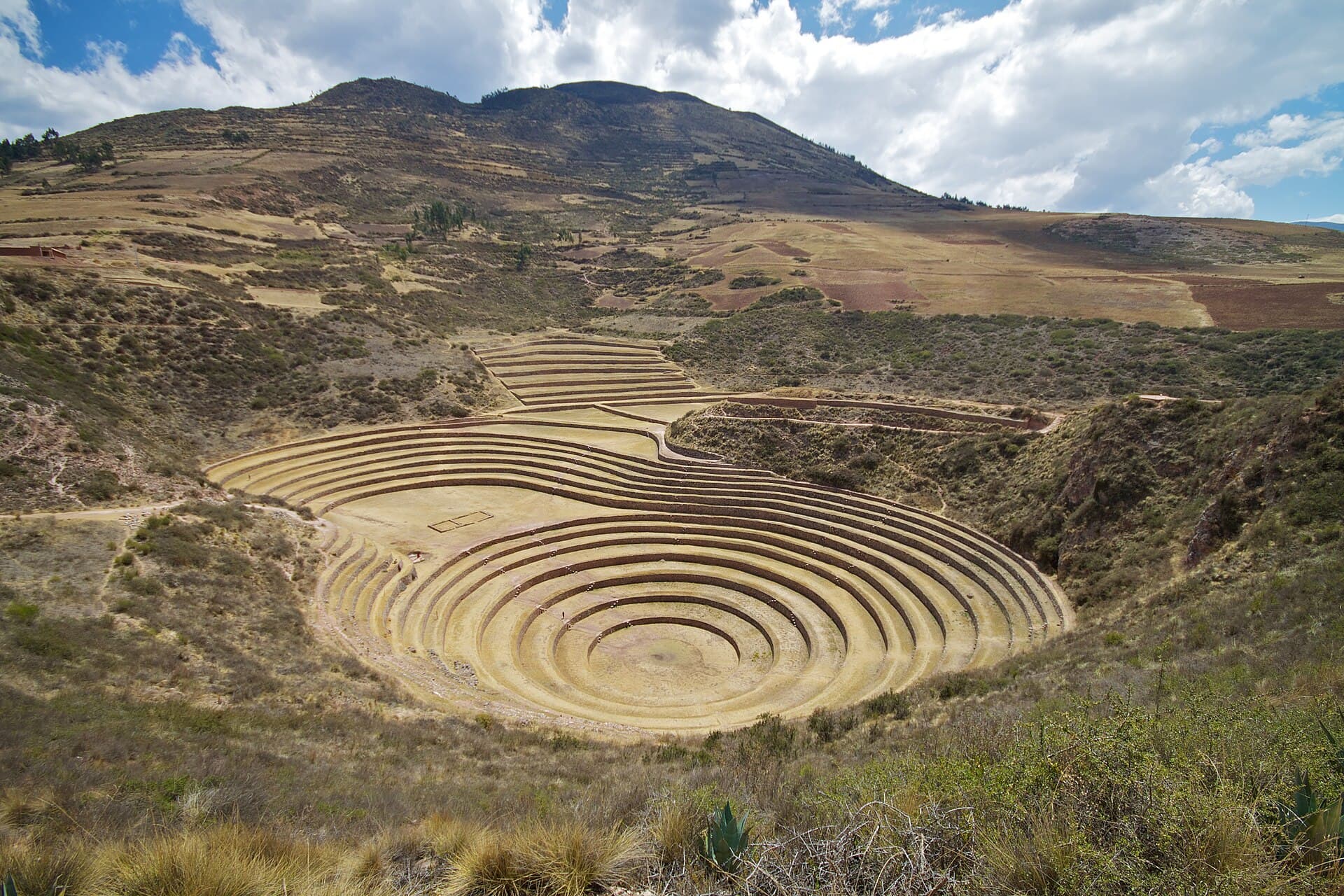 McKay Savage from London, UK / CC BY 2.0, via Wikimedia Commons
“Where ancient ingenuity cultivated an empire.”
Not the postcards. The stories even locals don't know — whispered in your ear, right where they happened.
Imagine standing at the very bottom of Moray's deepest depression. The air around you feels different, noticeably cooler than the rim. This isn't just a trick of the mind.
The Incas were meticulous farmers, but their dedication to agricultural experimentation at Moray went far beyond simply shaping the land.
Even during heavy rainy seasons, when other areas might flood, the base of Moray's massive circular depressions remains remarkably dry.
Discover every secret of Moray
Every address, every reveal in full — in your ear, right where it happened.
You pick your stops. You walk. The voice reveals what the others miss.
No tours available yet. Check back soon — we're preparing them.
Moray, an archaeological site in Peru's Sacred Valley, defies easy categorization. Unlike the fortresses or ceremonial centers often associated with the Inca, Moray presents a series of concentric circular terraces that descend into the earth like colossal, sculpted bowls. This unique design, carved into natural depressions, has led most scholars to believe it served as an advanced agricultural laboratory.
Approximately 50 kilometers (31 miles) northwest of Cusco and just west of the village of Maras, Moray rests on a high plateau at an elevation of about 3,500 meters (11,482 feet) above sea level. The site's visual impact is immediate and profound, inviting visitors to ponder the ingenuity and scientific acumen of the Inca civilization. It’s a place where ancient engineering, agricultural innovation, and a deep connection to the natural world converge.
The exact origins and precise dates of Moray's construction remain somewhat obscured, as the Inca left no written records. However, archaeologists generally date the ruins to the 15th or 16th century, during the zenith of the Inca Empire. Some evidence suggests that the bottom six terraces may have even been constructed by the Wari culture, which preceded the Incas, flourishing from the 6th to the 10th century.
The prevailing theory is that Moray functioned as an agricultural research center or laboratory. The Incas were master agronomists, and this site allowed them to experiment with different crops under varying conditions. The distinct microclimates created by the terraces, with temperature differences of up to 15°C (27°F) between the top and bottom levels, enabled them to simulate environments from various regions of their expansive empire—from warm valleys to cold highlands. This allowed them to test and adapt over 250 crop varieties, including maize, potatoes, and quinoa, for optimal growth in different altitudes and conditions. The importation of soil from various regions of Peru further supports this hypothesis.
Beyond its scientific purpose, Moray is also thought to have held spiritual and ceremonial significance. Its spiral design, descending into the earth, may have symbolized the connection between humans, the earth (Pachamama), and the cosmos, reflecting Inca cosmology and cycles of life and fertility. The site's alignment with celestial events further underscores this cultural and spiritual dimension.
The engineering prowess of the Incas is evident in Moray's construction. The terraces feature sophisticated drainage systems, with stone walls and layers of soil and gravel, designed to prevent erosion and landslides, even during heavy rains. This sustainable design has allowed the structures to remain largely intact for centuries, inspiring modern studies in agriculture and climate adaptation.
The primary attraction at Moray is the series of impressive circular terraces themselves. There are three main groups of these depressions, with the largest descending about 150 meters (490 feet) from its highest to lowest point and having a diameter of 600 feet. As you walk along the paths and descend into the different levels, you can experience the noticeable temperature variations, a tangible demonstration of the Inca's microclimate creation. The precision of the stonework and the intricate design of the terraces, built without mortar, are a testament to Inca engineering. While exploring, observe the ingenious irrigation channels that once distributed water across the agricultural plots. The surrounding Andean landscape, with its green agricultural fields and distant snow-capped peaks, provides a dramatic backdrop to this ancient marvel.
Many visitors combine a trip to Moray with a visit to the nearby Maras Salt Pans, a striking landscape of thousands of salt-encrusted ponds that have been harvested since pre-Inca times. These two sites are often included together in tours from Cusco or the Sacred Valley.
The best time to visit Moray is during Peru's dry season, which runs from May through September. During these months, you can expect clear skies, minimal rainfall, and comfortable daytime temperatures, making for ideal exploration and photography conditions. The dry paths also make navigating the terraces safer. The shoulder months of April and October also offer mild weather with potentially fewer crowds. While the rainy season (November to March) brings lush green landscapes, be prepared for occasional afternoon showers and potentially muddy trails.
Moray is located approximately 50 kilometers (31 miles) northwest of Cusco. Most visitors travel from Cusco or the Sacred Valley. Options include organized tours, which often combine Moray with the Maras Salt Pans and include transportation and a guide. Alternatively, you can take a colectivo (shared taxi) from Cusco towards Urubamba and get off at the Maras turnoff, then hire a local taxi to Moray. Private taxis are also available.
Moray is at a high altitude of around 3,500 meters (11,482 feet), so it's crucial to acclimatize in Cusco or the Sacred Valley for a day or two before visiting to minimize the risk of altitude sickness. Wear comfortable walking shoes suitable for uneven terrain, bring sunscreen, a hat, and plenty of water. Entrance to Moray requires the Cusco Tourist Ticket (Boleto Turístico), which can be purchased as a partial ticket (Circuit III) for 70 soles (approximately $19 USD) and includes other sites like Pisac, Ollantaytambo, and Chinchero, valid for two days.