The Berntor Gate
This prominent gate is more than an entrance; it holds a secret that once kept time for the entire town.
Full story unlocks in the tour
 Clement Dominik (Chlempi at de.wikipedia) / CC BY-SA 2.0 de, via Wikimedia Commons
“Where ancient walls meet lakeside calm, and history echoes in two languages.”
Not the postcards. The stories even locals don't know — whispered in your ear, right where they happened.
This prominent gate is more than an entrance; it holds a secret that once kept time for the entire town.
Beneath the tranquil surface of Lake Murten lies a chilling reminder of a pivotal battle.
These ancient ramparts offer expansive views, but their construction was incentivized by an unusual offer.
Discover every secret of Morat
Every address, every reveal in full — in your ear, right where it happened.
You pick your stops. You walk. The voice reveals what the others miss.
No tours available yet. Check back soon — we're preparing them.
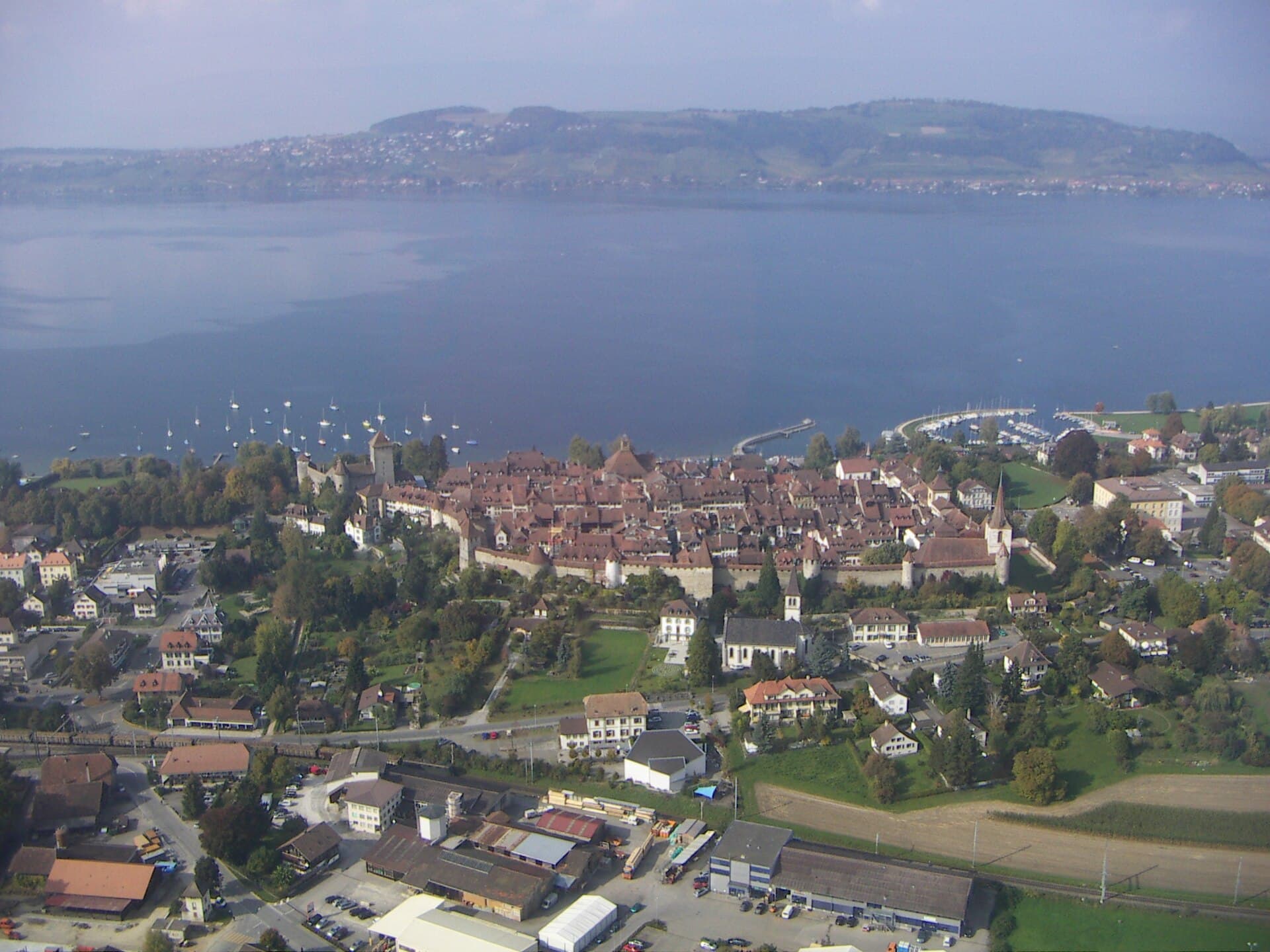
Morat, known as Murten in German, is a remarkably preserved medieval town in Switzerland, situated on the southern shore of Lake Murten in the canton of Fribourg. This bilingual town, where German is predominantly spoken (around 73%) despite being in a largely French-speaking canton, offers a unique cultural blend. Its strategic location on a gentle hill overlooking the lake has shaped its story, from ancient settlements to a pivotal role in the Burgundian Wars.
Stepping into Morat feels like a journey through time, with its complete ring of walkable ramparts, historic castle, and charming arcaded streets. The town's character is defined by its antique buildings, decorative fountains, and picturesque alleys, inviting visitors to explore on foot. Beyond its historical core, Morat provides access to the serene Lake Murten, offering opportunities for water activities and leisurely strolls along its promenade, with views stretching towards the distant Jura Mountains.
The area around Morat has a long history of human settlement, with the oldest evidence dating back to the Mesolithic period (around 8,200 to 5,500 BC). Later, during the Neolithic and Bronze Ages, more settlements emerged, and archaeologists have uncovered ancient burial sites. The Romans also left their mark, with remains of a large Roman villa and a Roman road from the 1st or 2nd century BC found in the vicinity.
The town's name, Murten, is derived from the Celtic word moriduno, meaning "lakeside fortress," reflecting its early defensive purpose. It was first mentioned as a defensive place called "Muratum" in 515 AD. King Rudolph III of Burgundy further fortified the area in 1013. Morat was officially recognized as a city around 1238, after being founded as a city between 1159 and the 1180s. For a period, it was even a "Free Imperial Town" under the German Emperor Frederic II.
One of the most significant events in Morat's history is the Battle of Morat, fought on June 22, 1476. Charles the Bold, Duke of Burgundy, laid siege to the town with an army of approximately 25,000 men. Morat bravely held out for 13 days until the arrival of the Bernese army, which, along with other Swiss Confederates, launched a surprise attack. The Burgundian army suffered a crushing defeat, with an estimated 10,000 to 12,000 soldiers killed. This victory is still celebrated annually on June 22nd.
Following the battle, from 1484 onwards, Morat was jointly administered by the cantons of Bern and Fribourg for 300 years. In 1530, Morat adopted the Protestant Reformation, influenced by Bern, which often led to disagreements with the predominantly Catholic Fribourg. The late 17th century saw Morat prosper from trade, leading to many houses being rebuilt in stone after a major fire in 1416. After the French invasion in 1798, Morat became part of the Fribourg canton in 1803. Today, the town continues to grow through mergers with nearby municipalities, maintaining its historical character while embracing its role as a regional center.
Begin your exploration with a walk along the medieval rampart walls, the only complete circuit in Switzerland open to the public. From these walls, you'll gain expansive views of the old town's baroque houses, red-tiled roofs, and the shimmering expanse of Lake Murten. Stop at the original defensive towers from the 12th century, where information panels detail their historical military function.
Descend into the Old Town to wander through its cobbled streets, admiring the arcaded buildings that shelter cafes and local shops. The Berntor Gate, a prominent landmark, dates back to the early 13th century and has been rebuilt multiple times. You'll also encounter the German and French Churches, reflecting the town's bilingual heritage.
No visit to Morat is complete without experiencing Lake Murten. The lakeside promenade offers a relaxing stroll to the harbor, where boat cruises depart. The lake is suitable for swimming, and you can rent stand-up paddleboards or take sailing lessons. For a taste of local flavor, seek out a slice of Nidelkuchen, a cream pie specialty of Morat. A short trip to Mont Vully, known for its vineyards, offers wine tastings and scenic views of the lake and Alps.
The best time to visit Morat for general outdoor activities is from late June to early September, when the weather is pleasant and skies are often clear. July is typically the clearest month. For warm-weather activities like swimming and boat cruises on Lake Murten, early July to mid-August is ideal, as lake temperatures can reach 20°C by early June. The spring months (March to May) offer Alpine blooms, while autumn (September to November) brings colorful foliage and harvest festivals.
Morat is easily accessible by train, with direct connections from Bern (approximately 30 minutes via Kerzers) and Fribourg (around 20 minutes). The train station is a short five-minute walk from the Old Town. Once in Morat, the town is best explored on foot, as the center is compact and many attractions are within walking distance. Comfortable shoes are recommended for navigating the cobbled streets and walking the ramparts. If you plan to utilize public transportation throughout Switzerland, consider purchasing a Swiss Travel Pass, which often includes train, bus, and even some boat services on Lake Murten. While Morat is well-suited for a focused day trip, allowing ample time to see the main highlights, a full day is recommended if you plan to include a multi-lake boat cruise.