Monreale Cathedral's Cloister
The cloister's columns are a study in individuality, but one stands out with a curious detail that hints at an even older, submerged past.
Full story unlocks in the tour
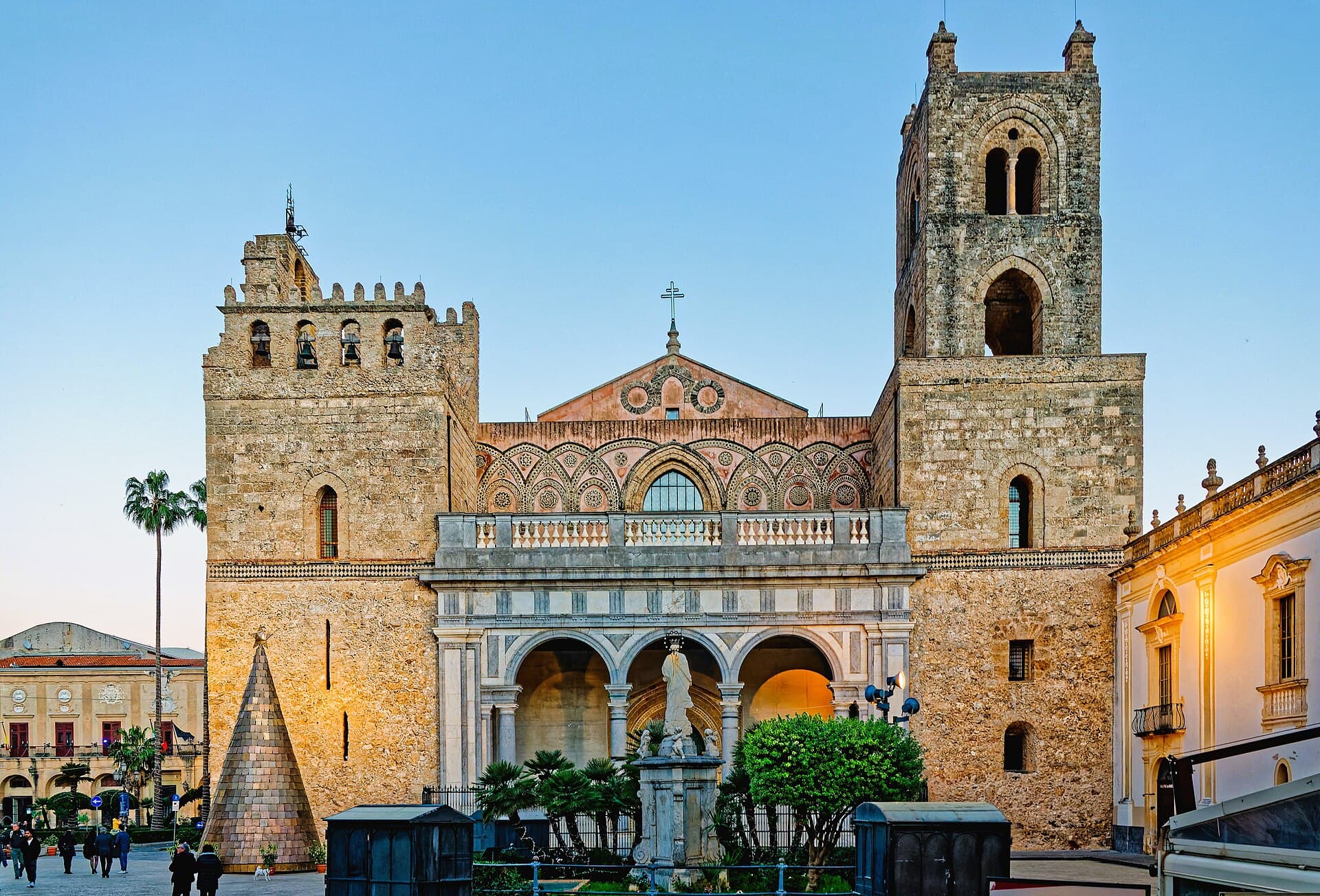 Holger Uwe Schmitt / CC BY-SA 4.0, via Wikimedia Commons
“Where golden mosaics tell ancient stories under Sicilian skies.”
Not the postcards. The stories even locals don't know — whispered in your ear, right where they happened.
The cloister's columns are a study in individuality, but one stands out with a curious detail that hints at an even older, submerged past.
The sheer amount of gold in the cathedral's mosaics is staggering, but there's a reason beyond mere opulence for its dazzling effect.
The cathedral's construction was fueled by more than just devotion; a fierce rivalry between two powerful figures shaped its very essence.
Discover every secret of Monreale
Every address, every reveal in full — in your ear, right where it happened.
You pick your stops. You walk. The voice reveals what the others miss.
No tours available yet. Check back soon — we're preparing them.
Monreale rests on the slopes of Monte Caputo, gazing out over the fertile Conca d'Oro valley and the city of Palermo. This town is celebrated for a singular, extraordinary masterpiece: its Norman cathedral. This UNESCO World Heritage site stands as a testament to Sicily's intricate narrative, where cultures—Norman, Arab, and Byzantine—intertwined to forge a distinct artistic expression.
Travelers arrive in Monreale primarily for the sheer scale and brilliance of its cathedral's interior, a vast canvas adorned with shimmering golden mosaics that depict biblical narratives with remarkable precision. Beyond the cathedral, the town offers a quieter, more traditional Sicilian experience, with narrow streets, local shops, and expansive views that stretch to the Tyrrhenian Sea.
Monreale provides a compelling day trip from Palermo, offering a profound glimpse into a pivotal era of Sicilian art and power. The town's atmosphere, while centered around its iconic cathedral, invites exploration of its medieval allure and the surrounding landscape.
Monreale's origins trace back to a spot favored by Norman kings for hunting, where a royal dwelling, known as Mons Regalis (Royal Mountain), was established. The town's significance dramatically increased in 1174 when King William II of Sicily, often called 'the Good,' initiated the construction of the Monreale Cathedral and an adjacent Benedictine monastery.
Lore suggests that William II, while hunting, fell asleep under a carob tree. In a dream, the Virgin Mary appeared, revealing a treasure beneath the tree and instructing him to build a church on that very spot. Regardless of the legend's veracity, the cathedral was indeed dedicated to the Nativity of the Virgin Mary, also known as Santa Maria la Nuova.
The construction of the cathedral, which took approximately four years, was a monumental undertaking. William II's ambition was to create a church that would surpass all others, potentially to assert his authority over the Archbishop of Palermo, who was simultaneously building Palermo Cathedral. In 1182, Pope Lucius III elevated the church to the rank of a metropolitan cathedral, and by 1183, it became the seat of the archbishop.
The cathedral's distinctive style is a fusion of Norman, Arab, and Byzantine architectural and artistic elements, reflecting Sicily's multicultural journey under Norman rule. Craftsmen from Constantinople and local workers contributed to its creation, with Byzantine mosaicists responsible for the extensive golden mosaics. These mosaics, covering over 6,000 square meters, depict biblical scenes and were intended as a 'stone book' to convey sacred stories to a largely illiterate populace.
The Benedictine cloister, built concurrently with the cathedral, features 228 twin columns, each intricately carved with unique designs, showcasing a blend of Christian and Muslim influences. The entire complex, including the cathedral and cloister, stands as a prime example of Arab-Norman Palermo and is recognized as a UNESCO World Heritage site.
The undisputed highlight of Monreale is its Cathedral (Duomo di Monreale), a UNESCO World Heritage site. Step inside to be enveloped by over 6,000 square meters of shimmering golden mosaics, depicting biblical scenes from the Old and New Testaments. The colossal Christ Pantocrator in the main apse, with his right hand raised in a Byzantine blessing, is a focal point, his left hand holding an open Gospel to John 8:12: 'I am the light of the world. Whoever follows me shall not walk in darkness.' The mosaics also include depictions of King William II being crowned by Jesus and offering the cathedral to the Virgin Mary.
Adjacent to the cathedral is the Benedictine Cloister, a serene square courtyard measuring 47 by 47 meters. It is framed by 228 paired columns, each adorned with unique carvings or mosaic patterns, showcasing an incredible array of biblical scenes, stylized animals, and allegorical figures. In one corner, a particularly ornate fountain in the form of a stylized palm tree adds to the tranquil atmosphere.
For expansive views of Palermo and the Conca d'Oro valley, ascend to the cathedral's terraces, often included with the cathedral ticket. Afterwards, explore Piazza Guglielmo II, the main square, where you can find cafes and shops, and admire the Triton's Fountain. The Diocesan Museum, near the cathedral, houses religious art and historical manuscripts, providing further context to Monreale's heritage.
The most pleasant times to visit Monreale are during the spring (April to June) and fall (September to October). During these months, the weather is mild, with average temperatures ranging from 19°C to 30°C, and there are fewer crowds. Summers (July and August) can be very hot, with average highs reaching 30-31°C, and more humid. While winter is cooler, it can also be rainier, with December being the wettest month. To avoid peak tourist times, aim to arrive early in the morning or later in the afternoon on weekdays.
Monreale is easily accessible from Palermo, located just 10 miles (16 kilometers) away. Public bus route 389 from Piazza Indipendenza in Palermo offers a cost-effective option, with tickets costing around €1.40-€2 and the journey taking approximately 30-40 minutes. It's advisable to purchase bus tickets in advance from tabacchi (tobacco shops) or newsagents. If driving, be aware that parking in Monreale can be challenging; private paid parking lots at the town's entrance are recommended.
The cathedral is generally open daily, but hours can be inconsistent and it may close for religious services, especially on Sunday mornings. Always check the current opening hours before your visit. Entrance to the main cathedral is typically free, but there are separate fees for the cloister (around €8) and often for the terraces (around €4-€6). An audio guide is highly recommended to fully appreciate the intricate mosaics, as there are few descriptive panels inside. Comfortable shoes are a good idea, as Monreale's streets are cobbled and can be uphill.