Dead Horse Point State Park
The dramatic cliffs of Dead Horse Point hold a somber tale behind their evocative name.
Full story unlocks in the tour
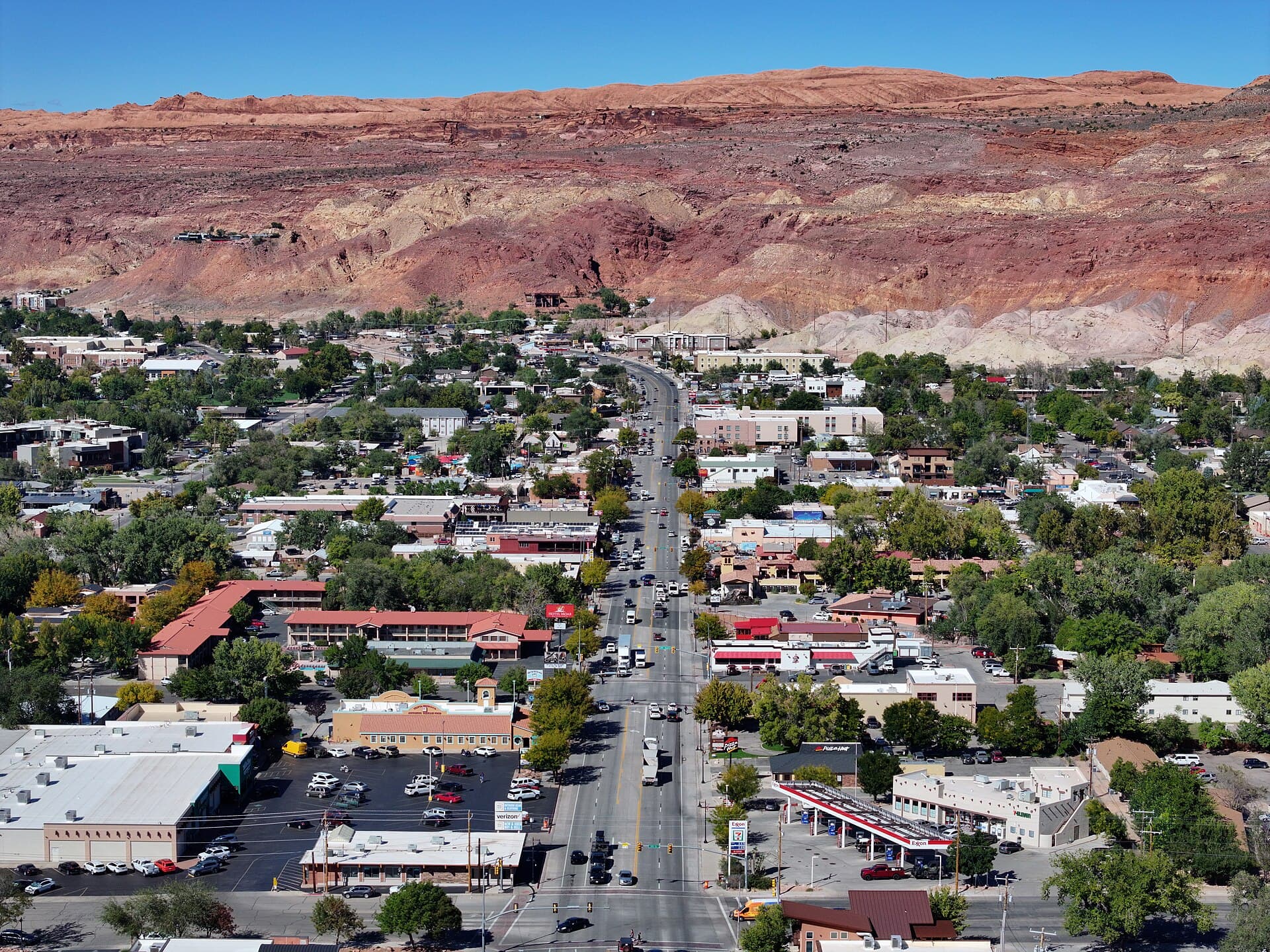 Quintin Soloviev / CC BY 4.0, via Wikimedia Commons
“Where ancient sandstone meets the spirit of exploration.”
Not the postcards. The stories even locals don't know — whispered in your ear, right where they happened.
The dramatic cliffs of Dead Horse Point hold a somber tale behind their evocative name.
During the 1950s, Moab experienced a boom that transformed it from a quiet farming town into something unexpected.
Beyond the famous arches, Moab's red rocks preserve a much older, colossal history.
Discover every secret of Moab
Every address, every reveal in full — in your ear, right where it happened.
You pick your stops. You walk. The voice reveals what the others miss.
No tours available yet. Check back soon — we're preparing them.
Moab, Utah, is a desert town carved by millennia of wind and water, a place where the earth’s raw power is on full display. Situated along the Colorado River, it serves as a gateway to two of America's most iconic national parks: Arches and Canyonlands. This small city, with a population of just over 5,300, draws millions of visitors annually, all eager to explore its unique geological formations and vast stretches of public lands.
Beyond its natural wonders, Moab is a hub for outdoor adventure, offering everything from world-class mountain biking trails like the challenging Slickrock Trail to whitewater rafting on the Colorado River. The town itself, though small, provides a base for exploration, with a variety of lodging and dining options to refresh adventurers after a day in the red rock playground.
The Moab region has been inhabited for a long time, with evidence of human presence dating back thousands of years, including ancient petroglyphs depicting what might be woolly mammoths. Native American tribes, including the Sabuagana Utes, utilized the valley and the Colorado River crossing for centuries. European exploration began in the late 1700s, with Spanish expeditions reconnoitering the land.
The first recorded attempt at permanent European settlement came in 1855 when Latter-day Saint (Mormon) settlers established the Elk Mountain Mission. Their goal was to create a trading fort and engage with the Ute people. However, repeated conflicts with Native Americans led to the abandonment of the fort after only a few months. Permanent settlers, primarily cattle ranchers, returned to the area around 1878. The town was officially named Moab in 1880, a name believed by some to be inspired by the biblical 'land beyond the Jordan,' while others suggest Paiute origins from the word 'moapa,' meaning 'mosquito.'
Moab's early economy was rooted in agriculture, ranching, and fruit growing, with the area becoming known for peaches, apples, and grapes by the early 20th century. The construction of a ferry across the Colorado River by 1885 and a steel bridge in 1912 further connected Moab to the wider region. However, the town's destiny took a dramatic turn with the discovery of valuable minerals. Uranium and vanadium were found in the area in the 1910s and 1920s, followed by potash, manganese, and eventually oil and gas.
The 1950s marked a pivotal era for Moab with the 'Uranium Boom.' Geologist Charles Steen's significant uranium discovery in 1952 transformed the sleepy town into the 'Uranium Capital of the World.' The town's population surged by nearly 500% in a few years, reaching close to 6,000 residents, as prospectors and workers flocked to the area. This boom, fueled by the demand for nuclear weapons and power during the Cold War, brought new businesses, motels, and infrastructure to Moab. However, with the winding down of the Cold War, the uranium boom subsided, leading to a decline in population and the closure of most mines by the early 1980s.
Even before the uranium boom, the natural beauty of the Moab area began to capture attention. Early descriptions of the rock formations appeared in local newspapers as early as 1911. The establishment of Arches National Monument in 1929 by President Hoover and Canyonlands National Park in 1964 by Lyndon B. Johnson cemented the region's future as a tourist destination. By the early 1980s, as mining declined, a new industry emerged: adventure tourism. The rise of mountain biking, with Moab becoming a renowned mecca for the sport, along with off-roading, hiking, and rafting, redefined Moab as the 'Adventure Capital of the West.'
Moab's dramatic landscapes have also made it a popular backdrop for filmmakers for nearly 75 years. Director John Ford was persuaded to film Wagon Master in the area in 1949, initiating Moab's long association with Hollywood. Since then, nearly 200 feature-length films, commercials, and television shows, including Thelma & Louise, Indiana Jones and the Last Crusade, and Westworld, have utilized Moab's diverse scenery.
Moab is a gateway to unparalleled natural beauty and adventure. Arches National Park, just a short drive north of town, is a place to experience, home to over 2,000 natural sandstone arches, including the iconic Delicate Arch. Visitors can explore scenic drives with short walks to major viewpoints, or embark on longer hikes to formations like Landscape Arch and Double Arch.
Canyonlands National Park offers a more expansive and rugged experience, divided into distinct districts by the Green and Colorado Rivers. The easily accessible Island in the Sky district provides sweeping vistas of canyons and mesas. Another popular spot is Dead Horse Point State Park, offering expansive overlooks of the Colorado River and the surrounding canyons, particularly striking at sunset.
Beyond the national parks, Moab is a center for outdoor activities. The Slickrock Bike Trail is world-renowned for mountain biking, offering a technically challenging ride. The Colorado River provides opportunities for whitewater rafting, kayaking, and scenic floats. For a journey back in time, explore the Mill Canyon Dinosaur Tracksite to see fossilized dinosaur footprints and bones. The La Sal Mountains Scenic Drive offers a cooler, alpine contrast to the desert landscape.
The best times to visit Moab are during the spring (March to early May) and fall (September to October). During these shoulder seasons, temperatures are mild and ideal for hiking, biking, and exploring the national parks, with lively wildflowers in spring and golden hues in fall. Summer (June to August) brings intense heat, making early morning or late evening activities and water-based adventures on the Colorado River more appealing. Winter (December to February) offers solitude, crisp air, and the chance to see the red rocks dusted with snow, though some businesses may have shorter hours.
A car is essential for exploring Moab and its surrounding attractions, as public transportation and rideshare services are limited and unreliable due to the spread-out nature of the sights. Canyonlands Field Airport (CNY) is located 18 miles north of Moab, with larger airports in Salt Lake City and Grand Junction, Colorado, offering more flight options.
Accommodation should be booked in advance, especially during peak seasons (spring and fall), as Moab is a popular destination and lodging fills up quickly. Be aware that prices for necessities like gas and groceries can be higher due to tourism. When visiting the national parks, be sure to check for timed entry requirements, particularly during peak seasons. Always carry plenty of water, especially during warmer months, and be mindful of sun exposure. Cell service can be inconsistent, so downloading offline maps is recommended.