Strait of Messina
The narrow stretch of water separating Sicily from mainland Italy holds a secret far older and more monstrous than any human conflict.
Full story unlocks in the tour
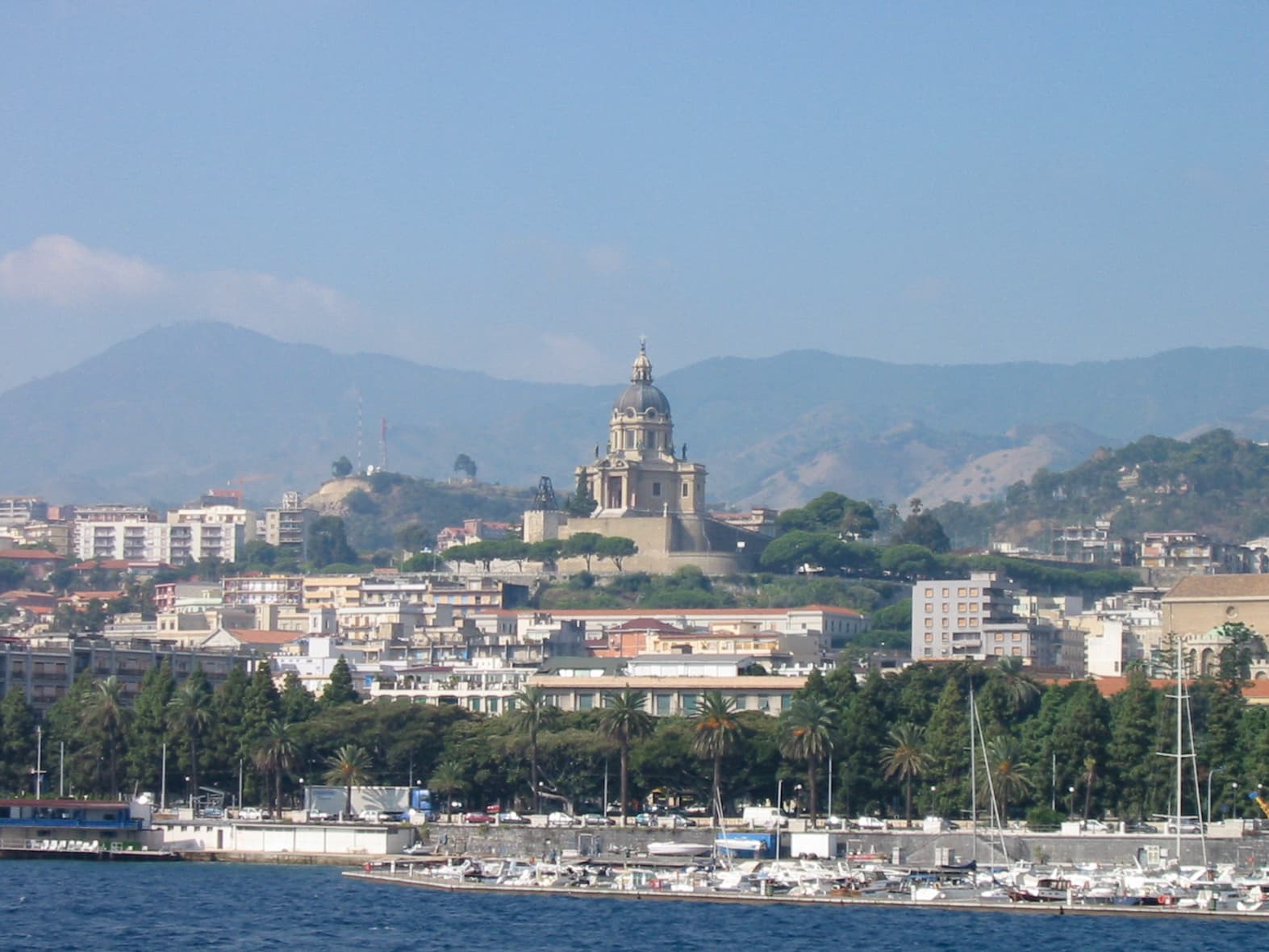 Alexander Hoernigk / CC BY 3.0, via Wikimedia Commons
“Where ancient myths meet resilient streets.”
Not the postcards. The stories even locals don't know — whispered in your ear, right where they happened.
The narrow stretch of water separating Sicily from mainland Italy holds a secret far older and more monstrous than any human conflict.
Every day at noon, a captivating spectacle unfolds in Piazza Duomo, a performance far more intricate than a simple chime.
This seemingly modest church, a survivor of Messina's tumultuous past, conceals layers of history literally beneath its feet.
Discover every secret of Messina
Every address, every reveal in full — in your ear, right where it happened.
You pick your stops. You walk. The voice reveals what the others miss.
No tours available yet. Check back soon — we're preparing them.
Messina, a port city on Sicily's northeastern tip, serves as a vital gateway between the island and mainland Italy, looking across the strait that shares its name towards Calabria. Originally founded as "Zancle" by Greek colonists in the 8th century BCE, a name reflecting its scythe-shaped natural harbor, Messina's strategic location has made it a crossroads of cultures and stories. Despite a history marked by seismic events and conflicts, including devastating earthquakes in 1783 and 1908, the city has repeatedly rebuilt, blending ancient remnants with modern vitality.
While often overshadowed by other Sicilian destinations like Taormina or Palermo, Messina offers a laid-back allure, with uncrowded sights and a pace that invites leisurely exploration. Visitors arriving by ferry, including some of Europe's last remaining train-ferries, experience an old-fashioned sense of arrival. The city's resilience is palpable in its architecture, which showcases a mix of Norman, Byzantine, Arab, and Renaissance influences, a testament to its diverse past.
Messina's story began in the 8th century BCE when Greek colonists established a settlement they called Zancle, a name inspired by the sickle-like shape of its natural harbor. Its strategic position at the Strait of Messina quickly made it a significant center for trade and commerce in the ancient Mediterranean. Over the centuries, Messina became a prize for various powers, experiencing periods under Greek, Carthaginian, Roman, Goth, Byzantine, and Arab rule.
In 264 BCE, Messina allied with the Romans, a pivotal moment that led to Roman intervention and the First Punic War, after which Messina became a free city and an ally of Rome. The city flourished under Roman rule, with the construction of aqueducts, theaters, and public baths. The Normans liberated Messina in 1061, ushering in a period of prosperity as a commercial and cultural hub, leaving a legacy of impressive fortifications and churches, including the original Messina Cathedral.
Messina reached the height of its prosperity between the late Middle Ages and the mid-17th century, even competing with Palermo for the role of capital of the Kingdom of Sicily. However, this period of prominence was followed by decline, marked by an anti-Spanish revolt in 1678 and subsequent devastation. The city faced further catastrophes with major earthquakes in 1783 and, most notably, on December 28, 1908. The 1908 earthquake, with a magnitude of 7.1, nearly leveled Messina and the neighboring city of Reggio Calabria, causing an estimated 80,000 to 120,000 deaths and triggering a tsunami with waves up to 40 feet high. Much of the city was destroyed, including its Norman cathedral, which had to be largely rebuilt. Despite these ravages, Messina was rebuilt in a modern style, incorporating Art Deco elements, and has since recovered, maintaining its role as a significant port and a city of enduring resilience.
A visit to Messina often begins at the Piazza del Duomo, the city's ceremonial heart. Here stands the Messina Cathedral, a 12th-century Norman structure that has been rebuilt multiple times after earthquakes. Inside, you'll find intricate mosaics and a vast polyphonic organ. Adjacent to the cathedral is its iconic Bell Tower, home to the world's largest astronomical clock. Arrive just before noon to witness the elaborate 12-minute mechanical show, where gilded bronze figures enact historical and religious scenes to the sound of Schubert's Ave Maria. Also in the Piazza del Duomo is the exquisite Fontana di Orione, a 16th-century Renaissance fountain crafted by Montorsoli, a student of Michelangelo.
Another significant architectural survivor is the Church of the Santissima Annunziata dei Catalani. This striking church, dating from the 12th century, showcases a blend of Byzantine, Arab, and Norman influences and is notable for its sunken position, marking the pre-1908 earthquake street level. For art enthusiasts, the Messina Regional Museum (Museo Regionale) houses a collection of medieval, Renaissance, and Baroque art, including works by Caravaggio. For sweeping views of the city and the Strait of Messina, consider visiting the Shrine of Christ the King (Sacrario di Cristo Re) or the Santuario di Montalto.
Messina enjoys a Mediterranean climate, making it a year-round destination. For warm and sunny weather ideal for beach activities, late spring and summer (mid-June to mid-September) are best, though temperatures can be hot, averaging 75°F to 87°F in August. Shoulder months like June, September, and October offer pleasant temperatures (68°F to 77°F) with fewer crowds, perfect for exploring historical sites. Autumn brings mild temperatures and a chance of rain, while winters are cool and rainy but offer fewer tourists and lower costs.
Messina is a city that invites exploration on foot, especially its historic center. The central train station is conveniently located near the waterfront, providing a good starting point for navigating the city. Trams and local buses are available for longer distances, connecting major cultural sights like the Duomo and the Regional Museum. Taxis are also an option, though they can be more expensive. If you're arriving by cruise, the port is close to the city center, allowing easy access to many attractions. For those driving, be aware that narrow streets and local traffic can make navigation challenging. Ferries from Villa San Giovanni or Reggio Calabria on the mainland are a common way to reach Messina.