Roman Theatre
The Roman Theatre in Mérida is not merely an ancient ruin; it holds a secret that gave rise to a local legend for centuries.
Full story unlocks in the tour
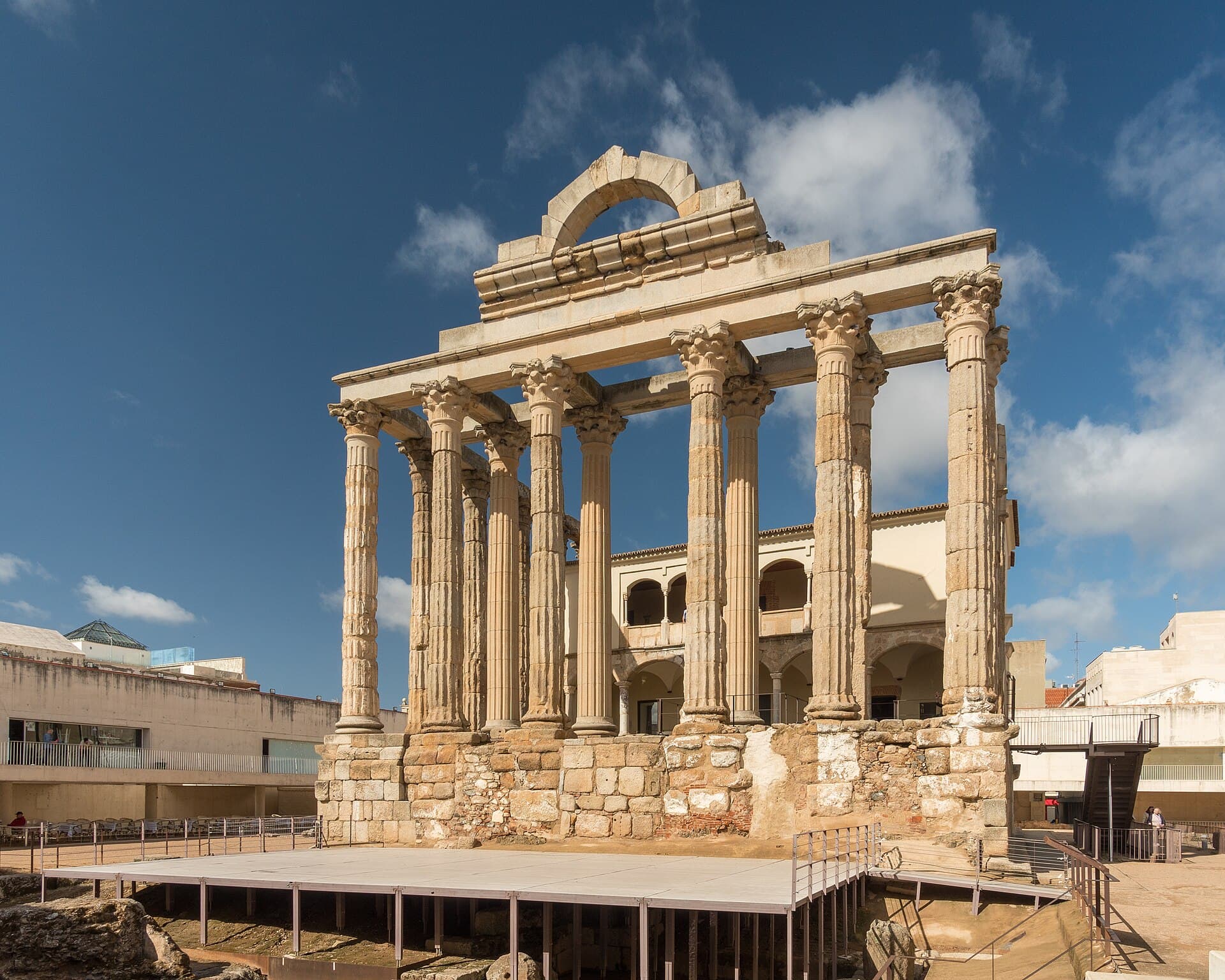 Fernando / CC BY-SA 4.0, via Wikimedia Commons
“Where Roman grandeur echoes through every stone.”
Not the postcards. The stories even locals don't know — whispered in your ear, right where they happened.
The Roman Theatre in Mérida is not merely an ancient ruin; it holds a secret that gave rise to a local legend for centuries.
The Temple of Diana, a prominent Roman structure in Mérida, is not actually dedicated to the goddess whose name it bears.
Mérida's Roman Bridge is an engineering marvel that has stood for two millennia, but it has a unique structural detail that speaks to its enduring resilience.
Discover every secret of Mérida
Every address, every reveal in full — in your ear, right where it happened.
You pick your stops. You walk. The voice reveals what the others miss.
No tours available yet. Check back soon — we're preparing them.
Mérida, the capital of Spain's Extremadura region, is a city where the past is not merely preserved but actively lives and breathes. Founded in 25 BCE as Emerita Augusta by Emperor Augustus, it served as a retirement settlement for Roman soldiers and quickly became one of the most important cities in Roman Hispania, even surpassing Athens in significance at one point. Today, Mérida offers an extraordinary collection of Roman ruins, so extensive and well-preserved that the entire archaeological ensemble was designated a UNESCO World Heritage site in 1993.
Walking through Mérida is akin to stepping directly into the Roman Empire, with ancient monuments integrated into the urban fabric. Beyond its Roman heritage, Mérida's story also includes periods of Visigothic and Moorish rule, leaving behind a layered history that is visible in its architecture and streetscapes. From the grandeur of its theatre and amphitheatre to the enduring strength of its bridges and aqueducts, Mérida offers a profound journey through time, revealing the daily life, entertainment, and engineering prowess of ancient civilizations.
Mérida's origins trace back to 25 BCE when it was established as Augusta Emerita by Emperor Augustus. The city was intended as a place of retirement for veteran soldiers (emeritii) from the Roman legions who had fought in the Cantabrian Wars. Its strategic location on the Guadiana River and along the Vía de la Plata, a crucial Roman route, quickly elevated its status. Emerita Augusta became the capital of the Roman province of Lusitania, encompassing much of modern-day Portugal, and grew into a major economic, military, and cultural center, considered one of the most flourishing cities of its time.
After the decline of the Western Roman Empire in the 5th century, Mérida continued to hold importance under Visigothic rule, even serving as the capital of their kingdom for a period. In 713 CE, the city was conquered by the Umayyad Caliphate under Musa ibn Nusayr, marking the beginning of Moorish influence. The Moors fortified the city, notably enlarging the Alcazaba, a citadel built upon existing Roman structures, to control access across the Roman bridge. This period lasted for over 500 years until King Alfonso IX of León recaptured Mérida in 1230 during the Reconquista.
The city experienced a slow recovery after the Reconquista, with its political and economic resurgence beginning more prominently during the reign of the Catholic Monarchs. In the 18th century, it became the capital of the Intendencia de Mérida. While the French invasion in the early 19th century led to the destruction of some historical heritage, Mérida eventually recovered. In modern times, Mérida was designated the capital of the autonomous community of Extremadura in 1983, re-establishing its role as a significant administrative, economic, and cultural hub.
Mérida's archaeological sites offer a comprehensive look into Roman life. The Roman Theatre and Amphitheatre Complex is a highlight; the theatre, commissioned by Marcus Vipsanius Agrippa and inaugurated around 15–16 BCE, could seat approximately 6,000 spectators and still hosts the International Classical Theatre Festival. Next to it, the Roman Amphitheatre, completed in 8 BCE, held about 15,000 people for gladiatorial contests and beast hunts. Nearby, the House of the Amphitheatre provides a glimpse into a wealthy Roman residence with preserved mosaics and wall paintings.
The Roman Bridge (Puente Romano), built around 25 BCE, is nearly 800 meters long with 60 arches, making it the longest surviving Roman bridge in the world. Adjacent to the bridge is the Alcazaba, an 9th-century Moorish fortress built on Roman foundations, offering views of the river and bridge. The Temple of Diana, dating from the 1st century CE, is a well-preserved Corinthian temple that once stood in the city's forum. Do not miss the Roman Circus, one of the best-preserved circuses of the Roman Empire, measuring over 400 meters long and capable of seating 30,000 spectators for chariot races. Finally, the National Museum of Roman Art, designed by Rafael Moneo, houses an extensive collection of Roman artifacts, mosaics, and sculptures found in Mérida.
Mérida experiences extreme temperatures, with hot summers often reaching 40°C (104°F) or more, and mild winters. The best times to visit are during the shoulder seasons: March to June or September to October. During these months, the weather is pleasant for exploring the outdoor archaeological sites. Visiting in July and August can be very hot, though the city is less crowded on weekends as locals head to the coast. Consider aligning your trip with local festivals, such as the International Classical Theatre Festival in July and August, or Semana Santa (Holy Week).
Mérida is a compact city, and most major attractions are within walking distance of each other, making it ideal for exploration on foot. If you are arriving by car, parking is available, with options like Parking Cervantes being centrally located. Mérida is well-connected by road to cities like Madrid, Seville, and Lisbon, and also accessible by train and bus. The train station is about a 10-minute walk from the Roman Theatre, and the bus station is approximately 15 minutes from the city center.
To make the most of your visit, consider purchasing a global ticket, which offers access to multiple ancient sites at a reduced price. Tourist information centers, such as those at the Roman Theatre and Puerta de la Villa, can provide up-to-date information on opening times and any temporary changes. Allow at least two full days to comfortably explore the main Roman ruins and the National Museum of Roman Art.