Kordopulov House wine cellar
Beneath a grand 18th-century merchant's home, a network of tunnels extends deep into the earth.
Full story unlocks in the tour
 Κλέαρχος Π. Καπούτσης Original uploader was Klearchoskapoutsis at el.wikipedia / CC BY-SA 2.5, via Wikimedia Commons
“Where ancient stones meet the scent of old vines.”
Not the postcards. The stories even locals don't know — whispered in your ear, right where they happened.
Beneath a grand 18th-century merchant's home, a network of tunnels extends deep into the earth.
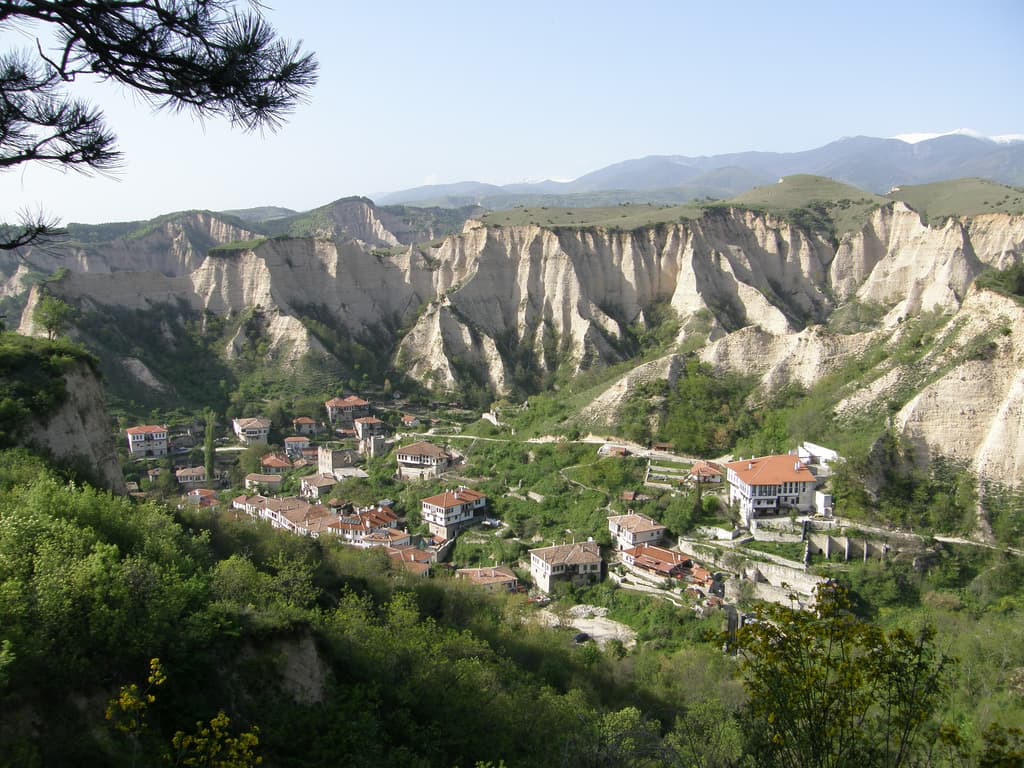
These geological formations, some reaching 100 meters, look like something from another planet.
Among Melnik's many historic churches, one stands apart, not for its biblical scenes, but for its tranquil imagery.
Discover every secret of Melnik
Every address, every reveal in full — in your ear, right where it happened.
You pick your stops. You walk. The voice reveals what the others miss.
No tours available yet. Check back soon — we're preparing them.
Melnik, Bulgaria's smallest town, holds a disproportionately large allure. With a permanent population of around 200-400 people, its status as a town is maintained largely for historical reasons, a nod to its deep past. Situated in the southwestern Pirin Mountains, near the Greek border, Melnik is an architectural reserve, with 96 of its buildings designated as cultural monuments. The town's singular character is defined by its traditional stone houses, well-worn streets, and the dramatic backdrop of the Melnik Earth Pyramids—unusual natural sandstone formations that resemble giant mushrooms and ancient towers.
Beyond its striking landscape, Melnik is celebrated for its winemaking tradition, which dates back to at least 1346. The local Broad-Leaved Melnik Vine produces a distinctive red wine, reportedly a favorite of Winston Churchill, who is said to have ordered 500 liters annually. A visit here offers a journey through centuries of human endeavor, a taste of exceptional wine, and a chance to experience a slower pace of life amidst captivating natural beauty.
Melnik's origins stretch back to the Thracian tribe Medi, from which the legendary rebel Spartacus is believed to have originated. Later, Romans settled the area, leaving behind an ancient Roman bridge that still stands today. The Slavs, who subsequently inhabited the territory, named the settlement "Melnik" after the surrounding sand formations, deriving the name from the Slavic word "mel," meaning white clay or crayon.
The first written evidence of the Melnik Fortress dates to the early 11th century. In 1215, Melnik became the capital of an independent feudal principality under Despot Alexius Slav, a period that saw significant economic and cultural prosperity. The town continued to flourish under Tsar Ivan Asen II, benefiting from duty-free trade with Dubrovnik.
The Ottoman conquest in the 14th-15th century led to a period of decline, but Melnik experienced a revival in the 17th and 18th centuries during the Bulgarian National Revival. During this time, it became a thriving administrative and trade center, known for tobacco and wine production, with wine exported to places like Budapest, Vienna, Genoa, and Venice. At its peak in the late 18th century, Melnik was home to an estimated 7,000 to 20,000 people, with about 1,300 residential buildings and seventy churches. Many Bulgarian schools and churches were built during this era, and Melnik was also known for its large library.
However, tragedy struck during the Balkan Wars (1912-1913), when much of Melnik was razed by fire, and its population significantly dwindled as many inhabitants moved to Greece after the town became part of Bulgaria. Despite this, Melnik was declared a museum-town in 1968, preserving its unique architectural heritage. Today, nearly 100 of its buildings are designated historic landmarks, reflecting its storied past.
The town's history is visible in its surviving structures, from the ruins of Despot Alexius Slav's fortress to the impressive Kordopulov House, a large 18th-century mansion that exemplifies Bulgarian National Revival architecture. The Byzantine House, dating from the 13th century and once part of Despot Alexius Slav's residence, is one of the oldest surviving buildings on the Balkan Peninsula, though only partially preserved. Melnik's enduring legacy lies in its ability to transport visitors back in time, offering a tangible connection to the Thracians, Romans, Byzantines, and Bulgarians who shaped its singular identity.
Begin your exploration at the Kordopulov House, Bulgaria's largest Revival-style mansion, built in 1754 by a wealthy Greek wine merchant. Explore its grand rooms, adorned with stained glass and intricate wood carvings, before descending into its vast underground wine cellar, carved into the rock. A wine tasting here offers a glimpse into Melnik's winemaking heritage.
Just outside town, the Melnik Earth Pyramids are a striking natural phenomenon. These sandstone formations, sculpted by erosion, create a surreal landscape of giant mushrooms, obelisks, and ancient towers. Hike the trails that wind through these pyramids for expansive views, especially the path leading to Rozhen Monastery.
Six kilometers northeast of Melnik, the Rozhen Monastery is the largest Orthodox monastery in the Pirin region. This well-preserved medieval complex features beautiful frescoes, intricate wood carvings, and a miraculous icon of the Virgin Mary. The monastery's holiday on September 8th draws crowds from the entire region.
Other notable sites include the ruins of the Metropolitan's Church of St. Nikola, a 13th-century Byzantine church, and the Church of St. Antony, unique for its floral interior paintings. The Melnik Wine Museum offers further insight into the region's viticulture, showcasing the winemaking cycle and a vault of 400 wine types.
Melnik is most enjoyable in spring (April to June) and early autumn (September to early October), when temperatures are mild and pleasant for walking and exploring. During these months, daytime temperatures typically range from 16°C to 29°C. Autumn is particularly lively, coinciding with the grape harvest season, which brings wine tastings and festivals. Summers (July and August) can be warm, with average highs around 29°C, and attract more tourists. Winters are cooler, with average highs of 6°C in January, but still manageable for indoor attractions.
Melnik is located in southwestern Bulgaria, about 175-180 km north of Sofia and only 30 km from the Greek border. The easiest way to reach Melnik is by car, with the drive from Sofia taking approximately 2.5 to 3 hours. There is also a daily bus service from Sofia to Melnik, which takes around 4 hours. Alternatively, you can take a bus from Sofia to Sandanski, and then a taxi or local bus to Melnik.
Accommodation options in Melnik range from cozy guesthouses to boutique hotels, many reflecting traditional Bulgarian architecture. Popular choices include Guest House Holiday in Melnik, Hotel Slavova Krepost, and Zornitza Family Estate Relais & Chateaux. While many establishments accept cards, it's advisable to carry some small cash for artisans and smaller wineries. Comfortable walking shoes are recommended for navigating the town's well-worn streets and the paths around the Melnik Pyramids.