Melk Abbey Library
Beyond the rows of ancient tomes and gilded shelves, a secret staircase leads to a part of the library few visitors ever see.
Full story unlocks in the tour
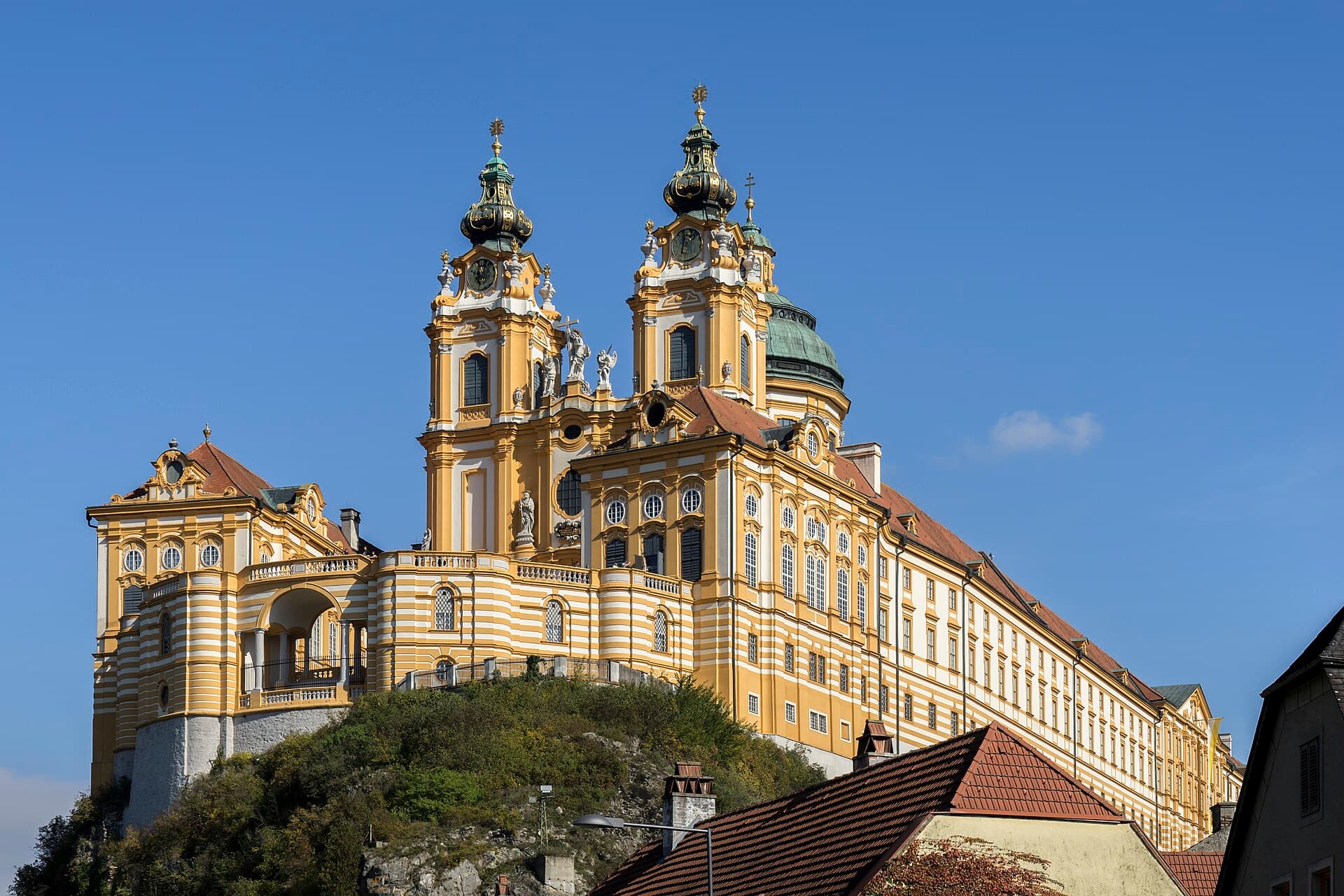 Thomas Ledl / CC BY-SA 4.0, via Wikimedia Commons
“Where Baroque grandeur meets Danube tranquility.”
Not the postcards. The stories even locals don't know — whispered in your ear, right where they happened.
Beyond the rows of ancient tomes and gilded shelves, a secret staircase leads to a part of the library few visitors ever see.
The opulent Marble Hall appears to have a dramatically curved, domed ceiling, but a closer look reveals a masterful deception.
The striking 'Schönbrunn Yellow' facade of Melk Abbey holds a surprising secret about its sheer scale, often overlooked by the casual observer.
Discover every secret of Melk
Every address, every reveal in full — in your ear, right where it happened.
You pick your stops. You walk. The voice reveals what the others miss.
No tours available yet. Check back soon — we're preparing them.
Melk, Austria, is a town where history and natural beauty intertwine, most famously recognized as the gateway to the UNESCO-listed Wachau Valley. Dominated by the magnificent Melk Abbey, the town offers a serene setting along the Danube River. Beyond its iconic landmark, Melk provides a charming pedestrianized medieval center, inviting visitors to wander its ancient streets and discover local delights.
This historic hamlet draws visitors with its picturesque core and the allure of the surrounding countryside, characterized by vineyards, tranquil trails, and forests. Whether arriving by river cruise or exploring on foot, Melk presents a blend of cultural immersion and opportunities to savor Austrian country life.
The story of Melk Abbey begins in 1089 when Leopold II, Margrave of Austria, gifted one of his castles to Benedictine monks from Lambach Abbey. This act established a continuous monastic presence in Melk for over 900 years. The site, originally a castle residence of the Babenbergs (Austria's first ruling dynasty from 976 to 1101), was transformed into a fortified monastery.
In the 12th century, a monastic school, a precursor to the present-day Stiftsgymnasium Melk, was founded. The abbey's library quickly gained renown for its extensive collection and production of manuscripts, many of which included musical compositions. The 15th century saw Melk Abbey become the epicenter of the Melk Reform movement, a significant effort to revitalize monastic life across Austria and Southern Germany.
Despite its academic and spiritual prominence, the abbey faced numerous challenges. A fire in 1297 severely damaged the structures, though monks managed to save most of the invaluable manuscripts. Further damage occurred during the Turkish invasion of 1683. The Baroque abbey seen today was constructed between 1702 and 1736, designed by the architect Jakob Prandtauer. This extensive remodeling transformed the monastery into one of the most impressive Baroque ensembles north of the Alps.
The abbey continued to navigate historical upheavals, including threats during the Napoleonic Wars and confiscation by the state after the Anschluss in 1938. Its reputation as an academic institution, however, helped it escape dissolution under Emperor Joseph II in the late 18th century, a fate many other Austrian abbeys did not avoid. A more recent fire in 1974 marred ornamented rooms and damaged the interior, leading to a comprehensive restoration project from 1978 to 1995, which involved using eight pounds of gold bullion to restore statues and altars. Today, Melk Abbey remains a lively center for culture, education, and spirituality, housing Austria's oldest continuously operating school.
The undisputed highlight of Melk is the Benedictine Melk Abbey, an opulent Baroque structure overlooking the Danube. Begin your visit in the Prelate's Courtyard, surrounded by imposing buildings and statues of prophets. From here, the grand Imperial Staircase leads to the Imperial Wing, which houses the abbey's museum. The museum's exhibition, "On the way from yesterday to today," utilizes multimedia and art installations to narrate the monastery's 900-year history.
Continue to the Marble Hall, a spectacular room once used for receptions. Its highlight is the ceiling mural by Paul Troger, which creates an optical illusion of a vaulted dome. The Abbey Library is another striking space, with high, dark shelves, a magnificent ceiling fresco, and tens of thousands of volumes, including precious manuscripts. Photography is generally prohibited inside to preserve these delicate materials. The Abbey Church, considered one of the finest Baroque churches north of the Alps, dazzles with gold, stucco marble, and frescoes by Johann Michael Rottmayr and Paul Troger.
Outside the main abbey buildings, explore the Abbey Park and Gardens, opened to the public in 2000. These gardens offer a blend of formal English gardens and whimsical elements, including a Baroque pavilion with frescoes of exotic animals. From various points within the abbey and its grounds, you can enjoy panoramic views of the Danube River and the Wachau Valley.
The best time to visit Melk for pleasant weather and outdoor activities is from mid-June to early September, with a peak in the second week of August. During these months, temperatures are warm, ranging from 65°F to 80°F, and there's minimal chance of rain. July and August also coincide with the Wachau's apricot harvest, while the wine harvest typically begins in mid-September. For those preferring a winter visit, Melk is particularly enchanting in the lead-up to Christmas, with the Schallaburg Castle hosting a Christmas market. The abbey is open year-round, though winter (November to March) may have shorter hours and guided tours as the primary option for interior access.
Melk is easily accessible, making it a popular day trip destination. From Vienna, you can reach Melk by train, with services typically departing three or four times an hour. The walk from Melk station to the abbey is approximately ten minutes, mostly uphill. Alternatively, many visitors opt for a Danube River cruise, which often includes Melk as a stop. Combination tickets that include train travel, abbey entrance, and a river cruise are also available.
When visiting the abbey, plan to spend at least two hours exploring its various sections. While guided tours are offered, self-guided visits are also possible at certain times. Comfortable shoes are recommended for walking around the town and the extensive abbey complex. Photography is generally not allowed inside the abbey's historic rooms, particularly the library and church. The abbey has a large, free car park for ticket holders.