Bab Mansour Gate
The most celebrated gate in Morocco bears an inscription that frankly, brags a little. But there's a darker, more human story behind its creation.
Full story unlocks in the tour
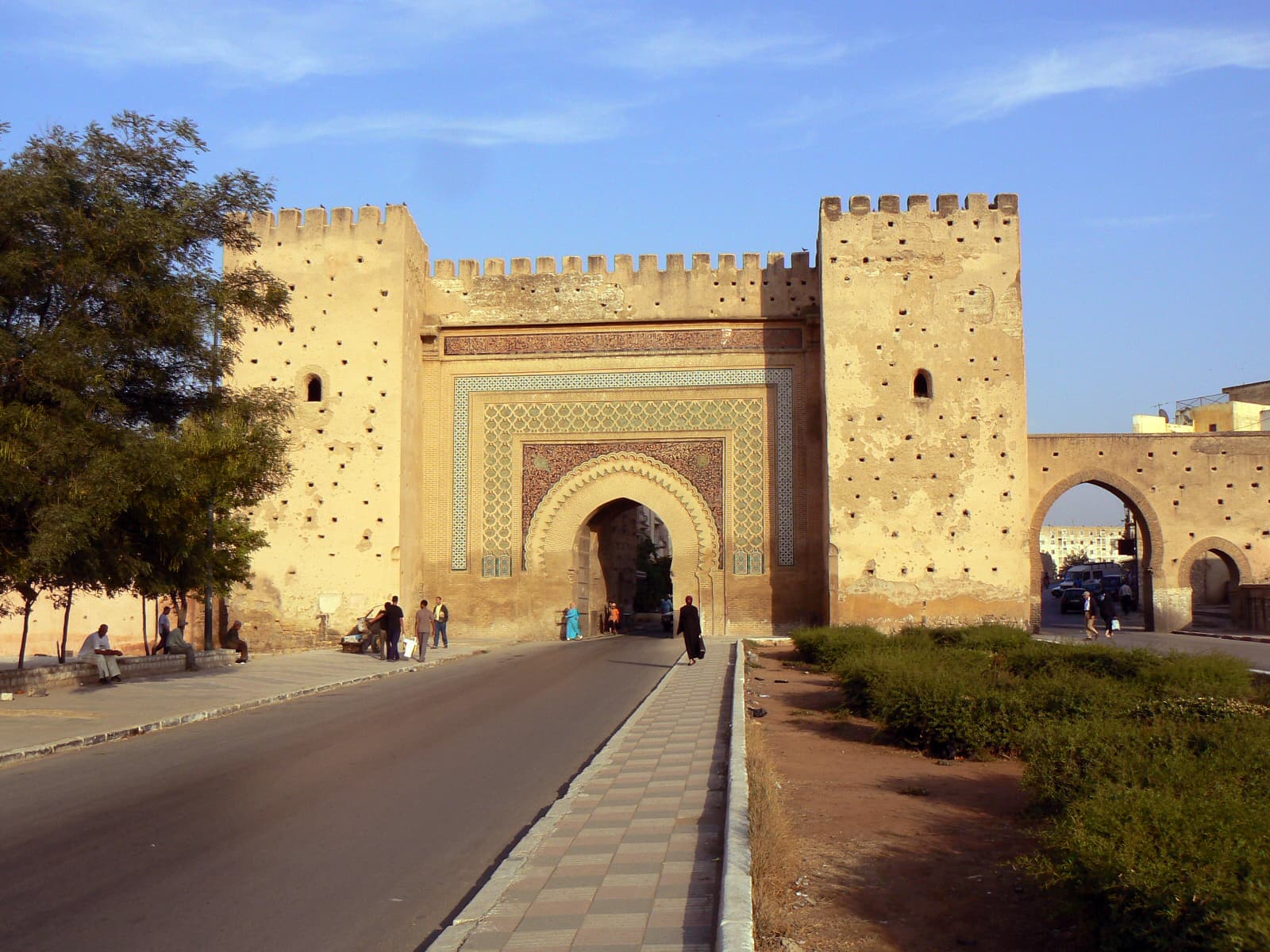 Verox66 / CC BY-SA 3.0, via Wikimedia Commons
“Meknès: Where imperial ambition carved a city from earth and legend.”
Not the postcards. The stories even locals don't know — whispered in your ear, right where they happened.
The most celebrated gate in Morocco bears an inscription that frankly, brags a little. But there's a darker, more human story behind its creation.
Beneath the soaring arches of what appear to be vast stables, a subtle engineering marvel kept an entire imperial city provisioned.
An unassuming square in Meknès conceals a chilling secret beneath its surface, a subterranean labyrinth of immense scale.
Discover every secret of Meknès
Every address, every reveal in full — in your ear, right where it happened.
You pick your stops. You walk. The voice reveals what the others miss.
No tours available yet. Check back soon — we're preparing them.
Meknès, one of Morocco's four imperial cities, often finds itself in the shadows of its more famous siblings, Fès and Marrakech. Yet, this city offers a distinct blend of historical grandeur and authentic Moroccan life, less touched by the relentless pace of mass tourism. Its monumental gates, expansive royal complex, and a medina that feels genuinely lived-in, not merely performed for visitors, provide a compelling experience for those who seek to delve deeper into the country's past.
Designated a UNESCO World Heritage site, Meknès unfolds a narrative of ambition and power, primarily under the reign of Sultan Moulay Ismail in the 17th and 18th centuries. He transformed a modest settlement into a formidable capital, earning it the moniker 'the Versailles of Morocco.' From the intricate tilework of its gateways to the colossal scale of its granaries, Meknès invites exploration at a more leisurely rhythm, revealing its secrets to those who linger.
The origins of Meknès trace back to the 10th century with the Miknasa, a Berber tribe who established a series of fortified settlements near the ancient Roman city of Volubilis. In the 11th century, the Almoravids arrived, building a fortress that laid the groundwork for the city, initially known as Tagrart. Over the following centuries, under the Almohads and Marinids, Meknès saw its medina expand and early monuments constructed.
The city's golden age, however, dawned in the late 17th century with the ascent of Sultan Moulay Ismail. After his brother, Moulay Rashid, the first Alaouite sultan to unite Morocco, died in 1672, Moulay Ismail chose Meknès as his new capital. His reign, lasting 55 years (1672–1727), was the longest of any Moroccan monarch and marked a period of immense construction and transformation. He envisioned a city that would rival the splendor of Versailles, leading to the creation of a vast imperial palace complex and extensive fortifications, some ramparts reaching 15 meters in height. He employed an army of loyal Black Guard soldiers and, according to some accounts, fathered over 800 children. His ambitious projects, though never fully completed, left an indelible architectural legacy.
Following Moulay Ismail's death, Meknès's prominence waned. The capital was moved back to Fès, and the city experienced a period of decline, exacerbated by the devastating Lisbon earthquake of 1755, which caused significant damage. Despite this, subsequent rulers, like Sultan Muhammad ibn Abdallah in the late 18th century, undertook renovation and construction projects, including the Dar al-Bayda Palace and the Er-Roua Mosque. Under the French Protectorate in 1912, Meknès regained some importance as a military headquarters, and a new 'Ville Nouvelle' was developed. In 1996, the historic city of Meknès was inscribed as a UNESCO World Heritage Site, recognized for its monumental ramparts and its unique blend of Islamic and European architectural and planning elements.
Begin your exploration at Place el-Hedim, the central square that serves as a smaller, more relaxed version of Marrakech's Djemaa el-Fna. Facing the square is the monumental Bab Mansour Gate, considered one of Morocco's most beautiful gates, adorned with intricate green and white zellij tiles and marble pillars reportedly repurposed from Volubilis.
Beyond the gate lies the imperial city. Visit the Mausoleum of Moulay Ismail, the lavish resting place of the sultan who made Meknès his capital. Non-Muslims are permitted to enter certain courtyards, offering a glimpse into its detailed Moroccan craftsmanship. Nearby, explore the vast, vaulted chambers of Heri es-Souani, the royal granaries and stables that once housed thousands of horses and stored provisions for the imperial army.
For a deeper dive into the city's past, consider a day trip to the ancient Roman ruins of Volubilis, a UNESCO World Heritage site just 30 kilometers away, known for its well-preserved mosaics and the Arch of Caracalla. Combine this with a visit to the holy town of Moulay Idriss Zerhoun, a significant pilgrimage site.
The most pleasant times to visit Meknès are during spring (March to May) and autumn (September to November). Temperatures are mild and comfortable for exploring, though spring can see some rain, particularly in April. May and June offer warm, sunny weather, ideal for outdoor activities. Summers (June to August) can be hot, with temperatures sometimes reaching 30-40°C (86-104°F), which might be less comfortable for some travelers. Winters (December to February) are cooler, especially at night, but can be a good option for avoiding crowds if you don't mind the chill.
Meknès is well-connected by train, with two stations: Gare de Meknès-Amir Abdelkader, closer to the medina, and Gare Meknès-Ville. Trains offer convenient access from major Moroccan cities like Fès (about an hour away), Rabat (two hours), and Casablanca (three hours). Grand taxis are also a common mode of transport, arriving and departing from various points, including near the Amir Abdelkader train station.
Within the city, walking is ideal for exploring the medina. For longer distances, small taxis are readily available. When shopping in the souks, particularly for Meknès's specialty, silver damascene, bargaining is expected. The city offers a more relaxed shopping experience compared to other imperial cities. Dress modestly, especially in the medina and around religious sites, and wear comfortable shoes for navigating uneven streets.