Frauenkirche (Church of Our Lady)
The bells of Frauenkirche do not ring with a typical bronze clang.
Full story unlocks in the tour
 Avda / CC BY-SA 3.0, via Wikimedia Commons
“Where 'white gold' was forged, and history resonates through ancient lanes.”
Not the postcards. The stories even locals don't know — whispered in your ear, right where they happened.
The bells of Frauenkirche do not ring with a typical bronze clang.
Germany's most ancient residential castle held a closely guarded secret for over a century, transforming its grand halls into something far more industrial.
The iconic crossed swords mark of Meissen porcelain is more than just a logo.
Discover every secret of Meissen
Every address, every reveal in full — in your ear, right where it happened.
You pick your stops. You walk. The voice reveals what the others miss.
No tours available yet. Check back soon — we're preparing them.
Meissen, a beautiful town on the Elbe River in Saxony, Germany, is a place where medieval allure and groundbreaking craftsmanship intertwine. With its commanding castle and cathedral rising above the river, the town offers a compelling blend of history, art, and natural splendor. Meissen is globally recognized as the origin of European hard-paste porcelain, a secret uncovered here in the early 18th century that forever altered the course of European decorative arts.
Beyond its 'white gold' legacy, Meissen invites exploration through its ancient town, where colorful gabled houses and a lively market square create a captivating atmosphere. The town is also part of the Saxon Wine Route, with vineyards tracing the Elbe valley, offering opportunities to taste local wines. Whether you are drawn to its architectural marvels, the intricate art of porcelain, or the relaxed pace of a riverside town, Meissen provides a memorable glimpse into Saxon heritage.
## From Slavic Settlement to Saxon Stronghold Meissen's origins trace back to a Slavic settlement known as Misni. The town's German beginning commenced in 929 AD when King Henry I the Fowler established a fortress on a rock overlooking the Elbe River. This strategic location quickly solidified Meissen as a significant center, becoming the seat of the Margraviate of Meissen in 968 and a bishopric in the same year. The House of Wettin, a powerful dynasty, gained control of the margraviate in 1089, laying the foundation for their centuries-long rule over Saxony.
Meissen received its town charter in 1205, affirming its role as a stronghold of German colonization in the Slavic lands east of the Elbe. Construction of the Gothic Meissen Cathedral began around 1250, adjacent to the castle, a testament to the town's increasing importance. In 1423, Meissen briefly served as the capital of the Electorate of Saxony before the royal seat was transferred to Dresden in 1464. The magnificent Albrechtsburg Castle, considered Germany's first residential castle, was constructed between 1471 and 1524, displaying innovative late-Gothic architecture.
## The Dawn of European Porcelain Meissen's most transformative period arrived in the early 18th century. Until then, the secret of hard-paste porcelain was known only in China and Japan. Augustus the Strong, Elector of Saxony and King of Poland, driven by a passion for collecting Asian porcelain, tasked alchemist Johann Friedrich Böttger and scientist Ehrenfried Walther von Tschirnhaus with uncovering the elusive formula. In 1708, the breakthrough occurred, and in 1710, Augustus the Strong established Europe's first porcelain manufactory in Albrechtsburg Castle, marking the birth of Meissen porcelain. This discovery brought immense wealth and prestige to Meissen, making its exquisite pieces symbols of luxury across Europe.
## Modern Meissen After the porcelain factory moved to a larger location in 1863, Albrechtsburg Castle reopened as a museum in 1881, featuring monumental murals depicting Saxon history. Meissen largely survived World War II without damage, a rarity among German cities, preserving its medieval old town. Post-reunification in 1990, the city center underwent extensive renovation, reaffirming Meissen's status as a cultural and historical destination.
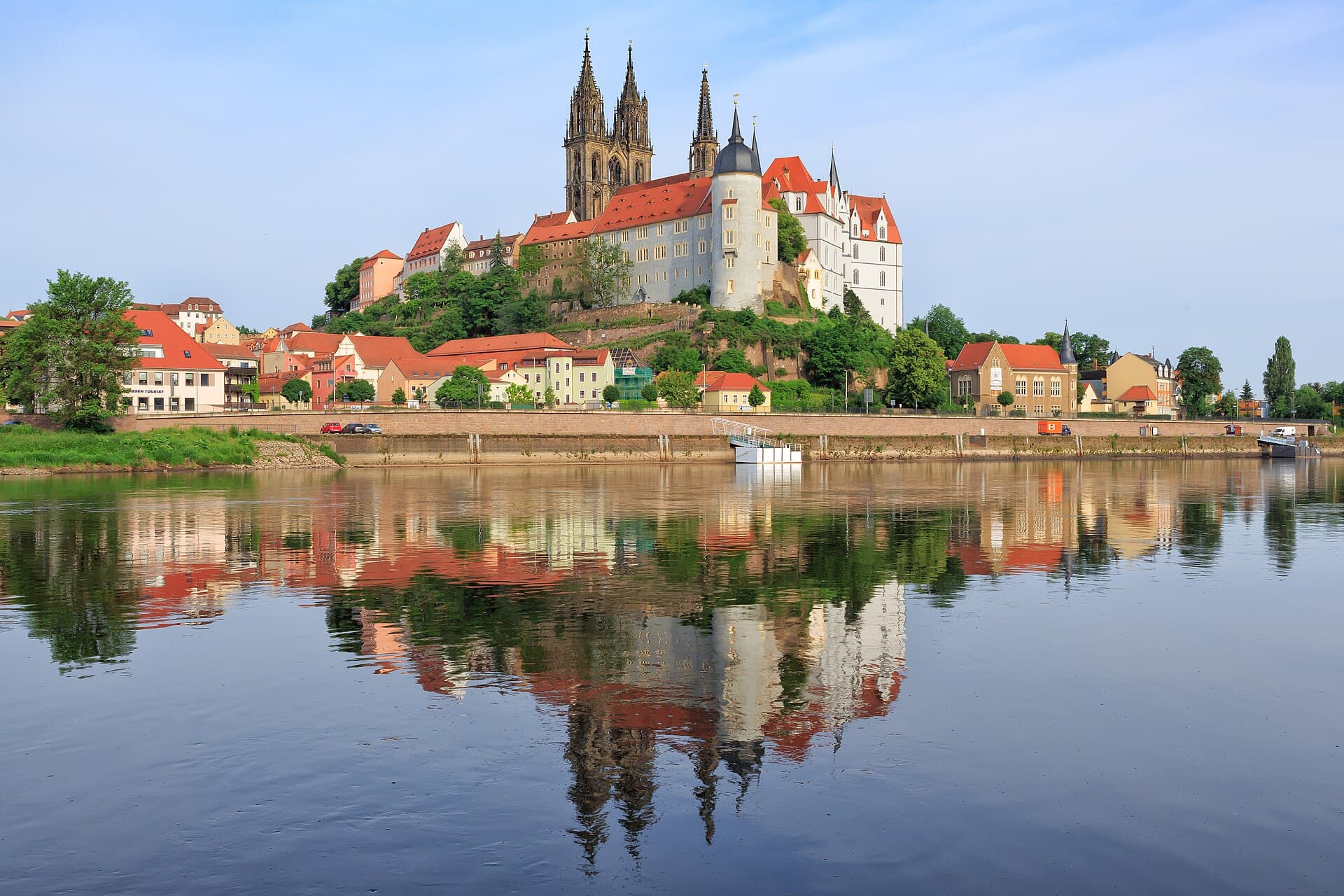
Begin your exploration on the Domplatz, the castle hill, where the imposing Albrechtsburg Castle and Meissen Cathedral stand side-by-side. Albrechtsburg, Germany's oldest residential castle, offers a journey through its late-Gothic architecture and its surprising past as Europe's first porcelain manufactory. Interactive exhibits, including a 'Histopad' tablet, allow you to visualize the castle's rooms in different historical periods. Next to it, the Meissen Cathedral, a masterpiece of Gothic architecture, features intricate grave plates, statues, and paintings by Lucas Cranach the Elder. Consider ascending its towers for sweeping views of the city and the Elbe Valley.
Descend to the Marktplatz (Market Square), the core of Meissen's Old Town, encircled by colorful townhouses and the Renaissance-era Town Hall. Here, you will find the Frauenkirche (Church of Our Lady), notable for its unique carillon crafted from Meissen porcelain bells that chime several times daily. An ascent up the Frauenkirche tower offers another excellent vantage point over the city. A visit to Meissen is incomplete without a pilgrimage to the Meissen Porcelain Manufactory and Museum. Tour the workshops to observe artisans shaping and hand-painting porcelain, and explore the museum's extensive collection spanning over 300 years of history. For a deeper immersion into local history, the Meissen City Museum, housed in a former Franciscan Monastery, displays unusual exhibits, including a large hand-operated wine press.
The most pleasant time to visit Meissen is during the warmer months, from May to September. During this period, temperatures are comfortable, typically ranging between 20°C and 25°C (68°F and 77°F), making it ideal for outdoor activities and exploring the town on foot. Spring and autumn also offer agreeable weather and the added benefit of local festivals, such as pottery and wine celebrations. July is the wettest month, while April is the driest. For those interested in wine, the vineyards are particularly inviting in spring and autumn.
Meissen is easily accessible, making it a popular day trip from Dresden, located about 25 kilometers away. You can take a direct S-Bahn train from Dresden's main station to Meissen-Altstadt, a journey of approximately 30-34 minutes, placing you within a short walk of the market square. Alternatively, a scenic Elbe River cruise from Dresden by paddle steamer offers a distinctive approach to the town.
Once in Meissen, the historic old town and major attractions are largely walkable, though the ascent to Albrechtsburg Castle and the Cathedral is steep. A panorama elevator is available for a small fee to take you up to Domplatz. If traveling by car, several highway exits lead to Meissen, and parking is available. For accommodation, Meissen offers a range of options, from charming hotels to guesthouses among the vineyards.