Malaspina Castle
The imposing Malaspina Castle holds a secret about a famous Renaissance artist.
Full story unlocks in the tour
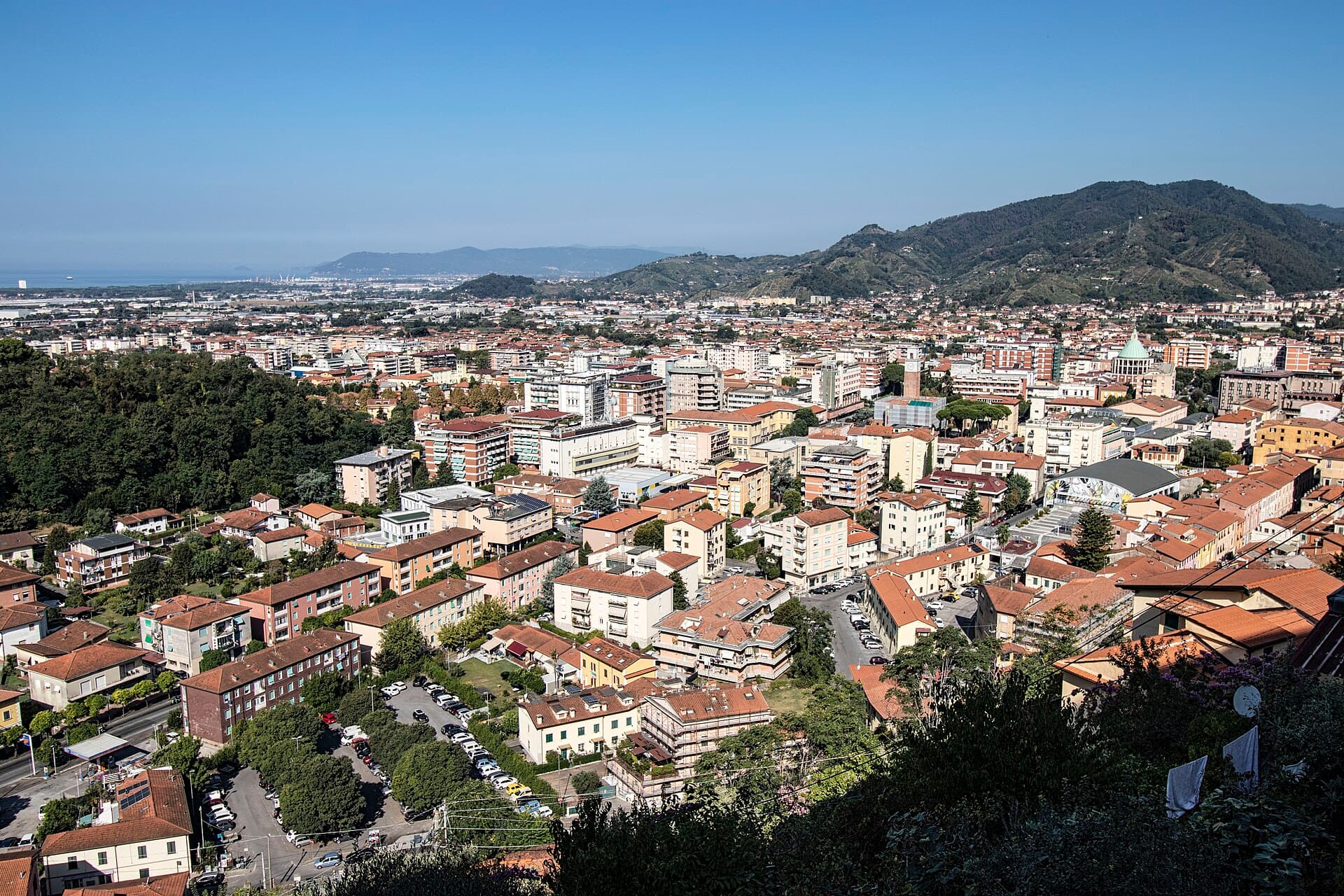 Sgado walter / CC BY-SA 4.0, via Wikimedia Commons
“Where the Apuan Alps meet the Tyrrhenian Sea, a Tuscan story unfolds.”
Not the postcards. The stories even locals don't know — whispered in your ear, right where they happened.
The imposing Malaspina Castle holds a secret about a famous Renaissance artist.
This square, ringed by fragrant orange trees, was once a canvas for a powerful woman's urban vision.
The city's magnificent Ducal Palace carries a colorful local nickname.
Discover every secret of Massa
Every address, every reveal in full — in your ear, right where it happened.
You pick your stops. You walk. The voice reveals what the others miss.
No tours available yet. Check back soon — we're preparing them.
Massa, the capital of the Massa-Carrara province in northern Tuscany, offers a unique blend of coastal charm and mountainous grandeur. Situated in the Frigido Valley, it lies at the foot of the Apuan Alps and just five kilometers from the Ligurian Sea. This strategic location provides access to both hiking trails in the mountains and relaxing beaches along the coast. The city, mentioned in historical documents as early as 882 AD, carries a distinct cultural identity, influenced by its position on the border with Liguria.
While not as widely known as some of Tuscany's more iconic destinations, Massa presents an authentic Italian experience, making it an appealing choice for travelers seeking to venture off the beaten path. Its historic center, though compact, invites exploration of its colorful buildings and lively squares. Beyond the city's immediate attractions, Massa serves as an excellent base for day trips to the Carrara marble quarries, the picturesque Cinque Terre, and the wilder areas of Lunigiana and Garfagnana.
The history of Massa traces its roots back to Roman times, with the presence of the Taberna Frigida station on the Via Aemilia Scauri. However, the city began to take shape as a proper settlement during the early Middle Ages, with its first official mention in 882 AD as "Massa Prope Frigidum," indicating its proximity to the Frigido river. Initially, the territory was under the influence of the Bishops of Luni before passing to noble Lombard families like the Obertenghi.
In 1421, Massa fell under the control of the Malaspina family, who would play a pivotal role in its development. The era of significant growth began in 1553 under Alberico I Cybo-Malaspina, who initiated a large-scale reconstruction and expansion of the city, leading to what was known as "Massa Nuova." In 1568, the holding was elevated to an Imperial Principality by Emperor Maximilian II, and by 1664, it gained the title of Duchy, solidifying the political power of the Cybo-Malaspina dynasty. This period established Massa as the capital of the independent Principate, and later Duchy, of Massa and Carrara, a status it maintained from the 15th to the 19th centuries.
During the early 19th century, the Napoleonic government under Elisa Bonaparte Baciocchi, Napoleon's sister, brought about significant urban transformations, including the construction of the current Piazza Aranci. Following the unification of Italy, Massa experienced further expansion in territory and trade, benefiting from its geographical location and the marble trade. The city also grew in prominence as a prestigious bathing center from the 1800s onwards, with Marina di Massa becoming a popular tourist destination. Massa's distinct history, separate from the direct influence of Florence and the Medici family, is largely due to its border location between Liguria and Emilia Romagna.
Begin your exploration in Massa's historic center, a compact area ideal for walking. The heart of the city is Piazza Aranci, a square framed by orange trees and dominated by a marble obelisk with four lion sculptures. Overlooking this piazza is the Palazzo Ducale, also known as the "Red Palace," which once served as the seat of state government and the residence of the Cybo-Malaspina family. A short walk from the center, on a hill, stands the Malaspina Castle (Rocca Malaspina), a 15th-century fortress offering wide views of the Tuscan coast and the Apuan Alps. The castle complex includes the old city within its medieval defense walls.
Another significant historical square is Piazza Mercurio, named for the statue of Mercury at its center, and known for its lively market on Tuesday mornings. The Duomo, Massa's cathedral, features a distinctive marble facade with six arches and an interior adorned with 17th-century paintings. For art enthusiasts, the Diocesan Museum of Sacred Art, housed in the historic Palazzino dei Cadetti, showcases a collection of religious artworks. If time allows, consider a visit to the Rifugio Antiaereo della Martana, a restored World War II air-raid shelter carved into the rock beneath the city center.
The best time to visit Massa for general outdoor activities and sightseeing is from late May to late September. During these months, the weather is pleasant, with average temperatures ranging from 19°C to 26°C. For beach activities and warmer water, early July to late August is ideal, with average water temperatures around 73°F to 77°F. While summers are warm, they are generally not excessively hot due to the sea breeze. Spring (mid-April to mid-June) and early autumn (September) also offer agreeable temperatures and fewer tourists, making them suitable for exploring. Winters are mild, providing a quieter experience for indoor attractions.
Massa is well-connected and accessible. The closest airport is Pisa International Airport (PSA), approximately 50 kilometers away, with Florence (FLR) and Genoa (GOA) also convenient options. From these airports, you can reach Massa by train or car. Massa Centro railway station is located within the city limits, with trains running on the Pisa-Genoa line. Local buses, operated by Autolinee Toscane, provide transport within the city and to Marina di Massa. Tickets for local buses should be purchased in advance at tobacco shops or newsstands and validated upon boarding.
Walking is a pleasant way to explore the historic center, which has wide sidewalks. However, for trips to the coast or surrounding areas, a car offers more flexibility. If driving, be aware that parking near the old town can be limited during peak season. Taxis are also available for convenient travel to airports, stations, or within the city. When visiting religious sites, remember to dress modestly, covering your shoulders and knees.