Fondation Pierre Gianadda
An art museum built around an ancient Roman temple sounds like a bold architectural statement.
Full story unlocks in the tour
 Christian David / CC BY-SA 4.0, via Wikimedia Commons
“Where Roman echoes meet Alpine grandeur, and St. Bernards roam.”
Not the postcards. The stories even locals don't know — whispered in your ear, right where they happened.
An art museum built around an ancient Roman temple sounds like a bold architectural statement.
This Roman amphitheater, dating back to the 2nd century, wasn't just for gladiatorial contests.
Driving through Martigny, you might notice something unusual about its traffic circles.
Discover every secret of Martigny
Every address, every reveal in full — in your ear, right where it happened.
You pick your stops. You walk. The voice reveals what the others miss.
No tours available yet. Check back soon — we're preparing them.
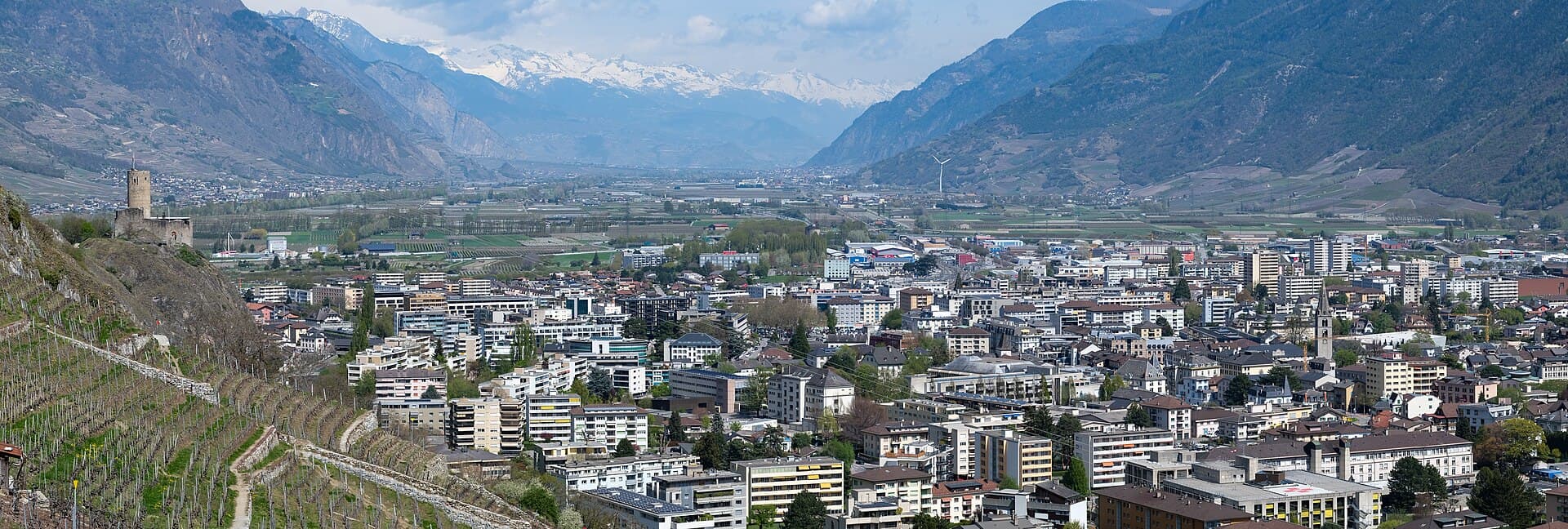
Martigny, a town of approximately 20,000 residents in the French-speaking Valais canton of Switzerland, holds a strategic position at the "elbow" of the Rhône River. It serves as a vital junction for routes connecting Italy, France, and Switzerland, historically controlling access to the Great St. Bernard, Simplon, and Forclaz passes. This location has shaped its history, economy, and culture, blending Roman heritage with Alpine character and a distinct Mediterranean flair.
Surrounded by vineyards and orchards, Martigny is celebrated for its gastronomy, benefiting from the warm Valais sunshine ideal for growing strawberries, apricots, and grapes. Beyond its culinary delights, the town offers a deep cultural-historical experience, evident in its Roman ruins, medieval castle, and world-class museums. Martigny is not just a transit point; it's a destination that invites exploration, from ancient archaeological sites to contemporary art exhibitions, all set against a backdrop of impressive mountain ranges.
## From Celtic Settlement to Roman Hub Martigny's history stretches back over two millennia, originating as Octodurus, the capital of the Celtic Veragri tribe. The first written records of the settlement date to the 1st century BC, a period when the Roman Empire began to expand its influence into these lands. A pivotal moment occurred in 47 AD when Emperor Claudius granted Octodurus the status of a Roman city, renaming it Forum Claudii Vallensium. This designation transformed Martigny into the administrative center of the entire Vallis region, known today as Valais, solidifying its importance as a strategic trade hub controlling the Great St. Bernard Pass.
During the Roman era, Martigny developed a sophisticated infrastructure, including a forum, thermal baths, temples, and an amphitheater, the latter of which remains remarkably preserved today. In the 4th century, Martigny gained significant religious importance, becoming the seat of the region's first bishop, Saint Theodore (Théodule), establishing it as a spiritual center, even after the episcopal see later moved to Sion.
## Medieval Fortifications and Napoleonic Influence Following the Roman period, Martigny evolved into a prominent center during the Middle Ages. The construction of La Bâtiaz Castle in the 13th century further underscored its strategic importance as a crossing point between the northern and southern Alps. The town's official name, Martigny, emerged in the 12th century, gradually replacing its ancient Roman and Celtic names. From the 16th to the late 18th century, Martigny experienced considerable development, with numerous noble houses being constructed.
Martigny faced challenges, including severe floods from the Dranse River in 1595 and 1818. From 1798 to 1802, it was part of the Napoleonic Republic of Valais, then the Rhodanic Republic, before being annexed by France from 1810 to 1814. In 1815, Valais, including Martigny, officially joined the Swiss Confederation. The 19th century also saw Martigny as a site of political confrontation between liberal and conservative movements, culminating in the Battle at the Trient in 1844.
## Modern Development and Cultural Revival Martigny's connectivity improved significantly with the arrival of the Simplon railway in 1878 and the construction of a new railway station in 1906. In 1981, it was integrated into the Swiss motorway system, further cementing its role as a key transport hub. The 20th century also saw a reversal of earlier administrative fragmentation, with Martigny-Ville merging with La Bâtiaz in 1956 and Martigny-Bourg in 1964, forming the modern municipality. In 2021, the town of Charrat also became part of Martigny.
A significant cultural milestone occurred in 1978 with the opening of the Fondation Pierre Gianadda. Built around the remains of a Roman temple, this foundation transformed Martigny into a major cultural center, housing a Gallo-Roman museum, a car museum, and hosting world-renowned art exhibitions. Today, Martigny continues to blend its deep historical roots with a dynamic cultural scene, offering visitors a journey through time.
Martigny offers a diverse array of sights, blending ancient history with modern culture. The Fondation Pierre Gianadda is a cultural cornerstone, recognized for its art exhibitions featuring world-famous artists, a Gallo-Roman Museum showcasing local archaeological finds, and a vintage car museum. The building itself is constructed around the remains of an ancient Roman temple.
Step back in time at the Roman Amphitheatre, a 2nd-century structure that once hosted gladiatorial games and now serves as a venue for local events, including traditional cow fights. Nearby, explore the remnants of Roman thermal baths, temples, and living quarters, offering a glimpse into Martigny's ancient past. For a taste of the medieval, ascend to La Bâtiaz Castle, a 13th-century fortress offering sweeping views of the Rhône Valley and surrounding vineyards.
Animal lovers will enjoy Barryland – Musée et Chiens du Saint-Bernard, a museum dedicated to the iconic St. Bernard dogs, complete with a puppy viewing area. Nature enthusiasts can explore the dramatic Gorges du Trient, carved by glacial waters, or the Durnand Gorge, accessible via a path of tunnels, steps, and bridges. For a unique outdoor experience, Labyrinthe Aventure in Evionnaz, a short train ride away, offers one of the world's largest labyrinths.
Additionally, Martigny's commitment to art extends to its seventeen roundabouts, each adorned with a unique sculpture by a Swiss artist.
Martigny experiences distinct seasonality, with moderately cold winters and mild, fresh summers. The warmest months are typically July and August, when daytime temperatures average around 19°C (66°F), making it ideal for outdoor activities and exploration. Even in summer, nights can be cool, dropping to around 8°C (46°F), so a warm layer is advisable.
Spring (March to May) brings blooming flowers and milder temperatures, while autumn (September to November) offers changing foliage and grape harvests. Both seasons are less crowded than summer. Winters (December to February) are frosty, with average January temperatures around -3°C (27°F) and nighttime lows reaching -12°C (10°F), making it a base for nearby ski resorts. Precipitation is significant year-round, peaking in May and June, so waterproof clothing is recommended regardless of the season.
Martigny is easily accessible, particularly by train. Geneva Airport (GVA) is the most convenient international arrival point, with direct train connections to Martigny taking approximately 1 hour and 40 minutes. From Zurich Airport, the journey is longer, around 3-4 hours, with a change of trains usually in Visp or Lausanne. Martigny's train station is a hub, connecting to major Swiss cities and offering scenic routes like the Mont Blanc Express to Chamonix, France, and the Sankt Bernhard Express towards the Great St. Bernard Pass.
Within Martigny, the primary language is French, with Portuguese and Italian also spoken by significant portions of the population. The local currency is the Swiss Franc (CHF), though Euros may be accepted in some places, with change typically given in CHF. Tap water is safe to drink, sourced from mountain springs. For exploring the town and its immediate surroundings, walking is often the best option, with public transport available for longer distances or day trips to nearby attractions and ski resorts.