Jemaa el-Fnaa
The central square of Marrakech, Jemaa el-Fnaa, carries a surprisingly somber origin in its name.
Full story unlocks in the tour
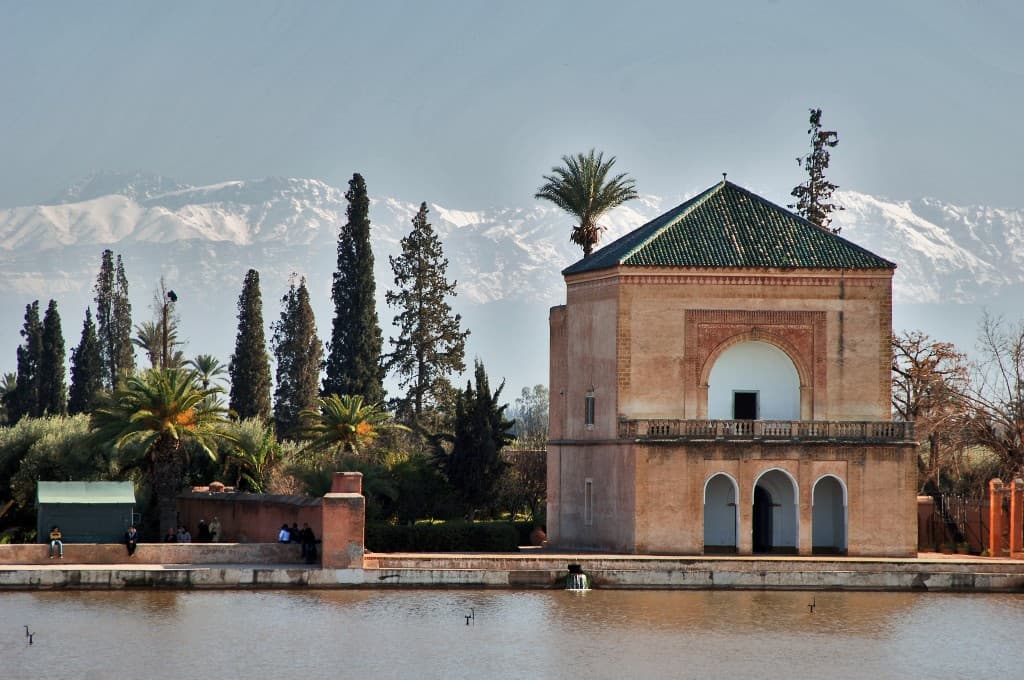 Acp / CC BY-SA 3.0, via Wikimedia Commons
“Beyond ochre walls, a city of contrasts and ancient echoes unfurls.”
Not the postcards. The stories even locals don't know — whispered in your ear, right where they happened.
The central square of Marrakech, Jemaa el-Fnaa, carries a surprisingly somber origin in its name.
The expansive Bahia Palace, a marvel of Moroccan artistry, did not arise from a singular, grand vision.
The distinctive 'Majorelle Blue' that defines this peaceful garden was more than a decorative choice.
Discover every secret of Marrakech
Every address, every reveal in full — in your ear, right where it happened.
You pick your stops. You walk. The voice reveals what the others miss.
No tours available yet. Check back soon — we're preparing them.
Marrakech, often known as the “Red City” or “Ochre City” for its distinctive red sandstone buildings and ramparts, is a significant urban center in central Morocco. It stands as one of Morocco's four imperial cities and is widely considered the country's cultural capital. Established around 1070 by the Almoravid dynasty, Marrakech swiftly grew into an important cultural, religious, and trading hub for the Maghreb region.
The city offers a vivid array of experiences, from its bustling souks and historic medina to its tranquil gardens and grand palaces. It is a place where ancient customs intermingle with a lively contemporary atmosphere, creating a captivating destination for travelers seeking immersion in Moroccan culture. Marrakech's medina, the old section of the city, was recognized as a UNESCO World Heritage site in 1985 for its impressive architecture and art.
The story of Marrakech stretches back nearly a thousand years, with its origins in the Berber phrase 'murr akush,' meaning 'the land of God.' The area itself saw habitation by Berber farmers since Neolithic times. The city was formally established around 1070 by Abu Bakr ibn Umar, a chieftain of the Almoravid dynasty, who made it their capital. The Almoravids laid out the medina and developed an elaborate irrigation system, known as 'khettaras,' to sustain the city's palm groves and gardens. They also constructed the city's distinctive red walls between 1122 and 1123, which, along with subsequent red sandstone constructions, cemented Marrakech's enduring nickname, the “Red City.”
In 1147, the Almohad Caliphate took control of Marrakech, and this new dynasty significantly reshaped the city. The Almohads were responsible for building the Koutoubia Mosque, its towering minaret serving as a model for other structures in the region. After a period of decline under the Marinids, who moved the capital to Fez in 1269, Marrakech regained its prominence in the early 16th century under the Saadian dynasty. The Saadian sultans, particularly Abdallah al-Ghalib and Ahmad al-Mansur, adorned the city with lavish palaces and restored ruined monuments, ushering in a new golden age. Notable constructions from this era include the El Badi Palace and the Saadian Tombs.
In 1669, the Alawi sharifs captured Marrakech. While it frequently served as a royal residence, it was not their sole capital, as Alawi sultans often moved their courts between various cities. Marrakech was conquered by French troops in 1912 and became part of the French protectorate of Morocco. During this period, it was administered for many years by the influential Glaoui family. Morocco gained independence in 1956, and Marrakech has since maintained its status as a vital economic and cultural center, with tourism forming a significant part of its economy.
Begin your exploration in the Medina, the historic core of Marrakech, a labyrinth of narrow alleys and bustling souks where traditional trade flourishes. The Jemaa el-Fnaa square is the Medina's lively center, transforming from a daytime marketplace with snake charmers and storytellers to an open-air food court at night.
Admire the Koutoubia Mosque, the largest mosque in Marrakech, its impressive 77-meter minaret commanding the skyline. While non-Muslims cannot enter, the exterior and surrounding gardens offer much to appreciate. Discover the opulent Bahia Palace, a 19th-century architectural wonder celebrated for its intricate wood carvings, geometric patterns, and expansive courtyards. Explore the Saadian Tombs, a necropolis adorned with exquisite tilework, marble pillars, and stucco designs, holding the remains of Sultan Ahmad al-Mansur and his descendants.
Find calm at the Jardin Majorelle, a 2.5-acre botanical garden created by French painter Jacques Majorelle and later restored by Yves Saint Laurent. Its distinctive “Majorelle Blue” buildings and exotic flora provide a peaceful escape. Another serene spot is Le Jardin Secret, a 19th-century courtyard garden displaying Islamic art and architecture, with mosaic-tiled waterways and elegant archways. For a glimpse into the past, visit the Ben Youssef Madrasa, a 14th-century Islamic college rebuilt in the 16th century, featuring intricate tilework, carved wood, and Arabic calligraphy.
The ideal times to visit Marrakech are during spring (March to May) and autumn (September to November). In these periods, temperatures are comfortable, ranging from 18°C to 30°C (64°F to 86°F), with minimal rainfall, creating perfect conditions for exploration. May and October are particularly agreeable, offering warm days and cool nights.
Summer (June to August) can be intensely hot, with temperatures often exceeding 40°C (104°F), which can make sightseeing challenging. Winter (November to February) brings cooler temperatures, averaging 8°C to 21°C (46°F to 70°F), and fewer crowds, though evenings can be quite chilly.
Moroccan Dirham (MAD) is the local currency; while credit cards are accepted in larger establishments, cash is essential for souks, smaller restaurants, and taxis. It's advisable to carry smaller denominations for daily transactions. While tap water is technically safe in cities, tourists are encouraged to drink bottled water to avoid stomach upsets.
Dress modestly to show respect for local culture, especially when visiting religious sites. Loose clothing that covers shoulders and knees is generally appropriate. Bargaining is customary in the souks; expect to negotiate prices, often aiming for 50-70% off the initial offer. Taxis are readily available, but drivers may try to offer a fixed price rather than using the meter; agree on a price beforehand or insist on the meter. For airport transfers, consider arranging a pickup through your riad or hotel for a smoother arrival.