Marlow Lock
Before the advent of modern locks, boats navigated the Thames at Marlow through a 'flash lock' with a less-than-charming reputation.
Full story unlocks in the tour
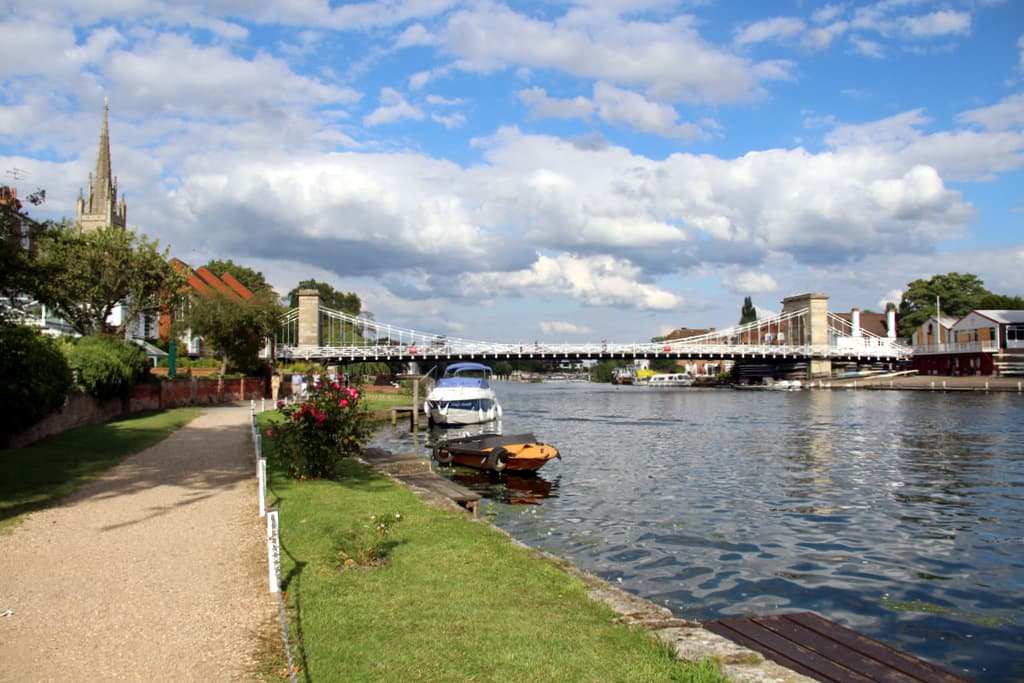 Christine Matthews / CC BY-SA 2.0, via Wikimedia Commons
“Where Georgian elegance meets riverside allure and literary echoes.”
Not the postcards. The stories even locals don't know — whispered in your ear, right where they happened.
Before the advent of modern locks, boats navigated the Thames at Marlow through a 'flash lock' with a less-than-charming reputation.
The distinctive spire of All Saints Church, a prominent Marlow landmark, is not the original structure.
An eminent 18th-century physician, Dr. William Battie, constructed a grand house in Marlow with a curious architectural oversight.
Discover every secret of Marlow
Every address, every reveal in full — in your ear, right where it happened.
You pick your stops. You walk. The voice reveals what the others miss.
No tours available yet. Check back soon — we're preparing them.
Marlow, a captivating town along the River Thames in Buckinghamshire, presents a harmonious blend of historical grace and natural splendor. Its refined Georgian architecture graces streets that lead to the celebrated Marlow Suspension Bridge, a Grade I-listed engineering marvel. The town finds its setting amidst the verdant meadows of the river valley and the wooded slopes of the Chiltern Hills, an Area of Outstanding Natural Beauty.
Marlow's bond with the Thames is fundamental to its character, evident in its thriving rowing community and riverside pursuits. The town has long drawn notable residents, including literary figures and Olympic athletes. With its independent boutiques, cafes, and acclaimed restaurants, Marlow sustains a lively yet tranquil atmosphere, making it a cherished destination for both those who live there and those who visit.
Marlow's origins extend back to at least the Saxon period, and it is recorded in the Domesday Book of 1086. Its strategic position on the River Thames made it an important inland port and a natural crossing point, with a market established by 1227, giving it the historical name "Chipping Marlow." Early bridges, some crafted from wood, facilitated trade and passage for centuries. Goods such as wool, grain, and timber were transported downstream, contributing to the town's commercial importance.
The river, however, presented challenges. For centuries, barges navigated rapids below the church using a "flash lock" in the weir. This rudimentary lock system, operated by releasing a surge of water, was notoriously perilous and gained a reputation for causing accidents, some of them fatal. In 1773, a timber "pound lock" was constructed to replace the dangerous flash lock, and it was later rebuilt in stone in 1825 on its present site.
A pivotal moment in Marlow's history was the construction of its elegant suspension bridge. While a bridge has existed at Marlow for over 600 years, the current metal suspension bridge was completed in 1832. Designed by William Tierney Clark, this engineering triumph served as a prototype for the renowned Széchenyi Chain Bridge across the River Danube in Budapest, Hungary. The bridge's completion coincided with the rebuilding of All Saints Church between 1832 and 1835, following the collapse of its predecessor's spire.
Marlow has long been a desirable place to reside, drawing notable figures. The poet Percy Bysshe Shelley and his wife Mary Shelley lived in Marlow in 1816, where Mary completed her gothic masterpiece Frankenstein. The town also has a strong connection to rowing, with the prestigious Marlow Rowing Club, founded in 1871, having produced numerous Olympic athletes, including Sir Steve Redgrave. Today, Marlow continues to be a center for fine dining, with several Michelin-starred establishments, further solidifying its place as a sophisticated riverside town.
Begin your exploration at the celebrated Marlow Suspension Bridge, a Grade I-listed structure offering expansive views of the Thames. Adjacent to the bridge stands All Saints Church, a Gothic-style church rebuilt in the 19th century with a spire that ascends 170 feet. Wander into Higginson Park, a green expanse by the river, where you will find a bronze statue of five-time Olympic gold medalist rower Sir Steve Redgrave.
Take a stroll along the Thames Path, a national trail that offers picturesque views and opportunities for boat trips, rowing, kayaking, or paddleboarding. Just downstream from the bridge is Marlow Lock, a historic pound lock that has been a part of the river's navigation since 1773. Explore Marlow's High Street for independent boutiques, galleries, and cafes. For a glimpse into local history, consider a visit to the Marlow Museum. Across the river in Bisham, a short walk from Marlow, lies Bisham Abbey, a historic manor house that once housed royalty and now serves as a National Sports Centre.
Marlow is a delightful destination throughout the year, but it truly awakens in the spring and summer. From late June to early September offers the most pleasant weather for warm-weather activities, with average daily high temperatures above 67°F (19°C) in July. This period is ideal for enjoying riverside activities and outdoor dining. The Marlow Town Regatta and Festival in June is a highlight, featuring river races and a family-friendly festival. Autumn provides beautiful foliage, while winters are mild, making them suitable for exploring local pubs and cafes.
Marlow is easily explored on foot due to its compact size and inviting streets. For those arriving by train, Marlow is accessible with connections from London and nearby towns. If driving, be aware that the Marlow Suspension Bridge has a 3-ton weight restriction, effectively limiting it to lighter traffic. Parking is available, though it can be busy. The town offers a range of independent shops, cafes, and restaurants, including several acclaimed dining establishments. Accommodation options cater to various preferences, from boutique hotels to traditional inns. Public restrooms are available in Higginson Park. Consider bringing comfortable walking shoes and a waterproof jacket, as rain can occur throughout the year.