Holy Spirit Church
This enduring church holds a secret about the sun's path that few realize.
Full story unlocks in the tour
 iMahesh / CC BY-SA 4.0, via Wikimedia Commons
“Beyond the beaches, Margao reveals the authentic pulse of Goan life.”
Not the postcards. The stories even locals don't know — whispered in your ear, right where they happened.
This enduring church holds a secret about the sun's path that few realize.
The railway station, a bustling modern hub, has a surprisingly arduous origin story.
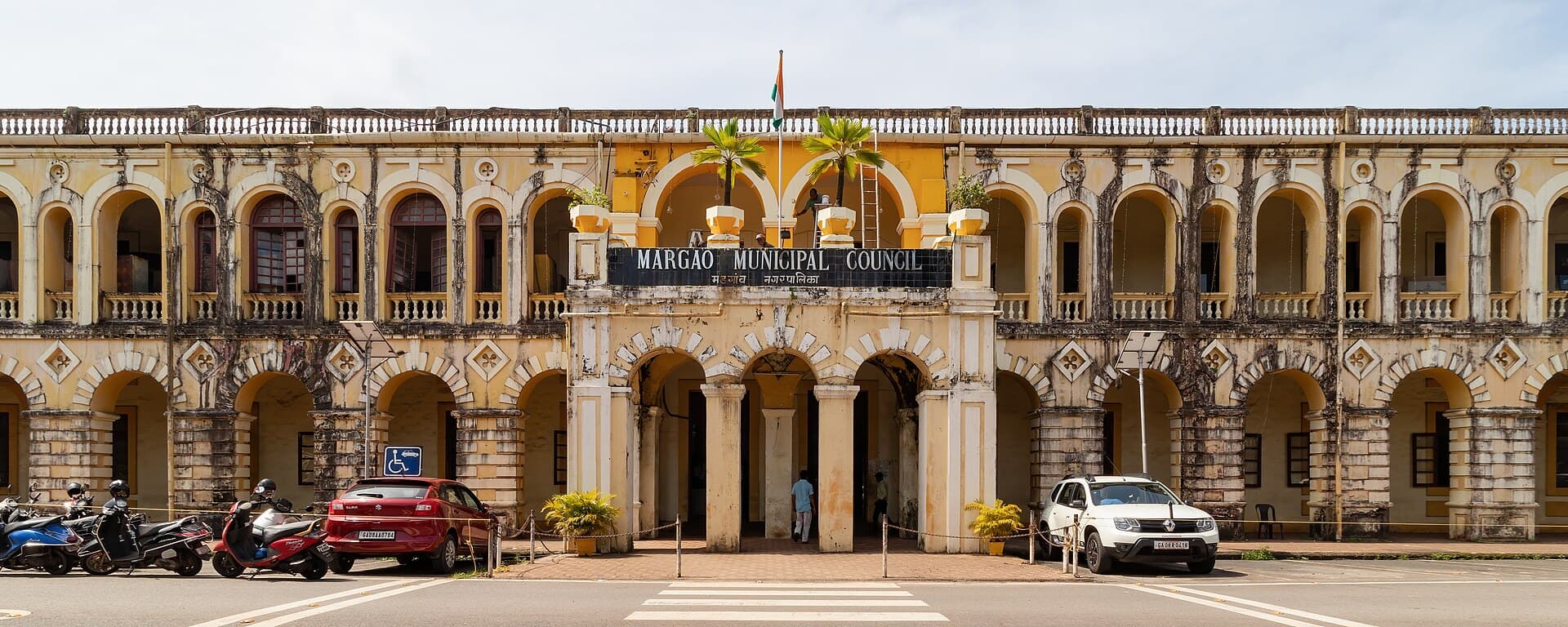
This seemingly ordinary administrative building carries the weight of a violent historical event.
Discover every secret of Margao
Every address, every reveal in full — in your ear, right where it happened.
You pick your stops. You walk. The voice reveals what the others miss.
No tours available yet. Check back soon — we're preparing them.
Margao, also known as Madgaon, is the commercial and cultural heart of South Goa, offering a glimpse into everyday Goan life beyond the coastal resorts. Situated on the banks of the Sal River, it serves as the administrative headquarters for the South Goa district. Unlike the more overtly tourist-centric areas of North Goa, Margao presents a more grounded and introspective experience, where the rhythm of local life unfolds with a warm, unhurried pace.
The city is a blend of colonial-era architecture and traditional Goan homes, with lively markets and a strong sense of local culture. Margao is a major transportation hub, particularly for rail travelers heading south, yet it maintains an authentic atmosphere that reflects Goan traditions, culinary habits, and daily routines. It's a place where history enthusiasts, food lovers, and culture seekers can delve into the city's distinctive character.
Margao's origins trace back to an important settlement known as 'Mathagram' or 'village of the Mathas' (monasteries), a testament to the nine temple schools that once flourished here. These religious centers, with their prosperous temples and dharmashalas, formed the spiritual core of the area. However, with the arrival of the Portuguese in the 17th century, many of these Hindu religious structures were destroyed. The first church in Margao was established by the Jesuits in 1564, on the site of a former Hindu temple dedicated to Lord Damodar. This initial church, however, faced destruction in a fire in 1571 during a Muslim incursion. It was rebuilt, only to be destroyed again in 1579. The current Holy Spirit Church, a prominent landmark, was finally constructed in 1675.
Margao developed as a principal settlement during the Portuguese period, evolving into a significant administrative and commercial center within Salcete taluka. The construction of the Holy Spirit Church in the 16th century solidified the town's role as a key parish center, fostering the expansion of civic and residential areas around it. Many of the grand Indo-Portuguese houses that still stand today, particularly around Church Square and along Abade Faria Road, date from the 18th and 19th centuries, reflecting the prosperity of local landowners and traders during that era.
The city was officially elevated to a town by a Royal Decree of Portuguese Queen Dona Maria I on April 3, 1778. After Goa's annexation into India in 1961, Margao was designated as the administrative center of the South Goa district. The establishment of the Madgaon Railway Station further cemented Margao's importance, making it a crucial entry point for travelers arriving in Goa by train.
Begin your exploration at the Holy Spirit Church (Espirito Santo Church), a prominent white-washed Baroque structure built in 1675. Its elaborate interiors feature detailed altars and a unique design that marks the equinox. Surrounding the church is Largo de Igreja (Church Square), an area dotted with old Portuguese mansions that offer a glimpse into the city's colonial past.
Immerse yourself in the local atmosphere at the Margao Municipal Market, a lively hub where you can find everything from fresh produce and spices to local handicrafts and traditional Goan pão. For a tranquil escape, visit the Margao Municipal Garden, a green space ideal for a leisurely stroll. History enthusiasts might also appreciate the Câmara Municipal de Salcete, an important administrative building during the Portuguese era. While in Margao, consider a visit to the Goa Chitra Museum in nearby Benaulim, which showcases Goa's agrarian past through over 4,000 artifacts. The Our Lady of Piety Chapel on Monte Hill offers scenic views. For cultural events, Ravindra Bhavan is a modern center for arts in South Goa.
The most comfortable time to visit Margao is during the dry winter season, from November to February. During these months, temperatures typically range between 20°C and 32°C, with lower humidity, making it ideal for sightseeing and exploring the city on foot. March also offers pleasant weather, with temperatures around 20°C to 30°C and low humidity, though it can be hotter. Avoid the heavy monsoon rainfall from June to September, which can disrupt travel and outdoor activities. April and May can be hot and humid, making sightseeing less comfortable.
Margao is well-connected and easily accessible. The nearest airport is Dabolim Airport (GOI), approximately 25 kilometers away, with taxis and pre-booked transfers available. Madgaon Junction (Margao Railway Station) is a major railway hub, connecting Goa to cities across India, including Mumbai, Delhi, and Bangalore. The station is a convenient disembarkation point for those heading to South Goa's beaches like Colva and Benaulim. By road, Margao is linked to other parts of Goa and neighboring states via bus services operated by Kadamba Transport Corporation (KTC) and private taxis.
Within the city, local eateries and bakeries are widely available. While public restrooms are limited, facilities are more reliably found in commercial establishments. The Municipal Market and central commercial streets are busiest between 9:00 AM and 1:00 PM, especially on Saturdays. Most shops close by 8:00–9:00 PM, after which the city center becomes quieter.