Jahaz Mahal
The 'Ship Palace' was constructed to house a royal harem, yet the true number of its inhabitants might astonish you.
Full story unlocks in the tour
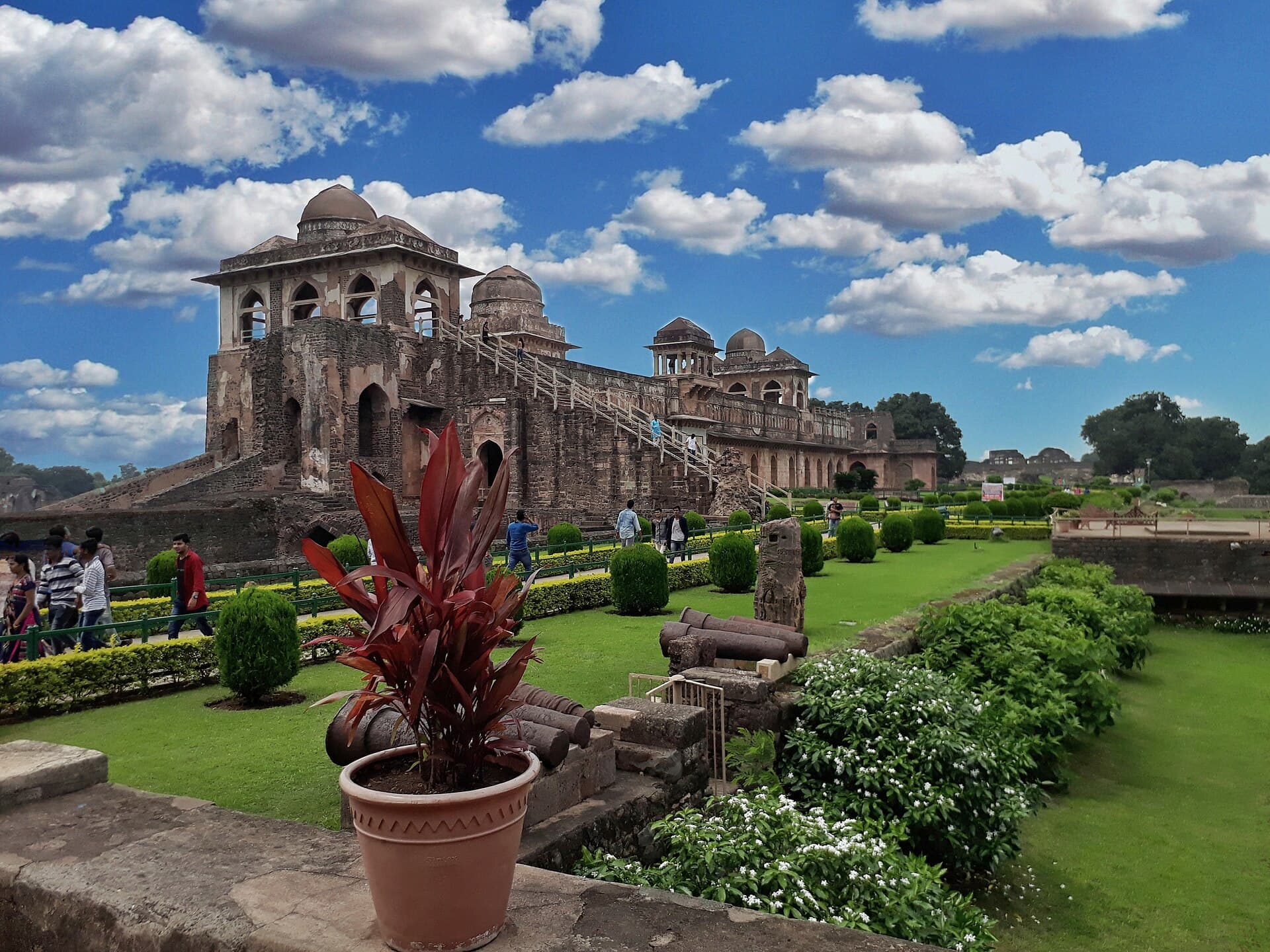 Aamin / CC BY-SA 4.0, via Wikimedia Commons
“Where ancient stones murmur tales of sultans and profound affection”
Not the postcards. The stories even locals don't know — whispered in your ear, right where they happened.
The 'Ship Palace' was constructed to house a royal harem, yet the true number of its inhabitants might astonish you.
This crumbling palace, once a center for scholarly pursuits, held an unexpected purpose for the royal women.
The 'Swinging Palace' features walls that incline at a dramatic angle, though the reason for this architectural choice is more practical than poetic.
Discover every secret of Mandu
Every address, every reveal in full — in your ear, right where it happened.
You pick your stops. You walk. The voice reveals what the others miss.
No tours available yet. Check back soon — we're preparing them.
Mandu, also known as Mandav or the 'City of Joy' (Shadiabad), is an ancient city in the Malwa region of western Madhya Pradesh, India. Situated atop a 633-meter high plateau within the Vindhya Range, the ruined city extends across approximately 20 square kilometers and is celebrated for its Afghan architecture and romantic folklore. Mandu's strategic position, overlooking the Malwa plateau to the north and the Narmada River valley to the south, provided natural defenses and made it a sought-after fortress in central India.
The landscape of Mandu is adorned with shimmering lakes, ancient dams, and rare baobab trees. These trees, native to Africa and uncommon in India, lend an almost African silhouette to certain parts of the region. The city's monuments, primarily from the 15th and 16th centuries, stand as enduring testaments to a glorious bygone era. Mughal Emperor Jahangir found Mandu particularly enchanting, describing it as a place with a pleasant climate and appealing scenery, especially during the rainy season.
Often described as a 'ghost city' that lay deserted for centuries, Mandu invites visitors to wander through its structures and imagine the lively life that once thrived within its boundaries. The city offers a unique blend of history, architectural wonders, and captivating love stories, most notably that of Sultan Baz Bahadur and Rani Roopmati.
Mandu's origins can be traced to the 6th century CE, with an inscription from 555 AD referring to it as 'Mandapa-Durga,' a name believed to be a Sanskrit form of Mandu. The city grew in prominence during the 10th and 11th centuries under the Paramara kings, who significantly influenced the region. During this period, Mandu served as a royal residence and a strategically important hill fort.
In the early 13th century, Mandu came under Muslim rule, and by 1305, it was annexed by the Delhi Sultanate. Following Timur's invasion of Delhi in 1398, Dilawar Khan Ghuri, the governor of Malwa, declared independence and moved the capital from Dhar to Mandu. It was Dilawar Khan who renamed Mandu 'Shadiabad,' meaning 'City of Joy,' inspired by its natural beauty. Under his son, Hoshang Shah (ruled 1405–1434), Mandu experienced a period of extensive construction, with grand monuments and fortified defenses.
The city reached its architectural peak under the Malwa Sultanate, with many structures blending Afghan, Mughal, Hindu, and Mesopotamian architectural styles. Mandu's strategic location on the route between Delhi and the Deccan made it highly desired, leading to periods of conquest and annexation by various rulers, including Humayun (1534), Sher Shah of Sur (1542), and Akbar (1561). Mughal emperors like Akbar and Jahangir frequently visited Mandu, drawn by its cool climate and verdant scenery. Jahangir even stayed for nearly seven months during one visit, ordering restorations and commissioning new structures.
After a period of decline, Mandu was eventually taken by the Marathas in 1732 under Peshwa Baji Rao I, who re-established Hindu rule and moved the capital back to Dhar. Today, the Archaeological Survey of India is tasked with the preservation of this once-resplendent citadel, allowing its structures to narrate stories of its complex past.
Mandu's vast structures are best explored by grouping the monuments. The Royal Enclave is a primary area, featuring the iconic Jahaz Mahal or 'Ship Palace.' Constructed between two artificial lakes, Kapoor Talao and Munj Talao, this 15th-century palace appears to float on water and was designed as a pleasure resort for Sultan Ghiyas-ud-din Khilji's extensive harem. Nearby, the Hindola Mahal, or 'Swinging Palace,' is a 15th-century audience hall recognized for its dramatically sloping walls. The Royal Enclave also includes the Taveli Mahal, which once housed royal elephants and horses and now serves as an archaeological museum.
The Village Group, situated in the heart of Mandu, encompasses the grand Jami Masjid, a 15th-century mosque inspired by the Great Mosque of Damascus, known for its expansive courtyard and intricate carvings. Adjacent to it stands Hoshang Shah's Tomb, considered India's first marble tomb, predating the Taj Mahal by a couple of centuries. The structures of Ashrafi Mahal, originally a madrasa, are also part of this group.
Further afield, the Rewa Kund Group is connected to the legendary romance of Sultan Baz Bahadur and Rani Roopmati. Here, you will find Baz Bahadur's Palace, a 16th-century structure with large courtyards and elevated terraces. Overlooking the Narmada River valley, Rani Roopmati's Pavilion was initially a military observation post that evolved into a romantic retreat for the queen. Do not overlook the Lohani Caves, an ancient Hindu temple complex with manmade caves and remnants of temple pillars, offering a glimpse into Mandu's pre-Islamic past.
The ideal time to experience Mandu is during the cooler months, from October to March. During this period, temperatures are comfortable, ranging between 10°C and 30°C, making it perfect for exploring the extensive outdoor monuments. The winter season also offers the opportunity to attend the Mandu festival, which displays a blend of Hindu and tribal culture.
While summers (April to June) can be very warm, with temperatures rising above 40°C, the monsoon season (July to September) transforms Mandu into a verdant landscape with clouds drifting through the valleys, providing a unique and picturesque experience for those who appreciate nature and photography.
Mandu is approximately 100 km from Indore, the nearest major city with an airport (Devi Ahilya Bai Holkar Airport) and a railway station. From Indore, you can arrange a taxi or take a bus to reach Mandu. Mandu is also accessible by road from nearby cities like Dhar (35 km) and Ujjain (135 km).
Within Mandu, public transport is limited, so reserving a cab or auto-rickshaw for the day is suggested for sightseeing. Alternatively, cycling is a favored method to explore the scattered monuments, with bicycle rentals available. Most monuments are accessible from sunrise to sunset, typically from 6:00 AM to 7:00 PM, though some, like Hoshang Shah's Tomb, open slightly later. Entry fees are modest for Indian tourists (around INR 5) and higher for international visitors (around INR 100); children under 15 often enter without charge. Carrying comfortable walking shoes is advisable, as the sites are spread across a wide area. Consider engaging a local guide to enrich your visit with historical context and local narratives.