Christ Blessing Statue
Manado's iconic Christ Blessing Statue appears to defy gravity, leaning forward at an unusual angle.
Full story unlocks in the tour
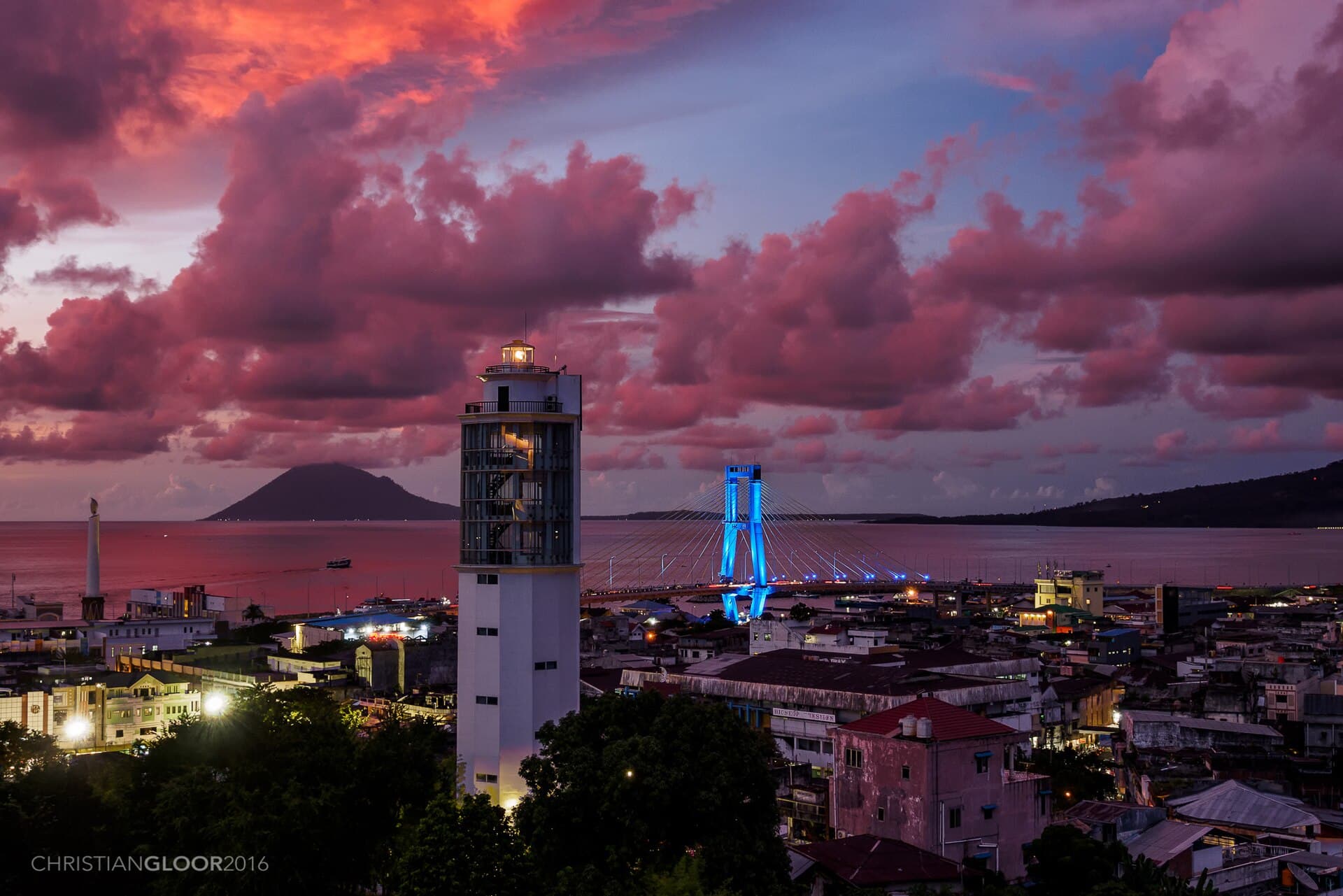 Christian Gloor / CC BY 2.0, via Wikimedia Commons
“Where volcanic peaks meet thriving reefs, and piquant flavors narrate a diverse past.”
Not the postcards. The stories even locals don't know — whispered in your ear, right where they happened.
Manado's iconic Christ Blessing Statue appears to defy gravity, leaning forward at an unusual angle.
The local language in Manado is a creole with unexpected European influences.
Despite a history of varied influences, Manado adheres to a simple, unifying philosophy.
Discover every secret of Manado
Every address, every reveal in full — in your ear, right where it happened.
You pick your stops. You walk. The voice reveals what the others miss.
No tours available yet. Check back soon — we're preparing them.
Manado, the capital of North Sulawesi, Indonesia, is a city that pulses with a unique blend of natural grandeur and cultural depth. Situated on the Bay of Manado and framed by verdant mountains, the city serves as a gateway to some of Indonesia's most celebrated natural wonders, including the world-renowned Bunaken National Marine Park.
Beyond its reputation as a premier diving destination, Manado offers a lively urban experience. The city is a convergence of cultures, shaped by centuries of trade and colonial eras, which is evident in its diverse heritage, architecture, and particularly its famously spicy Minahasan cuisine. With its warm hospitality and a local spirit of 'Torang samua basudara' (We are all family), Manado provides a welcoming and engaging experience for travelers seeking adventure, culinary delights, and a glimpse into a distinct Indonesian culture.
## Early Mentions and Colonial Footprints Manado's presence on world maps dates back to Renaissance cartographer Nicolas Desliens, who marked an island called 'Manarow' (today's Manado Tua). Before European arrivals, the area was under the rule of the Sultan of Ternate, who introduced Islam to the region. The Portuguese were among the first Europeans to establish influence, making the Sultan their vassal and establishing a factory in Wenang. The Spanish also made inroads, utilizing the fertile Minahasan soil for coffee cultivation and eventually controlling the entire Minahasa region, even establishing a fort in Manado in the 1550s. The first King of Manado, Muntu Untu (1630), was reportedly of Spanish descent, highlighting the early Indo-Eurasian communities that developed here.
## Dutch Dominance and Shifting Powers The Spanish eventually ceded control of Minahasa to the Portuguese, but this shift was brief. The Minahasans formed a treaty with the Dutch, leading to the expulsion of the Portuguese. In 1658, the Dutch East India Company solidified its presence by building Fort Amsterdam in Manado, around which the modern city began to take shape. The Dutch also introduced Christianity to the Minahasans, a faith that remains predominant in the region today. Manado became a key center for the global spice trade, exporting cloves and nutmeg.
## Modern Era and Cultural Hub Over the centuries, Manado experienced further shifts in power, including capture by the British in 1810 and occupation by the Japanese in 1942 during World War II, which also saw the city heavily damaged by Allied bombing. In 1958, the central Indonesian government intervened to quell the Permesta rebel movement, an event that resulted in many deaths. Manado became the capital of North Sulawesi in 1962. Today, Manado is recognized for its diverse population, including Minahasans, Javanese, Batak, Moluccans, and Makassarese, and is celebrated for its religious harmony and tolerance.
Manado offers a blend of natural wonders and cultural landmarks. The Bunaken National Marine Park, a short boat ride from Manado Harbor, is a world-class diving and snorkeling destination, celebrated for its dramatic coral walls, diverse marine life, and clear waters. Back on land, the Christ Blessing Statue (Monumen Yesus Memberkati) stands tall on CitraLand Hill, offering expansive views of the city.
For a glimpse into Manado's multicultural heritage, visit the Ban Hin Kiong Temple, the oldest Chinese temple in the city, adorned with intricate dragon sculptures and traditional pagoda-style roofs. The surrounding Chinatown district and the nearby Arabic area with its impressive mosque are also worth exploring. Nature enthusiasts can venture to the Tangkoko Nature Reserve, about 50 kilometers from Manado, to spot unique wildlife like tarsiers. Other attractions include Malalayang Beach for sunset views and God Bless Park along the Boulevard for open spaces and sports facilities.
The optimal time to visit Manado is during the dry season, which extends from May to October. This period offers sunny weather and clearer waters, ideal for diving and other outdoor activities. August is typically the warmest month, while January and February are comparatively cooler. October is often considered ideal, with warm water, clear visibility, and fewer tourists.
Sam Ratulangi International Airport (MDC) serves Manado, with direct flights from major Indonesian cities like Jakarta and Bali, and international connections to East Asia and Southeast Asia. A taxi from the airport to the city center takes about 30-40 minutes.
Within Manado, public transportation includes blue minibuses called 'mikrolets' or 'angkots,' which follow set routes and are an affordable way to get around. Ride-hailing apps like Grab and GoJek are also widely available. For exploring outside the city, renting a car with a driver is a convenient option.
Manado is generally considered safe for tourists, with low crime rates. However, standard precautions apply, such as sticking to bottled water and using mosquito repellent. The local currency is the Indonesian Rupiah (IDR). While Indonesian (Bahasa Indonesia) is the official language, locals often speak Manado Malay, and English is commonly spoken in tourist areas.