Xoriguer Gin Distillery
Step into a distillery on Mahón's waterfront, and you will find copper stills fired by wood, producing a gin unlike any other.
Full story unlocks in the tour
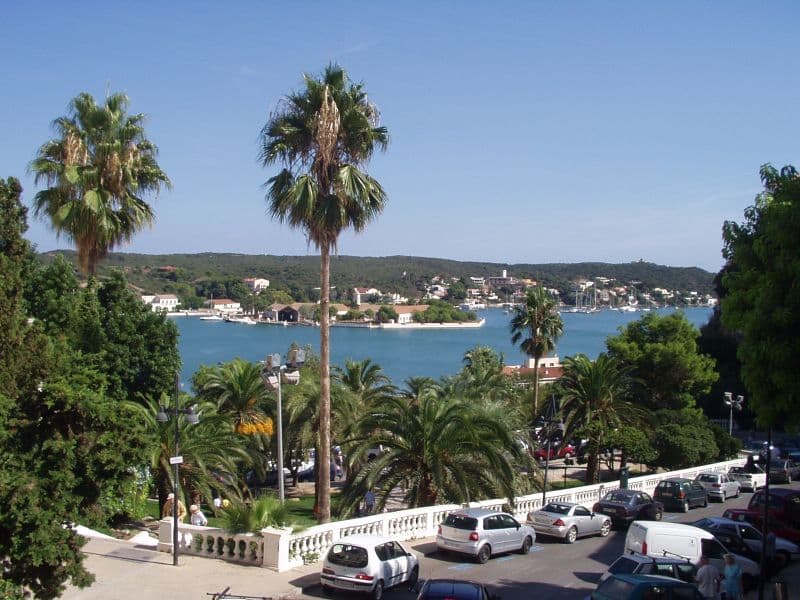 Jbr / CC BY-SA 3.0, via Wikimedia Commons
“Where history's tides meet Mediterranean charm.”
Not the postcards. The stories even locals don't know — whispered in your ear, right where they happened.
Step into a distillery on Mahón's waterfront, and you will find copper stills fired by wood, producing a gin unlike any other.
Look up at the Town Hall's clock, and you will observe it keeps time with a subtle nod to a former colonial power.
While strolling through the city's main square, consider how its very layout narrates a story of strategic military planning.
Discover every secret of Mahón
Every address, every reveal in full — in your ear, right where it happened.
You pick your stops. You walk. The voice reveals what the others miss.
No tours available yet. Check back soon — we're preparing them.
Mahón, or Maó in Catalan, serves as the capital of Menorca, an island within Spain's Balearic archipelago. This city, home to approximately 30,000 residents, presents a fusion of historical depth, maritime legacy, and local customs. Its most defining characteristic is its extraordinary natural harbor, extending for nearly six kilometers and recognized as one of the world's longest and deepest natural harbors. This profound, sheltered inlet has positioned Mahón as a strategic naval base and a center for trade across centuries, drawing various powers who each left their permanent marks on the city's identity.
The city ascends from a cliff, offering expansive views of the harbor and the surrounding terrain. Mahón's thoroughfares unveil a complex narrative, where 18th-century structures influenced by Georgian design stand beside Mediterranean balconies and stone stairways, a tangible legacy of British rule. From rocky promontories overlooking clear waters to lively markets and waterfront promenades, Mahón is a place where the past and present converge in the rhythm of daily existence.
The story of Mahón reaches back to ancient times, with its founding traditionally attributed to the Carthaginian general Mago Barca, Hannibal's brother, who is believed to have sought refuge here around 205 BC. The city's original name, Portus Magonis, is thought to derive from him. Following the decline of the Western Roman Empire, Mahón became part of the Eastern Roman Empire, enduring incursions from Vikings and Arabs until its conquest by the Islamic Caliphate of Córdoba in 903. In 1287, Alfonso III of Aragon seized Mahón from the Moors, integrating it into the Kingdom of Majorca. The harbor, acknowledged for its strategic significance in the western Mediterranean, was subsequently reinforced.
A momentous, though destructive, event in Mahón's past occurred in 1535 when the Ottoman corsair Hayreddin Barbarossa, also known as Red Beard, attacked the city, taking 600 captives as slaves in what is remembered as the Sack of Mahón. This vulnerability prompted further fortification efforts, including the construction of Castillo de San Felipe.
The 18th century marked a crucial era for Mahón, often referred to as its 'golden age,' as control of the island shifted between British, French, and Spanish authority. British forces, recognizing the harbor's potential as a naval base, captured Menorca in 1708 during the War of the Spanish Succession. The Treaty of Utrecht in 1713 confirmed Menorca as a British possession. During this period, the capital was relocated from Ciutadella to Mahón in 1722 by British Governor Richard Kane, who saw the advantage of proximity to the naval base. The British established a Royal Navy Dockyard in 1715, which served as their primary Mediterranean base for much of the 18th century and remains a Spanish Naval station today. This period left an enduring legacy, evident in the city's Georgian-influenced architecture, urban design, and even some local customs. Spain finally regained permanent sovereignty over Menorca in 1802 with the Treaty of Amiens.
Begin your exploration in the historic center, where the Plaça de la Constitució acts as the city's core, encircled by traditional buildings and cafes. Adjacent to the square stands the Church of Santa María, a Gothic church rebuilt in 1772, sheltering a monumental 19th-century organ with over 3,000 pipes. Nearby, the Town Hall displays an English Palladian style, a clear acknowledgment of British influence.
Descend towards the harbor to experience the Port de Maó, one of the world's grand natural harbors. Consider a glass-bottom boat tour to appreciate the harbor's distinctive ecosystem and historical islets like Illa del Rei (King's Island), home to an 18th-century British Naval Hospital, and Illa Pinto (Saffron Island), where 1760s dockyard buildings, including a naval storehouse with a clock tower, still stand. The Xoriguer Gin Distillery on the waterfront offers tours and tastings of the island's distinctive grape-based gin.
For a deeper understanding of the island's past, visit the Museu de Menorca, situated in a 15th-century Franciscan convent, displaying archaeological, historical, and ethnographic artifacts from prehistoric times to the present. Do not overlook the Pont de Sant Roc, a Gothic remnant of Mahón's medieval walls, providing a glimpse into the city's defensive history. For local flavors, explore the Mercat del Claustre del Carme, an indoor market ideal for sampling cheeses, cured meats, and other Menorcan specialties. The Fish Market (Mercat de Peix) at Plaza de España, constructed in the 1920s, is another lively spot for local produce.
The ideal time to visit Mahón is between May and September, when the weather invites outdoor activities and city exploration. Temperatures gradually ascend from 15°C in April to a high of 30°C in July and August, with minimal rainfall, ensuring clear skies. May and June, or September and October, are particularly recommended for pleasant temperatures and fewer crowds, making them perfect for walking tours and enjoying the blooming landscapes. The sea temperature is also agreeable for swimming between May and September. Summer months also bring night markets, local festivals, and a lively culinary landscape.
Menorca Airport (MAH) is situated approximately 5 kilometers from Mahón. The most convenient way to reach the city center is by the Line 10 public bus, which operates every 30 minutes throughout the day. The bus stop is located on the ground floor of the arrivals terminal. Cash payment is accepted on board, but having smaller notes (under 20 Euros) is advisable. Taxis are also readily available outside the arrivals hall, with fares to Mahón ranging from 8 to 10 Euros. Renting a car is an option, with an average daily cost of around $30.
Within Mahón, the old town is best explored on foot, with winding staircases and narrow alleyways connecting the upper town to the harbor. Two panoramic lifts also connect the harbor to the city center, providing an easier ascent. While there are no city tour buses, a 'little train' offers a hop-on/off service along the harbor road. Most shops and businesses operate Monday to Saturday, typically from 9:30 AM to 1:30 PM and 4:30 PM to 8:00 PM, with an afternoon siesta period. Sundays generally see most shops closed, though eating establishments remain open.