Rajarajeshwar Temple
At the Rajarajeshwar Temple, eleven lamps burn without ceasing, a tradition said to span centuries.
Full story unlocks in the tour
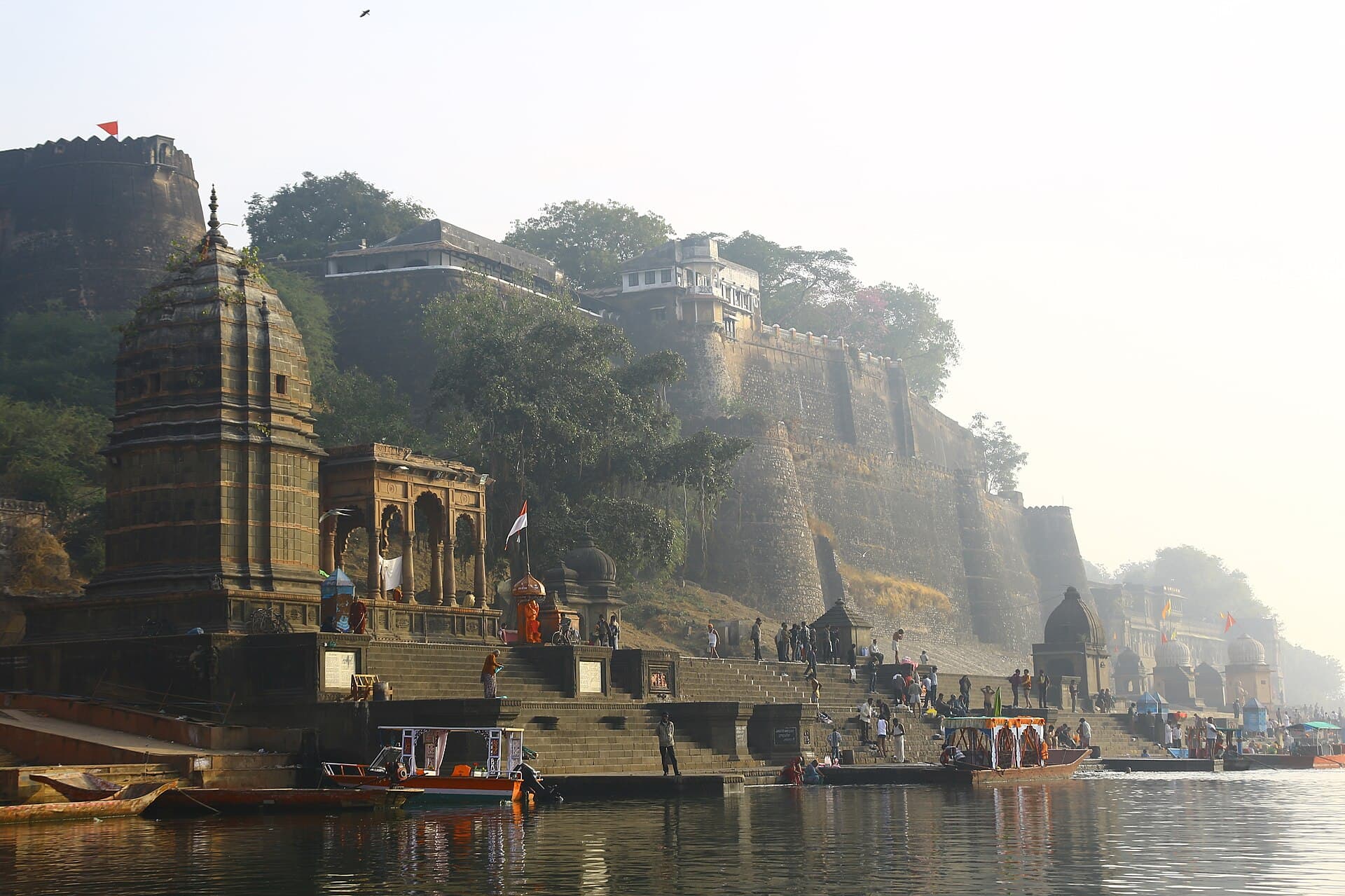 Lukas Vacovsky / CC BY-SA 3.0, via Wikimedia Commons
“Where ancient currents meet threads of royal design.”
Not the postcards. The stories even locals don't know — whispered in your ear, right where they happened.
At the Rajarajeshwar Temple, eleven lamps burn without ceasing, a tradition said to span centuries.
The distinctive Maheshwari saree, known for its reversible borders and light fabric, began as a royal creation under Queen Ahilyabai Holkar.
The sacred Narmada River, flowing through Maheshwar, shares a unique mythological bond with Lord Shiva.
Discover every secret of Maheshwar
Every address, every reveal in full — in your ear, right where it happened.
You pick your stops. You walk. The voice reveals what the others miss.
No tours available yet. Check back soon — we're preparing them.
Maheshwar, a town in the Khargone district of Madhya Pradesh, India, rests on the northern bank of the sacred Narmada River. Often referred to as the 'Varanasi of Central India,' Maheshwar offers a fusion of spirituality, heritage, and local culture. Its story stretches back over a thousand years, appearing in ancient texts like the Ramayana and Mahabharata, where it was known as Mahishmati, the capital of King Kartavirya Arjuna.
The town truly flourished in the 18th century when it became the capital of the Maratha Holkar reign under the remarkable Queen Ahilyabai Holkar. Her rule, from 1765 to 1796, transformed Maheshwar into a nexus of temples, ghats, and weaving traditions, an influence that continues to shape the town's character today. Maheshwar is celebrated for its handloom Maheshwari sarees, its grand fort, and the tranquil Narmada Ghats.
## Ancient Roots and Royal Patronage Maheshwar's story is deeply intertwined with ancient Indian epics. In ancient texts, it was known as Mahishmati and is believed to have been a significant city during the Mahabharata era, serving as the capital of King Kartavirya Arjuna. Legend recounts that King Sahasrarjun, with his thousand arms, once halted the mighty Narmada River to create a play area for his 500 wives. During this time, Ravana, flying in his Pushpak Vimana, fashioned a Shiva Linga on the dry riverbed. When the king released the river, the Linga was swept away, leading to a conflict where Sahasrarjun defeated Ravana. This triumph is still honored today with 11 lamps lit every evening at the Sahasrarjuna Temple.
Following the decline of the Mughal Empire in the early 18th century, the Malwa region, including Maheshwar, came under Maratha control. It was Malhar Rao Holkar, a notable cavalry commander, who acquired Indore, Maheshwar, and surrounding territories. However, Maheshwar's golden age truly began in the late 18th century when his widowed daughter-in-law, Rajmata Ahilyabai Holkar, assumed power in 1767 and made Maheshwar her capital. This was an unprecedented move for a woman in 18th-century India.
Queen Ahilyabai Holkar's reign, from 1765 to 1796, was distinguished by substantial development and cultural blossoming. She rebuilt and expanded the Maheshwar Fort, transforming it into her royal residence and an administrative center. She also commissioned the construction of numerous temples and ghats along the Narmada River, leaving an enduring architectural and spiritual legacy. Beyond architecture, Ahilyabai Holkar supported the arts, notably revitalizing the handloom industry and introducing the renowned Maheshwari sarees, which provided a stable livelihood for local weavers. Her vision and fair governance shaped Maheshwar into a significant spiritual and cultural capital.
Begin your exploration at the Ahilya Fort, also known as Maheshwar Fort, which served as Queen Ahilyabai Holkar's royal residence and administrative hub. Within the fort complex, you will find a life-size statue of the queen on her throne and various mementos from her reign. The fort offers sweeping views of the Narmada River and the town.
Descend to the Narmada Ghats, a series of broad stone steps leading down to the sacred river. These ghats, including Ahilya Ghat, Peshwa Ghat, Mahila Ghat, and Phanse Ghat, teem with pilgrims performing rituals, priests conducting pujas, and locals engaged in their daily routines. Consider a boat ride on the Narmada, particularly around sunset, for a distinct perspective of the fort and riverside temples.
Maheshwar is home to many temples. The Rajarajeshwar Temple is notable for its tradition of 11 'Akhand Deepaks,' eternal lamps said to have burned continuously for centuries. The Kashi Vishwanath Temple, commissioned by Queen Ahilyabai Holkar, is a smaller replica of the famous Varanasi temple. Other significant temples include the Ahilyeshwar Shiva Temple within the fort, and the Baneshwar Temple, uniquely situated on a small island in the Narmada River.
No visit to Maheshwar is complete without experiencing its celebrated Maheshwari sarees. Visit the Rehwa Society, a non-profit weavers' organization, to observe the intricate handloom weaving process and acquire authentic sarees. Various handloom shops and weaver cooperatives are also found near the fort and ghats.
The ideal time to visit Maheshwar is during the cooler winter months, from October to March. During this period, daytime temperatures typically range between 10°C and 30°C, making it comfortable for sightseeing and outdoor activities. The clear skies and mild climate are perfect for exploring the fort, ghats, and temples, and for enjoying a sunrise boat ride on the Narmada. This season also often coincides with festivals like Diwali and Narmada Jayanti, adding to the town's cultural atmosphere. Summers, from March to May, can be extremely hot, with temperatures reaching up to 45°C, making it less advisable for tourism.
Maheshwar is well-connected and accessible by road, rail, and air. The nearest airport is Devi Ahilya Bai Holkar Airport in Indore, approximately 90-95 km away. From Indore, you can hire a taxi or take a state-run bus to Maheshwar. The closest railway station is Barwaha (39 km), but Indore Junction (90 km) is a more convenient and better-connected option with frequent trains from across the country. Well-maintained state highways connect Maheshwar to surrounding cities like Indore, Ujjain, and Bhopal.
Within Maheshwar, the main attractions are close to each other, making walking an excellent way to explore. Auto-rickshaws and e-rickshaws are readily available for longer distances or when you prefer not to walk. When visiting temples and sacred sites, it is advisable to dress modestly and be prepared to remove your shoes before entering. Carrying cash is recommended for local handloom shops, temple donations, and small eateries. Accommodation options range from heritage stays like the Ahilya Fort Heritage Hotel to budget-friendly guesthouses and resorts.