Magome-juku's main street
The charming stone path you walk today isn't entirely original.
Full story unlocks in the tour
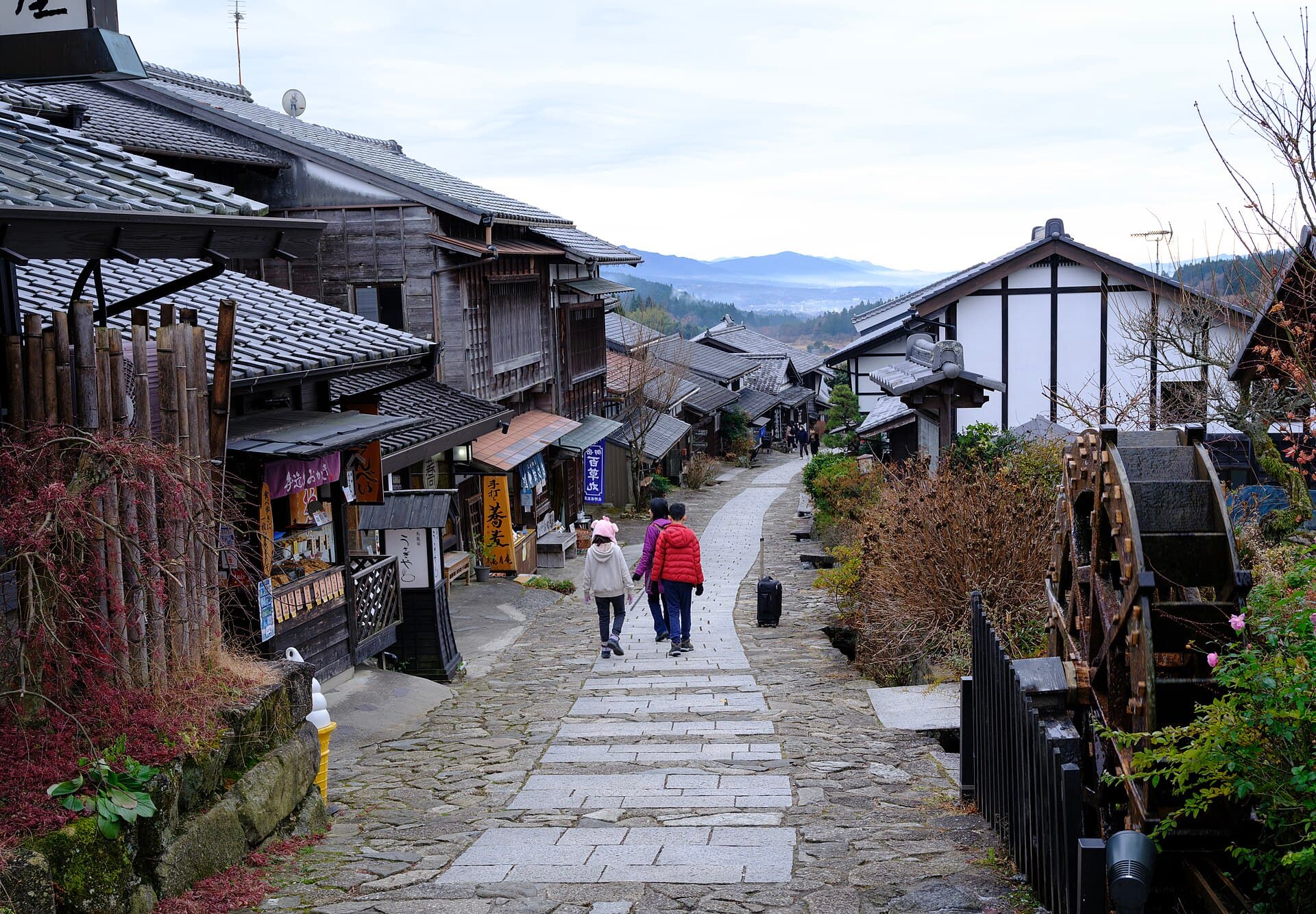 Chensiyuan / CC BY-SA 4.0, via Wikimedia Commons
“Step back in time on a sloping stone path, where Edo-period echoes linger in every wooden beam and waterwheel.”
Not the postcards. The stories even locals don't know — whispered in your ear, right where they happened.
The charming stone path you walk today isn't entirely original.
The name of this post town tells a story of its challenging terrain.
Beyond their picturesque presence, Magome's waterwheels hold a surprising modern purpose.
Discover every secret of Magome
Every address, every reveal in full — in your ear, right where it happened.
You pick your stops. You walk. The voice reveals what the others miss.
No tours available yet. Check back soon — we're preparing them.
Magome-juku, a carefully preserved post town in Gifu Prefecture, offers a tangible link to Japan's Edo period. As the 43rd of 69 post stations along the ancient Nakasendo highway, it once served as a crucial resting point for travelers journeying between Edo (modern Tokyo) and Kyoto. Unlike many post towns built on flat ground, Magome-juku is distinctive for its stone-paved main street that gracefully ascends a steep slope, creating a singular and evocative townscape.
Today, Magome-juku invites visitors to wander its historic street, where traditional wooden buildings house cafes, souvenir shops, and local eateries. The atmosphere evokes a sense of stepping back in time, allowing for a relaxed exploration of a bygone era. It's a place where the sounds of turning waterwheels and the scent of local delicacies contribute to an immersive cultural experience.
The Nakasendo, or "central mountain route," was one of Japan's five major highways during the Edo period (1603-1868), connecting the political capital of Edo with the imperial capital of Kyoto. This inland route traversed mountainous terrain, and along its 530-kilometer length, 69 post towns were established to provide lodging, meals, and horse exchanges for travelers, merchants, and feudal lords on their mandatory sankin-kotai journeys.
Magome-juku, the 43rd post town, played a crucial role in this network. Its challenging, sloping terrain, which gave the town its name (馬籠, meaning 'horse basket' due to horses being left at the foot of the slope), made it a unique stop. Under the strict management of the Tokugawa shogunate, these towns were essential hubs for relaying goods and information.
The prosperity of Magome-juku waned with the advent of the railway in the late 19th century. The construction of the Chuo Main Line bypassed the town, leading to a period of economic decline, population decrease, and the closure of businesses. Further misfortune struck with devastating fires in 1895 and 1915, which destroyed most of the original Edo-era buildings.
However, this very bypassing by modernization inadvertently preserved Magome-juku as a "time capsule." In the 20th century, the town underwent a significant restoration effort, with its traditional wooden houses meticulously rebuilt to recreate the Edo-period appearance. This dedication to historical preservation, coupled with its natural allure, has transformed Magome-juku into a popular destination, recognized even by the Michelin Green Guide Japan.
The primary draw of Magome-juku is its main thoroughfare, a 600-meter stone-paved slope lined with traditional wooden buildings. Strolling this street offers a glimpse into Edo-period Japan, with shops, cafes, and eateries housed in restored structures.
Working waterwheels are a symbolic element of Magome-juku, with water channels running alongside the stone path. These waterwheels, once vital for milling, now generate electricity for lighting. At the upper end of the slope, the Magome Furusato Plaza (Magome Misakidai) provides expansive views of the Central Alps, including Mount Ena.
Magome-juku is also the birthplace of novelist Shimazaki Toson (1872–1943), whose historical novel Before the Dawn is set in the town. The former honjin (main inn) where his family resided is now the Toson Memorial Museum, offering insights into his life and the town's past. Nearby, the Waki-honjin Museum further details the history of Edo-period post towns.
For those seeking a longer immersion, the approximately 8-kilometer Nakasendo hiking trail to the neighboring post town of Tsumago-juku is a highlight, offering a scenic walk through forests and past waterfalls.
The best seasons to visit Magome-juku are spring (April to early May) and autumn (late October to mid-November). In spring, cherry blossoms add a delicate pink hue to the traditional streetscape, and the weather is mild and pleasant for walking. Autumn brings brilliant red and yellow foliage to the surrounding mountains, creating a striking backdrop. While summer offers leafy greenery and cooler temperatures at this altitude, it can be humid. Winter transforms the town into a quiet, snow-covered landscape, which can be magical but cold.
To avoid crowds, consider arriving early in the morning or staying later in the afternoon, as the town is busiest mid-morning to mid-afternoon when tour buses are present.
Magome-juku is accessible by bus from JR Nakatsugawa Station, a journey of approximately 25 minutes. Buses are infrequent, so checking the timetable in advance is essential. Taxis are also an option from Nakatsugawa Station, taking about 25 minutes.
For those hiking the Nakasendo trail to Tsumago-juku, a luggage forwarding service is available between the tourist information centers in both towns from March 20 to November 30. Bags can be dropped off between 8:30 AM and 11:30 AM and collected after 1:00 PM for a fee of ¥1,000 per piece. Coin lockers are also available at Nakatsugawa Station.
Many shops and food stalls in Magome-juku primarily accept cash, so it's advisable to carry sufficient Japanese Yen. While the main street is free to explore, some museums and attractions have admission fees.