The Mafra National Palace Library
This Rococo hall, a sanctuary for ancient texts, employs a unique, nocturnal staff.
Full story unlocks in the tour
 Pedro S Bello / CC BY-SA 4.0, via Wikimedia Commons
“Where a king's solemn promise shaped stone into an empire of Baroque ambition.”
Not the postcards. The stories even locals don't know — whispered in your ear, right where they happened.
This Rococo hall, a sanctuary for ancient texts, employs a unique, nocturnal staff.
Within the palace's twin towers, a chorus of bells creates a soundscape of unparalleled scale.
Beyond the palace walls, a former royal hunting ground now serves a surprising contemporary purpose.
Discover every secret of Mafra
Every address, every reveal in full — in your ear, right where it happened.
You pick your stops. You walk. The voice reveals what the others miss.
No tours available yet. Check back soon — we're preparing them.
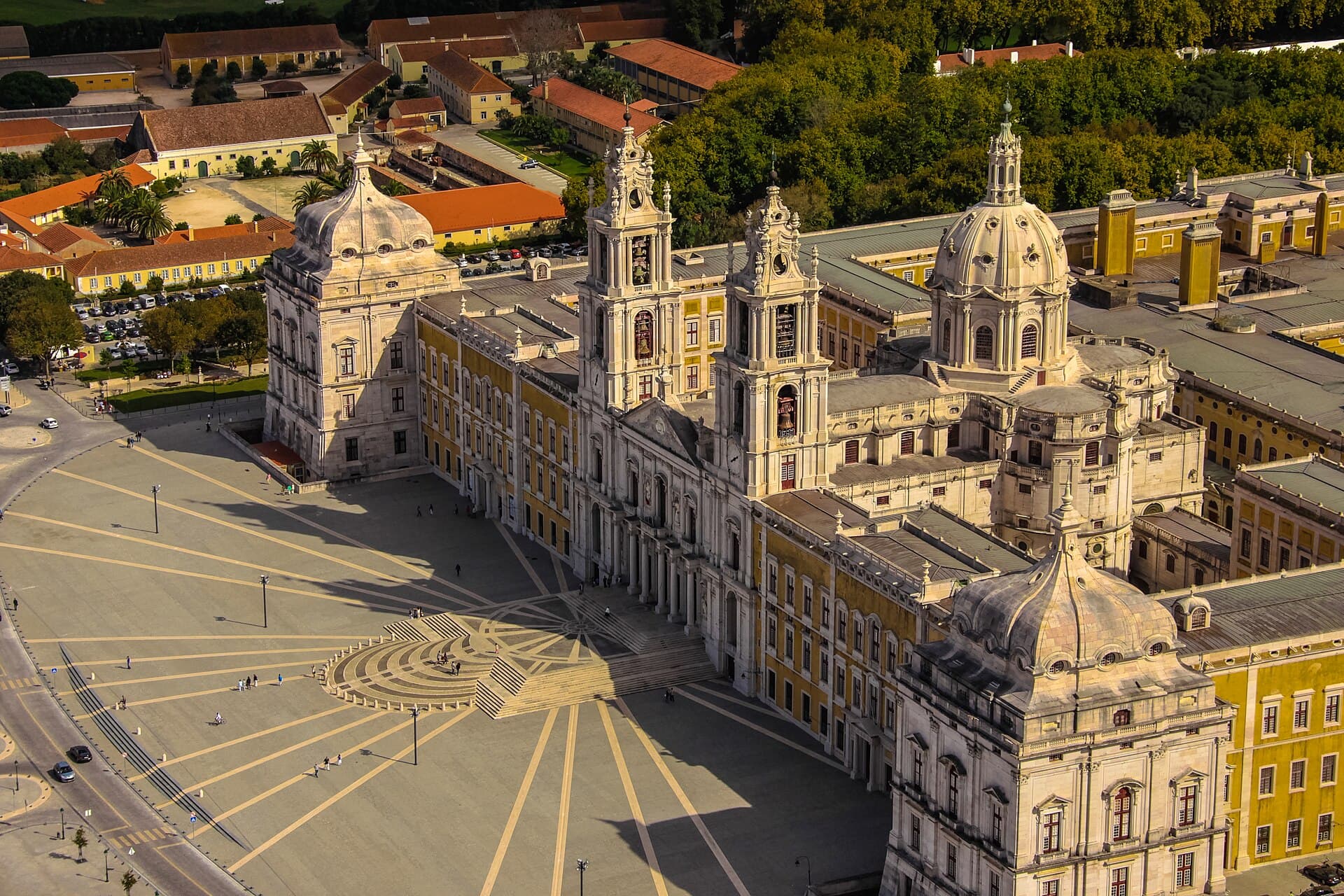
Mafra, a town merely 28 kilometers from Lisbon, is defined by the monumental Baroque and Neoclassical Palace-Convent. This immense complex, recognized as a UNESCO World Heritage site since 2019, encompasses a royal residence, a grand basilica, a convent, a meticulously designed garden, and an expansive hunting park. Its sheer scale—spanning nearly 40,000 square meters with over 1,200 rooms, 4,700 doors and windows, and 156 staircases—stands as a testament to the profound ambition of King João V.
The palace was constructed from local Lioz stone, its imposing 220-meter-long façade facing the town, flanked by two square towers crowned with bulbous domes. Inside, visitors can explore the royal apartments, the convent's infirmary, and the celebrated library. Mafra offers a vivid glimpse into 18th-century Portuguese grandeur and the powerful influence of a monarch's profound vow.
The story of the Mafra National Palace began in 1711 with King João V. After three years of marriage to Maria Anna of Austria without an heir, the king made a solemn vow: if God granted him offspring, he would construct a Franciscan convent. The birth of his first daughter, Infanta Barbara of Portugal, that same year, prompted the initiation of this grand undertaking.
Construction commenced in 1717, initially conceived as a smaller friary for 13 Capuchin friars. However, a sudden influx of gold from the Portuguese colony of Brazil dramatically altered the project's scope. This immense wealth allowed King João V to expand his vision, transforming the modest convent into a lavish palace-monastery intended to rival Spain's El Escorial. The palace was constructed symmetrically around a central basilica, with the royal apartments at one end and the convent structures behind the main façade.
The German architect Johann Friedrich Ludwig (João Frederico Ludovice) was appointed as the lead architect, drawing inspiration from contemporary Italian art and Roman architecture. Construction was a colossal endeavor, mobilizing an average of 15,000 workers daily, sometimes reaching 45,000. Materials were sourced from Italy, France, Brazil, and Flanders, with 1,270 cattle and 7,000 handcarts used for transport. The basilica was consecrated in 1730, and the entire complex was largely finished by 1735, though work continued until 1755.
While never a permanent royal residence, the palace served as a secondary home for the royal family, particularly for hunting in the nearby preserves and attending religious festivities. The palace also accommodated a military contingent under Queen Maria II and later a military training camp under King Pedro V. In 1910, it was from Mafra that D. Manuel II, the last Portuguese monarch, departed into exile. The Royal Building of Mafra, encompassing the palace, basilica, convent, Cerco Garden, and Tapada, was inscribed as a UNESCO World Heritage Site in 2019.
The Mafra National Palace is an expansive complex that invites thorough exploration. Begin with the Royal Palace, where you can wander through the generous royal apartments, offering a glimpse into the lives of Portuguese monarchs. The Basilica, centrally positioned, is a masterpiece of Baroque design, featuring a Latin cross plan, a dome, and an impressive collection of Italian sculpture. It houses six historic pipe organs designed to be played simultaneously, and two carillons with a total of 120 bells, forming the largest carillon ensemble in the world.
Do not overlook the magnificent Library, a Rococo-style hall stretching 88 meters long, containing over 36,000 rare volumes from the 15th to 18th centuries, many hand-bound by monks. The Convent section includes a remarkably well-preserved 18th-century infirmary. Outside, the Jardim do Cerco is a Baroque garden with geometric layouts, verdant greenery, and tranquil ponds, perfect for a contemplative stroll. Adjacent to the palace is the Tapada Nacional de Mafra, a vast former royal hunting ground now a nature reserve, where you can observe diverse wildlife.
Mafra welcomes visitors throughout the year, but the most pleasant times to arrive are late spring (mid-April to early June) and early autumn (mid-September through October). During these transitional seasons, the weather is mild, with temperatures ranging from the high teens to mid-twenties Celsius, and visitor numbers are more moderate than in the peak summer months. July and August offer warm, dry conditions and extended daylight hours, ideal for outdoor pursuits, though you should anticipate more fellow travelers. Winter (November to March) is quieter and cooler, with a greater chance of rain, but the palace's interior remains comfortable. Arriving at the 9:30 AM opening time is recommended to experience less crowded spaces, particularly in the library and basilica.
The Mafra National Palace is open Wednesday to Monday from 9:30 AM to 5:30 PM, with the final entry at 4:30 PM. It closes on Tuesdays, January 1st, Easter Sunday, May 1st, Ascension Thursday, and December 25th. Admission for adults is €15.00, and children under 12 enter without charge. Some sources indicate an admission fee of €6.00, with children under 12 free. Tickets can be purchased online or at the entrance. A typical visit spans 90 minutes to two hours, involving a substantial amount of walking. The palace is approximately 28-30 kilometers from Lisbon, a 45-60 minute drive via the A8 motorway, with free street parking available. Direct Mafrense bus services are accessible from Lisbon's Campo Grande terminal, taking about 75 minutes. The palace is a short bus ride from Ericeira, making it a popular combined day trip.