Wisconsin State Capitol Building
The grand dome of the Wisconsin State Capitol is a familiar sight, but what is embedded within its very structure?
Full story unlocks in the tour
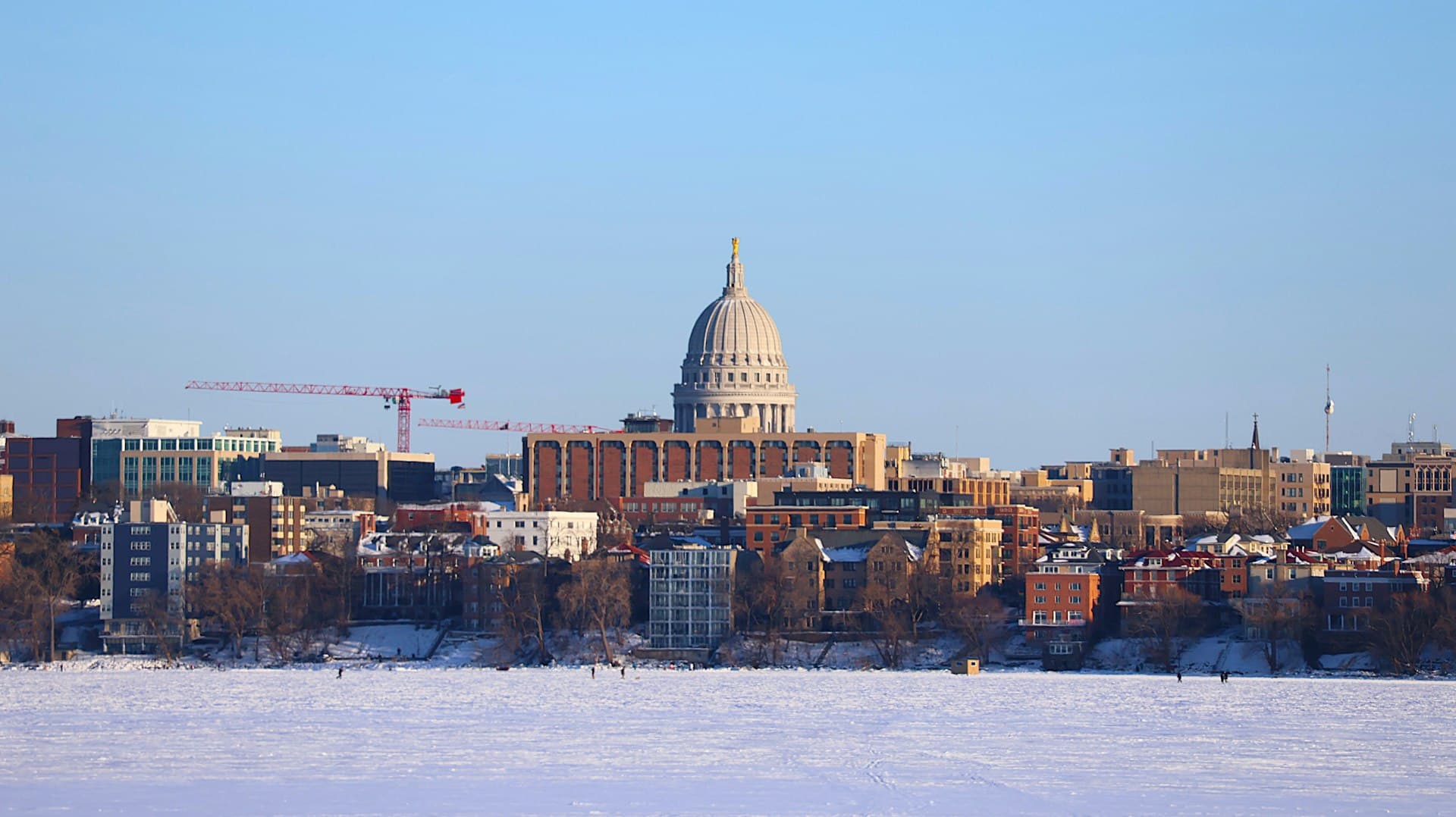 Photo: Kalyan Ram Mantrala / Unsplash
“A lakeside city, capital in spirit, with an unexpected depth.”
Not the postcards. The stories even locals don't know — whispered in your ear, right where they happened.
The grand dome of the Wisconsin State Capitol is a familiar sight, but what is embedded within its very structure?
The Abraham Lincoln statue on Bascom Hill is a campus landmark, but it once had some unexpected company.
Madison's lakes are known for recreation, but one holds a somber, musical secret.
Discover every secret of Madison
Every address, every reveal in full — in your ear, right where it happened.
You pick your stops. You walk. The voice reveals what the others miss.
No tours available yet. Check back soon — we're preparing them.
Madison, Wisconsin, is a city woven into a unique landscape, primarily situated on an isthmus between two of its five lakes: Mendota and Monona. This distinctive geography shapes much of its character, offering waterfront views and a compact, walkable downtown. As the state capital and home to the University of Wisconsin-Madison, the city balances its role as a political center with a lively academic and cultural scene. Often described as "The City of Four Lakes," Madison actually encompasses five lakes, with Waubesa and Kegonsa just south of the city, and the smaller Lake Wingra entirely within its bounds.
Beyond its natural beauty, Madison has a reputation for progressive political activity and a strong sense of community. It is a city that values its local connections, evident in its renowned farmers' market and a burgeoning farm-to-table culinary culture. Whether you are drawn to its historical landmarks, outdoor activities, or active arts scene, Madison offers a blend of experiences that are both engaging and uniquely Midwestern.
The landscape of Madison was sculpted approximately 15,000 years ago by retreating glaciers, leaving behind the distinctive lakes and rolling hills that characterize the region today. For about 12,000 years, Indigenous peoples inhabited this area, with the Ho-Chunk Nation being the primary group around Madison during the influx of European settlers. They knew the area as "Taychopera," meaning "land of four lakes." The University of Wisconsin-Madison campus alone contains more effigy mounds and archaeological sites than any other university globally.
Madison's modern origins trace back to 1829, when former federal judge James Duane Doty purchased over a thousand acres of land on the isthmus between Lakes Mendota and Monona. His intention was to build a city in the Four Lakes region. When the Wisconsin Territory was established in 1836, the territorial legislature convened in Belmont. Doty successfully lobbied for Madison to become the permanent capital, largely due to its central location between burgeoning eastern cities and established western posts. He named the city after President James Madison, who had recently passed away, and even named the streets after the other 38 signers of the U.S. Constitution.
The cornerstone for the first Wisconsin State Capitol was laid in 1837, and the legislature first met there in 1838. Madison was incorporated as a village in 1846 and then as a city in 1856. When Wisconsin achieved statehood in 1848, Madison remained its capital, and the University of Wisconsin was founded the same year. The original capitol building was replaced in 1863, but a second capitol was destroyed by fire in 1904. The current Wisconsin State Capitol, a Beaux-Arts and Neoclassical design, was constructed between 1906 and 1917. During the Civil War, Madison served as a significant center for the Union Army in Wisconsin.
Begin your exploration at the Wisconsin State Capitol Building, a prominent landmark situated on the isthmus. This impressive structure features the world's only granite dome and is adorned with 43 types of stone from eight states and six countries. Free guided tours are available, offering a look at its intricate mosaics and hand-carved furnishings. A city ordinance ensures that no other building on the isthmus can surpass the Capitol's dome in height, preserving its place in the skyline.
Just a short walk from the Capitol, you will find the Dane County Farmers' Market around Capitol Square. It is the largest producer-only farmers' market in the United States, with vendors selling a wide array of local produce, cheeses, and artisanal goods.
For art enthusiasts, the Madison Museum of Contemporary Art (MMoCA) offers free admission and a diverse collection of modern and contemporary art, including a rooftop for city views. The Chazen Museum of Art at the University of Wisconsin-Madison is another free option, showcasing a broad range of art.
Experience the natural beauty of Madison at Olbrich Botanical Gardens, featuring 16 acres of outdoor display gardens and a tropical conservatory. A highlight is the traditional Thai Pavilion, the only one of its kind in the continental United States. For a different outdoor experience, the University of Wisconsin–Madison Arboretum offers over 17 miles of trails and numerous effigy mounds.
The best time to visit Madison for warm-weather activities is from mid-June to early September, when average daily temperatures are pleasant. June, in particular, offers long days and comfortable conditions for enjoying the city's outdoor spaces and lake activities. May and September also provide milder weather with less rain and moderate temperatures, ideal for exploring. While winter can be beautiful with frozen lakes and opportunities for ice skating and cross-country skiing, temperatures can be quite cold.
Madison is easily navigable, especially the downtown area, which is compact and walkable. Biking is also a popular way to get around, with electric bikes available for rent. Public transportation options are available, and parking information for cars, motorcycles, and bikes can be found on the Downtown Madison website. The Downtown Madison Visitor Center, located at 452 State Street, is a good resource for maps, event information, and local suggestions. Many attractions, including the State Capitol, Olbrich Botanical Gardens, and several museums, offer free admission. Madison is known for its culinary scene, with a strong emphasis on local and farm-to-table dining, particularly around the Capitol Square. Do not miss the opportunity to try local specialties like fresh, squeaky cheese curds.