St. George's Greek Orthodox Church
The renowned Madaba Mosaic Map, depicting the Holy Land, is a marvel, yet few grasp the circumstances of its emergence.
Full story unlocks in the tour
 Freedom's Falcon / CC BY-SA 3.0, via Wikimedia Commons
“Where ancient maps are etched in stone, and every step tells a story.”
Not the postcards. The stories even locals don't know — whispered in your ear, right where they happened.
The renowned Madaba Mosaic Map, depicting the Holy Land, is a marvel, yet few grasp the circumstances of its emergence.
Beyond the impressive mosaic floors, the park safeguards a secret about the daily lives and beliefs of Madaba's ancient inhabitants, extending beyond religious iconography.
This church offers more than just religious significance; it provides a unique perspective on Madaba's layered past.
Discover every secret of Madaba
Every address, every reveal in full — in your ear, right where it happened.
You pick your stops. You walk. The voice reveals what the others miss.
No tours available yet. Check back soon — we're preparing them.
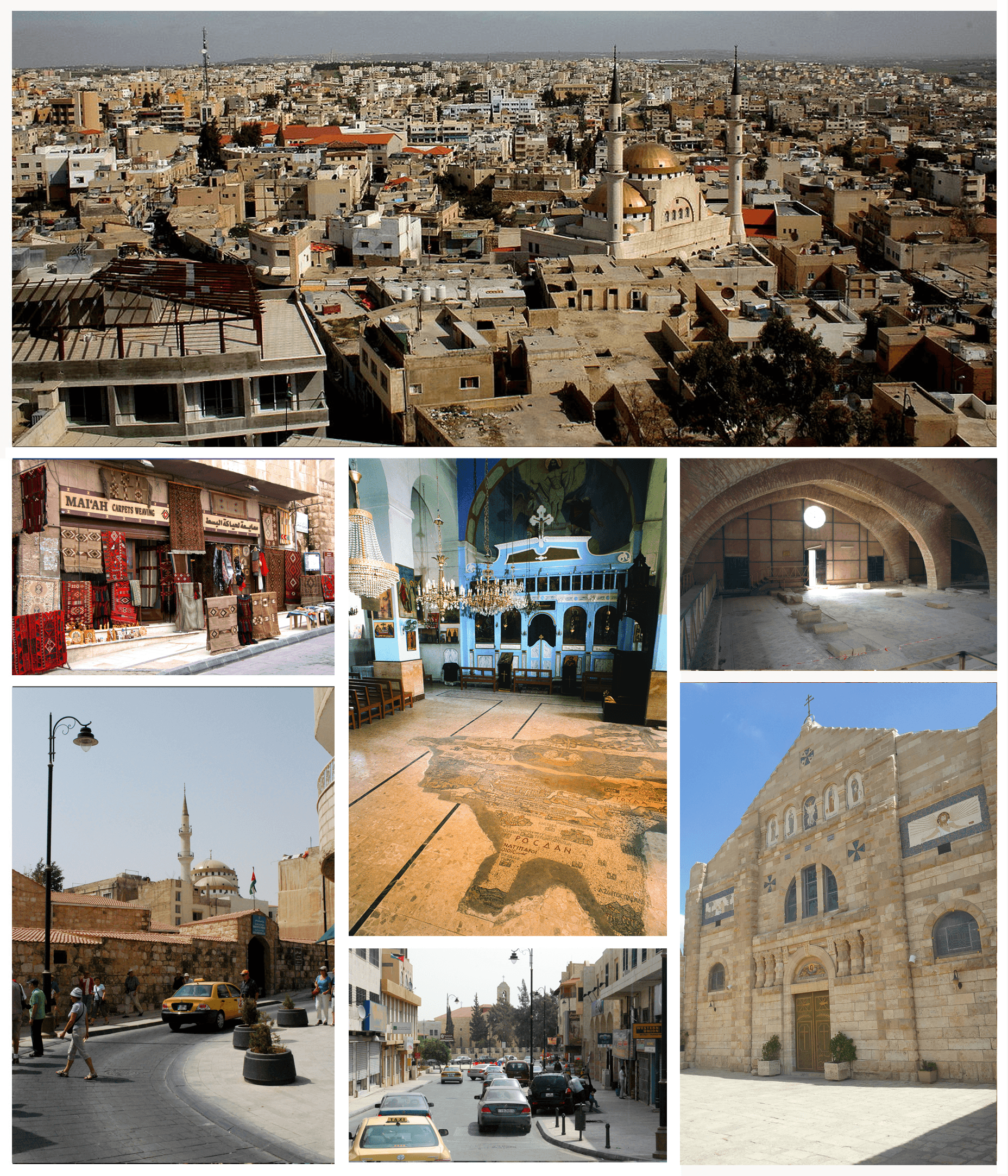
Madaba, often referred to as the "City of Mosaics," is a captivating destination in central Jordan, approximately 30 kilometers southwest of Amman. This city, with a population of about 60,000, offers a more relaxed atmosphere compared to the bustling capital. Madaba is celebrated for its extraordinary collection of Byzantine and Umayyad mosaics, many of which are remarkably well-preserved and date back over a thousand years. These intricate artworks, found in churches, archaeological sites, and museums, depict a diverse range of subjects from biblical stories and daily life to mythological tales and natural scenes.
The city's historical significance extends to the Middle Bronze Age, around 2000 BCE, making it over 4,000 years old. Madaba's strategic location along the ancient King's Highway also makes it an ideal base for exploring other significant sites in northern Jordan, including the Dead Sea and Mount Nebo. Whether you are an archaeology enthusiast, a history buff, or simply a curious traveler, Madaba offers an authentic Jordanian experience, inviting visitors to explore its deep heritage and lively local culture.
Madaba's history is a deep narrative woven through millennia, with its origins tracing back to the Middle Bronze Age, around 2000 BCE. It is mentioned in the Old Testament of the Hebrew Bible as Medeba or Medaba, notably in Numbers 21:30, where it is described as being conquered by the Amorite King Sihon of Heshbon. The city later served as a stronghold for the Moabites in the 9th century BCE.
Madaba was incorporated into the Roman Province of Arabia in 106 CE after Emperor Trajan's defeat of the Nabataeans. Christianity took hold in the late Roman period, with evidence of a bishop in Madaba as early as the mid-5th century. The city truly prospered during the Byzantine period, particularly in the 6th century, becoming a significant religious center. This era saw the construction of numerous churches adorned with elaborate and costly mosaic floors, for which Madaba is now recognized. The world-renowned Madaba Mosaic Map, dating to the 6th century, is a prime example of the artistic and cartographic prowess of this period.
In 746 CE, a devastating earthquake severely damaged Madaba, leading to a significant decline in its importance and eventual abandonment for centuries. The city remained largely deserted until the late 19th century. In 1880, Christian families from Kerak resettled in Madaba, seeking refuge from persecution. As they began rebuilding their homes and churches on the foundations of ancient structures, they uncovered the remarkable mosaic floors that had been interred for centuries. The discovery of the Madaba Mosaic Map in St. George's Church in 1884 brought international attention to the city and sparked extensive archaeological excavations, which continue to this day. This rediscovery breathed new life into Madaba, transforming it into a lively center for mosaic art and a key destination for cultural and religious tourism.
Begin your exploration at the Greek Orthodox Church of St. George, home to the iconic 6th-century Madaba Mosaic Map. This intricate floor mosaic is the oldest known cartographic depiction of the Holy Land, detailing biblical sites from Egypt to Palestine.
Next, visit the Madaba Archaeological Park, an open-air museum showcasing a collection of ancient mosaics and Roman ruins. Highlights include the remains of the Church of the Virgin Mary and the Hippolytus Hall, featuring a unique mosaic with classical mythological scenes.
For another perspective on Madaba's Christian heritage, explore the Shrine of the Beheading of St. John the Baptist. This church, built over Roman and Byzantine foundations, offers underground passages and a bell tower with expansive city views.
The Madaba Museum (Al Twal House) offers further insight into the city's mosaic legacy and broader Jordanian history, with archaeological and folk museum sections.
A short drive from Madaba is Mount Nebo, the biblical site where Moses is said to have viewed the Promised Land. It provides sweeping vistas of the Jordan Valley, the Dead Sea, and on clear days, even Jerusalem.
The best times to visit Madaba are during the spring (March to May) and autumn (September to November). During these months, the weather is mild and pleasant, making it ideal for exploring the city's outdoor attractions and nearby sites. Spring brings blooming landscapes, while autumn offers comfortable temperatures and generally fewer crowds than peak seasons in other parts of Jordan. Summers (June to August) can be very hot, with temperatures often exceeding 35°C (95°F), which can make sightseeing challenging. Winters (December to February) are mild with occasional rain.
Madaba is approximately 30 kilometers southwest of Amman and about a 30-minute drive from Queen Alia International Airport, making it a convenient first or last stop on a Jordanian itinerary. Taxis from the airport cost around 22.50 Jordanian Dinars (approximately $32 USD). The city itself is very walkable, with most attractions within a 15-minute radius. For day trips to nearby sites like the Dead Sea or Mount Nebo, taxis or shared shuttles are readily available. The local currency is the Jordanian Dinar (JOD). Dress modestly, especially when visiting religious sites. Madaba offers various accommodation options, including locally-owned guesthouses. Consider purchasing the Jordan Pass, as it includes entry to many attractions and waives visa fees for most nationalities.