Lund Cathedral Crypt
Descend into the crypt of Lund Cathedral, and you'll encounter a stone figure often overlooked by casual visitors.
Full story unlocks in the tour
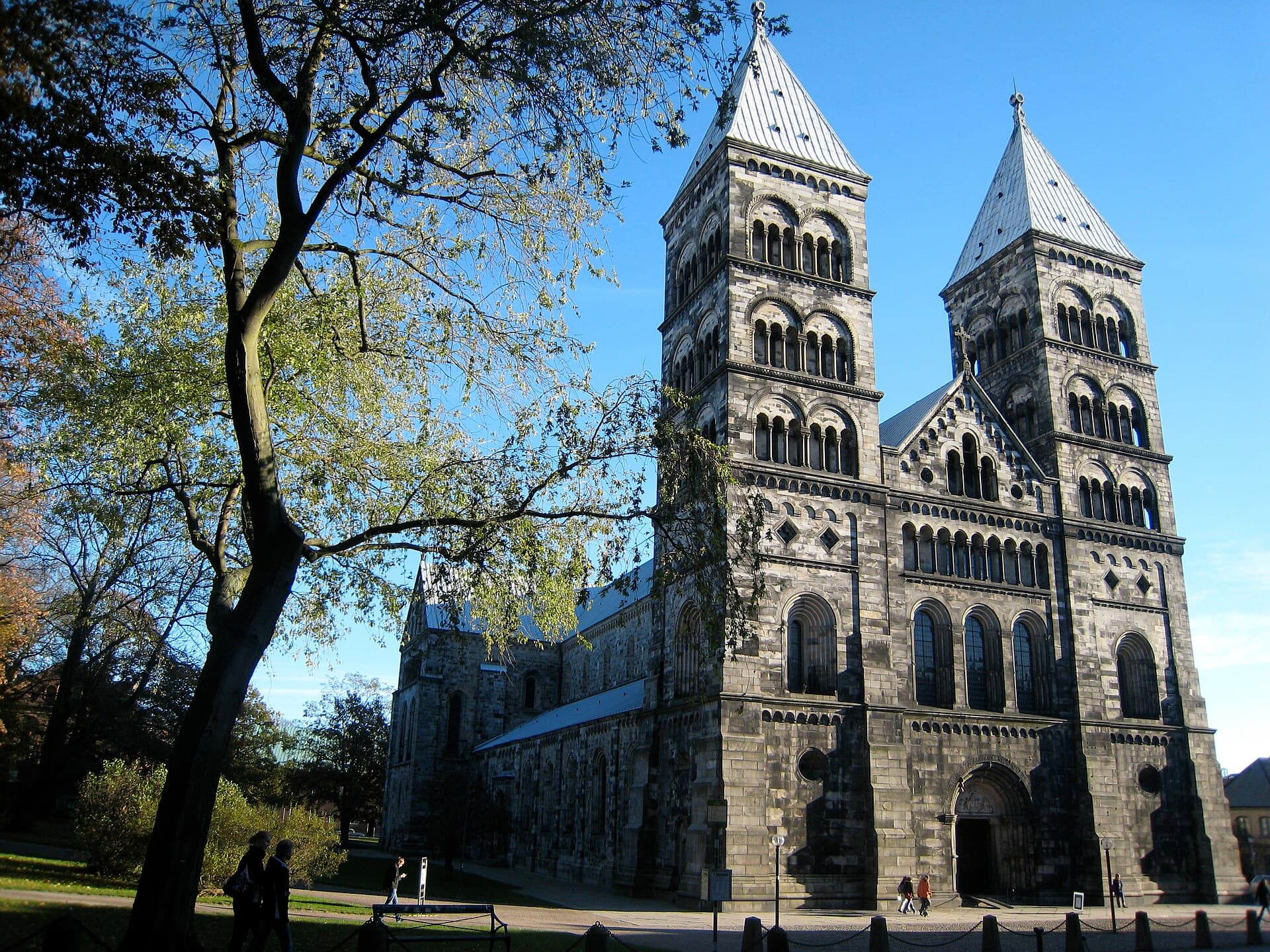 Kallekn / CC BY-SA 3.0, via Wikimedia Commons
“Where ancient stones meet a youthful pulse.”
Not the postcards. The stories even locals don't know — whispered in your ear, right where they happened.
Descend into the crypt of Lund Cathedral, and you'll encounter a stone figure often overlooked by casual visitors.
Within the grand Lund University Main Building, a peculiar collection resides, a testament to academic eccentricity.
Kulturen is an open-air museum, but one particular aspect makes it stand out from others around the world.
Discover every secret of Lund
Every address, every reveal in full — in your ear, right where it happened.
You pick your stops. You walk. The voice reveals what the others miss.
No tours available yet. Check back soon — we're preparing them.
Lund, a city in southern Sweden, offers a singular blend of ancient foundations and youthful energy. It is often described as a compelling university town, where aged lanes and medieval architecture coexist with a lively student atmosphere. As one of Sweden's oldest cities, with origins dating back to around 990 AD, Lund's deep past is palpable in its well-preserved core.
More than just a stop on a typical European itinerary, Lund invites visitors to slow down and absorb its distinct character. The city's compact size makes it incredibly walkable, encouraging exploration of its narrow lanes, colorful houses, and welcoming cafés. With Lund University at its heart, the city pulses with an intellectual and relaxed student current, contributing to its lively cultural landscape and innovative spirit.
Lund is conveniently located in the region of Skåne, just a short train ride from Malmö and easily accessible from Copenhagen Airport in Denmark. This makes it an ideal destination for a day trip or a calm overnight stay, offering a different pace from larger, more bustling cities.
The origins of Lund can be traced back to approximately 990 AD, founded during the reign of Danish King Sweyn Forkbeard, when the region of Skåne was part of Denmark. Archaeological discoveries suggest it may have been a relocation of settlers from the older Uppåkra settlement. Initially, Lund was strategically planned as a center of royal and ecclesiastical power.
Lund's importance grew significantly in the 11th century. It became the seat of a bishopric in 1060 and, crucially, was elevated to an archbishopric in 1103, overseeing all of Scandinavia. This transformation earned Lund titles like "Metropolis Daniae" and "Scandinavia's Rome." The economic conditions for constructing Lund Cathedral and establishing a cathedral school were laid by a donation from Canute the Holy in 1085. The crypt of the Romanesque-style cathedral was completed by 1123, and the main altar consecrated in 1145. In its medieval heyday, Lund contained 27 churches and monasteries.
The Reformation in 1536 saw the dissolution of most monasteries and churches in Lund, with only the Cathedral and St. Peter's Priory remaining. Denmark ceded Skåne, including Lund, to Sweden in 1658 through the Treaty of Roskilde. Soon after, in 1666, Lund University was established, a pivotal moment that transformed the city from a religious center into an academic one. The university quickly became one of Scandinavia's oldest and largest institutions for education and research, profoundly shaping Lund's identity.
Despite a brief recapture by Denmark during the Scanian War in 1676, which included a bloody battle just north of the city, Lund remained Swedish. King Charles XII even governed Sweden from Lund between 1716 and 1718. The 19th century brought renewed growth, with the railway connecting Lund to the rest of Sweden and Europe, leading to the demolition of old city ramparts. The 20th century saw the city's population more than double, driven by the continued expansion of the university and the rise of high-tech industries, including the founding of Tetra Pak in 1951. Today, Lund continues to be a hub of knowledge and innovation, blending its deep historical roots with a forward-looking spirit.
Begin your exploration at Lund Cathedral (Lunds Domkyrkan), a prominent Romanesque basilica dating back to the 12th century. Its imposing twin towers are a city landmark, and inside, you'll find an impressive astronomical clock from around 1425 that chimes twice daily, and the atmospheric crypt.
Adjacent to the Cathedral is Lundagård Park, a green space surrounded by historic university buildings, including the main university building and the Lund University Library. Wander through the Lund Botanical Garden (Botaniska Trädgården), which houses over 7,000 species and offers a peaceful escape.
For a journey through cultural history, visit Kulturen, an open-air museum with historic houses and exhibitions showcasing life from the Middle Ages to the 1930s. The Historical Museum at Lund University offers insights into the region's past, from the Stone Age to medieval artifacts. Don't miss the Museum of Sketches for Public Art (Skissernas Museum), which collects studies and sketches for public art. Stroll through Stortorget, the main square, and the surrounding old town streets to absorb the city's character.
The best time to visit Lund is during the warmer months, from mid-May to the end of September. Summer, specifically June to August, offers the warmest temperatures, ranging from 15°C to 25°C (59°F to 77°F), and the longest daylight hours, perfect for outdoor activities and exploring the city's green spaces. Late spring (April-May) and early autumn (September-October) also provide pleasant temperatures with fewer crowds, as the city awakens with blooming flowers or transitions with crisp air. While winter can be cold and dark, Lund remains engaging, though many outdoor attractions are less accessible.
Lund is a city that encourages walking and cycling. Its compact size means most attractions are easily accessible on foot, and it is recognized as a "City of Bikes," with rentals readily available. For longer distances, the public transport system, operated by Skånetrafiken, is efficient and cashless; tickets can be purchased via their app or by tapping a contactless card on buses.
When packing, consider Lund's changeable weather. Layered clothing is advisable, along with a windproof and waterproof jacket for unexpected rain showers. Comfortable walking shoes are essential for navigating the city's charming, yet uneven, lanes, particularly around the cathedral and university areas. If arriving by air, Copenhagen Airport (CPH) offers more public transport options to Lund than Malmö Airport (MMX), with a train journey taking approximately 35 minutes across the Øresund Bridge.