Gammelstad Church Town
Imagine a town where people constructed small dwellings, not for permanent residence, but solely for weekend church visits.
Full story unlocks in the tour
 Andreas Harnemo / CC BY-SA 3.0, via Wikimedia Commons
“Where the Arctic's breath shapes the land, and innovation finds its cold, clear home.”
Not the postcards. The stories even locals don't know — whispered in your ear, right where they happened.
Imagine a town where people constructed small dwellings, not for permanent residence, but solely for weekend church visits.
Before climate-controlled retail became common, one northern Swedish city pioneered the concept.
A city near the Arctic Circle leads globally in digital infrastructure, drawing tech giants for an unexpected reason.
Discover every secret of Luleå
Every address, every reveal in full — in your ear, right where it happened.
You pick your stops. You walk. The voice reveals what the others miss.
No tours available yet. Check back soon — we're preparing them.
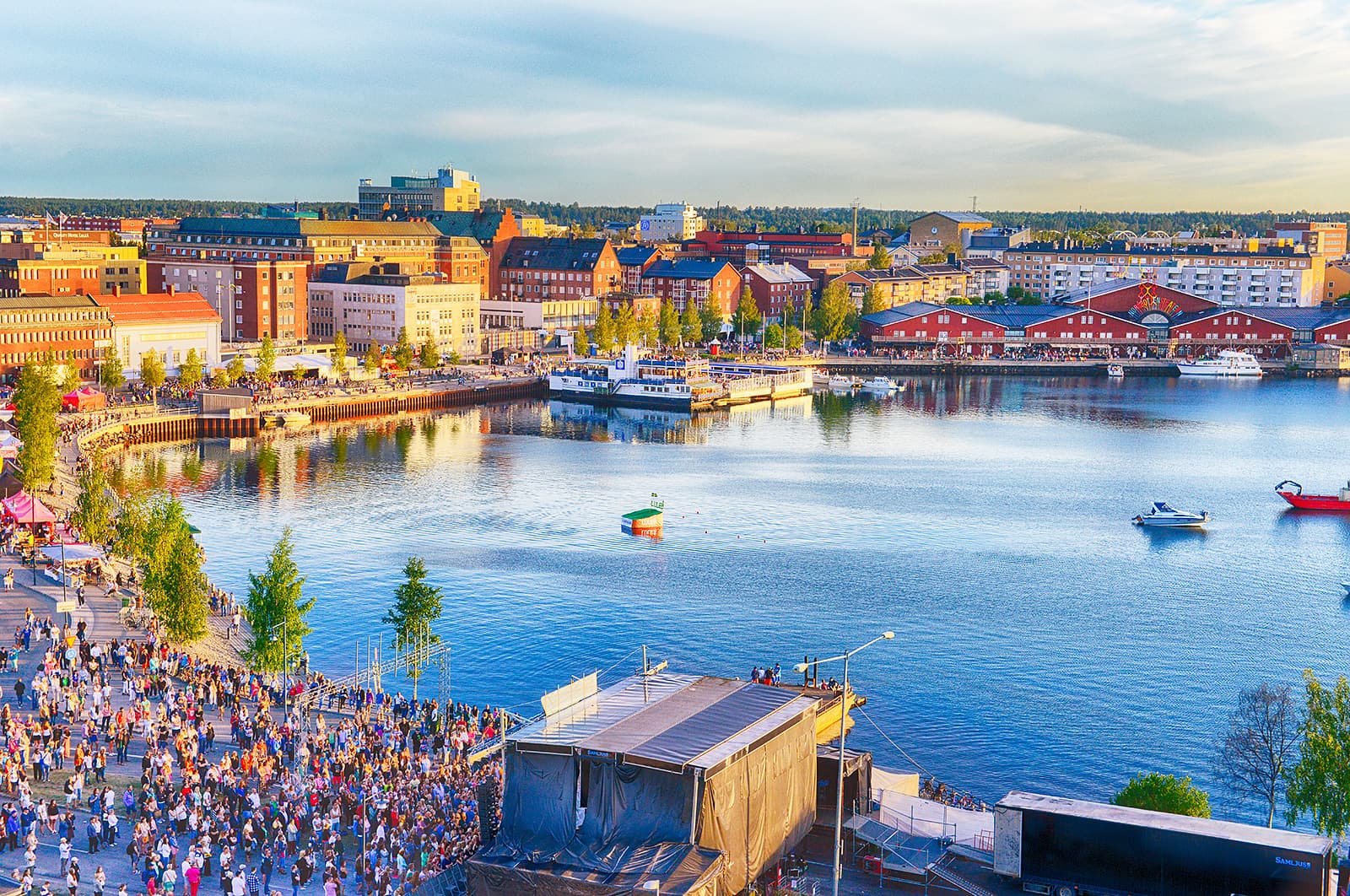
Luleå, the largest city in Swedish Lapland, settles at the mouth of the Lule River where it merges with the Gulf of Bothnia. This coastal city, with a population of approximately 80,000, offers a singular fusion of modern ingenuity and Arctic nature. Situated just below the Arctic Circle, Luleå experiences dramatic seasonal shifts, from the endless daylight of the Midnight Sun in summer to the snow-covered, enchanting landscapes of winter.
Serving as a gateway to Swedish Lapland, Luleå is a city that invites discovery, whether your interest lies in its deep past, its cutting-edge technology, or the compelling natural surroundings. It is a place where you can stride across a frozen sea, pursue the Aurora Borealis, or delve into a UNESCO World Heritage site, all within easy reach. The city's compact core makes navigation simple, with many points of interest accessible by foot.
Luleå is not merely a destination for adventure; it is also a center for education and industry, housing Luleå University of Technology and a substantial steel industry. Despite its contemporary feel, the city maintains a welcoming atmosphere, providing an authentically local encounter.
The story of Luleå stretches back to the Middle Ages, when the area served as a significant trading post and gathering place. The city officially received its charter in 1621 from King Gustav II Adolf of Sweden. The original settlement was situated approximately 10 kilometers from the present-day city center, in what is now known as Gammelstad (Old Town).
A pivotal moment in Luleå's development occurred in 1649. Due to post-glacial rebound, a geological process causing land to rise, the harbor in Gammelstad became too shallow for ships. This necessitated the relocation of the city to its current coastal site, closer to the open sea. Despite a royal decree, some residents initially resisted the move, preferring to remain in Gammelstad.
Luleå's progress was hindered by several destructive fires throughout its existence. Major fires in 1653, 1657, and particularly in 1887, consumed significant portions of the city. The 1887 fire, in particular, prompted a comprehensive reconstruction plan. The new layout featured wide streets and boulevards, designed not only for aesthetic appeal but also as a fire safety measure to prevent rapid spread between buildings. The city center still retains this geometric structure today.
In the 19th century, Luleå began to thrive as an industrial center, propelled by iron ore, timber, and steel. The construction of the iron ore harbor commenced in 1883, and the first train carrying iron ore from Gällivare arrived in 1888, marking the beginning of a significant period of expansion. The Norrbotten Ironworks, now SSAB Luleå, was constructed in the 1940s and remains one of Europe's most advanced steelworks. In 1955, Luleå made history with the inauguration of 'Shopping,' the world's first indoor shopping mall, envisioned by architect Ralph Erskine. The city continued to expand, and in 1969, the municipalities of Luleå City, Nederluleå, and Råneå merged to form the larger Municipality of Luleå. In 1971, Luleå University of Technology was established, further cementing the city's role as an educational and research center.
Luleå presents a varied array of sights and activities, blending cultural heritage with natural wonders. A visit to Gammelstad Church Town is essential, a UNESCO World Heritage site situated just beyond the city center. This remarkably preserved medieval church village features over 400 red-painted wooden cottages surrounding a 15th-century stone church.
For those drawn to the outdoors, the Luleå Archipelago stands out, comprising over 1,300 islands. In summer, it offers ideal conditions for kayaking, sailing, and hiking, with tour boats providing access to many islands. In winter, the frozen sea transforms into a playground for ice skating, kick-sledding, and even driving on designated ice roads. The 10-kilometer ice track encircling the city's central peninsula is a favored location for winter activities.
Beyond these, explore the city center with its distinctive architecture, including 'Shopping,' the world's first indoor mall. For a taste of local culture, consider visiting the Norrbotten County Museum or Kulturens hus, which houses a library, art gallery, and concert halls. Nature enthusiasts can also journey to Storforsen, Europe's largest unregulated rapids, about an hour's drive from Luleå, for an awe-inspiring display of natural power.
Luleå is a year-round destination, with each season presenting distinct experiences. For warm-weather activities and the Midnight Sun, the ideal time to visit is from early July to mid-August, when temperatures average around 16-18°C. During this period, the sun barely dips below the horizon, providing extended daylight for outdoor pursuits.
To experience Luleå as a winter wonderland, with snow, ice, and cold weather, plan your trip between mid-December and the end of February. This is also the prime season for viewing the Aurora Borealis, which is visible from September to March when the sky is clear. The frozen sea and ice roads are best enjoyed from January into March.
Luleå Airport (LLA) is conveniently located about 10 minutes from the city center, with daily flights from Stockholm. Alternatively, an overnight train from Stockholm offers a scenic and comfortable journey. Once in Luleå, the city center is compact and easily walked. For longer distances, an efficient local bus system (LLT) is available, with tickets purchasable via their mobile app or at the bus station. Taxis and car rentals are also options, especially for exploring the archipelago via ice roads in winter.
When preparing your luggage, particularly for winter visits (October to April), layering is essential. Thermal underwear (wool or synthetic), a warm fleece or sweater, and a wind- and water-resistant outer shell are recommended. Insulated, waterproof boots with good grip are crucial for icy conditions. In summer, while days are mild, temperatures can still drop, so bringing layers is always wise. Most Swedes speak English, so communication is generally straightforward. Tipping is not mandatory but is appreciated for good service, typically around 10%.