Lugo's Roman Walls
The Roman walls of Lugo, a UNESCO World Heritage site, stand as the only fully intact Roman city walls anywhere. Their initial purpose, however, might surprise you.
Full story unlocks in the tour
 D.Rovchak / CC BY-SA 4.0, via Wikimedia Commons
“Lugo: Where ancient Roman walls embrace a living, breathing city.”
Not the postcards. The stories even locals don't know — whispered in your ear, right where they happened.
The Roman walls of Lugo, a UNESCO World Heritage site, stand as the only fully intact Roman city walls anywhere. Their initial purpose, however, might surprise you.
Lugo Cathedral presents a convergence of Romanesque, Gothic, Baroque, and Neoclassical styles, a testament to centuries of building. Yet, one singular feature within distinguishes it from nearly every other cathedral in Spain.
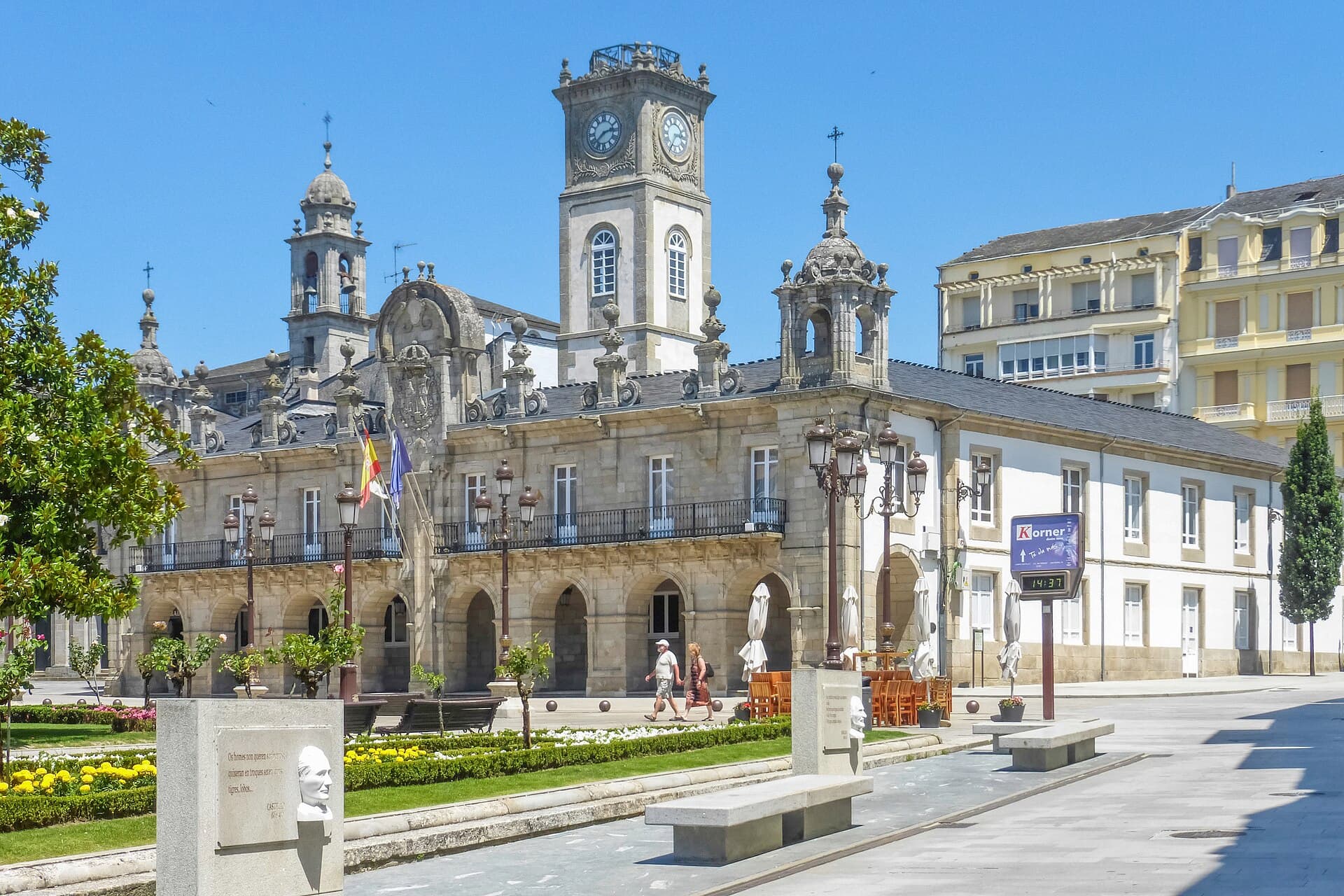
Lugo's main square, Praza Maior, pulses with activity, framed by elegant arcades and the Baroque City Hall. However, a subtle detail along its edge connects it to a broader Galician cultural legacy.
Discover every secret of Lugo
Every address, every reveal in full — in your ear, right where it happened.
You pick your stops. You walk. The voice reveals what the others miss.
No tours available yet. Check back soon — we're preparing them.
Lugo, a city in Spain's northwestern region of Galicia, stands as an enduring testament to history, most notably through its remarkably preserved Roman walls. Founded as Lucus Augusti around 14 BC, it is one of Galicia's most ancient cities. The city's Roman past is deeply embedded in its layout and surviving structures, which have shaped Lugo for over 2,000 years.
Beyond its ancient fortifications, Lugo offers a compact and walkable old town, where pedestrian streets, open squares, and gardens invite exploration. The city is also a significant stop on the Camino Primitivo, one of the routes of the Camino de Santiago, welcoming pilgrims through its historic gates. Lugo's lively local life, combined with its profound heritage and acclaimed gastronomy, provides an authentic Galician experience.
## From Roman Foundation to Medieval Crossroads Lugo's origins trace back to a Roman settlement established around 14 BC by Paulo Fabio Máximo, named Lucus Augusti in honor of Emperor Octavian Augustus. The city quickly grew into a significant administrative and military center in northwestern Hispania, particularly due to the region's abundant gold mines, which supported the Roman Empire's economy.
The most defining feature of Lugo, its Roman walls, were constructed between 263 and 276 AD. These formidable fortifications, built with slate slabs and granite, were designed to protect the Roman town from local tribes and Germanic invaders. Despite their defensive purpose, the walls also delimited the city's charter and tax collection points. The walls are singular as they are the only fully intact Roman city walls in the world, stretching over 2 kilometers with 85 towers (71 of which are still standing) and originally five gates.
Following the decline of the Roman Empire, Lugo experienced occupations by the Suebi, Visigoths, and Moors. King Alfonso I ordered the city's reconstruction in 741 after Muslim invasions, and Lugo became an important religious center. During the Middle Ages, Lugo gained prominence as a pilgrimage site due to the presence of a continuously displayed consecrated host in its cathedral—a rare privilege. The city also became a key reference point for pilgrims on the Camino Primitivo. Urban expansion in the 19th century led to the addition of five new gates to the Roman walls, bringing the total to ten.
Begin your exploration with a walk along the Roman Walls of Lugo. This UNESCO World Heritage site offers a continuous 2.1-kilometer circuit atop the ramparts, providing views of the old town and the newer parts of the city. Access to the walls is free and available at various points, such as near the cathedral or Porta Nova.
Within the walls, the Lugo Cathedral (Catedral de Santa María) is a blend of Romanesque, Gothic, Baroque, and Neoclassical architectural styles. Inside, observe the unique continuously exposed Blessed Sacrament and the ornate walnut choir stalls.
Praza Maior is the city's main square, a natural meeting point with gardens, shady trees, and the Baroque City Hall. It's an ideal spot for a coffee and people-watching. Nearby, explore the narrow streets lined with shops and cafes, or visit the Mercado de Abastos for local produce and Galician specialties.
For a deeper dive into the region's past, the Museo Provincial de Lugo houses art, history, and cultural exhibits, with a significant archaeological section that includes Roman mosaics. Consider a stroll across the Old Roman Bridge (Ponte Vella de Lugo) over the Miño River, which also dates back to the Roman era.
The ideal time to visit Lugo is during the spring and early autumn months, specifically May, June, September, and early October. During these periods, the weather is pleasant for walking, and the city's terraces and plazas are lively without the peak intensity of summer crowds. Summers, from June to August, are generally mild to pleasantly warm during the day and cool at night, with less rain. While July is the driest month, November is the wettest. Lugo also hosts significant festivals, such as Arde Lucus in June and the Saint Froilán Festivity in early October, which offer rich cultural experiences.
Lugo is a compact city, and its historic center, enclosed by the Roman walls, is easily explored on foot. For areas beyond the walls, local urban bus services are available. The nearest airports are Santiago de Compostela (SCQ) and A Coruña (LCG), both about two hours away by train or bus. Direct train connections to Lugo are available from Ourense, Monforte de Lemos, and Madrid, though the journey from Madrid can be lengthy.
Accommodation options are available both inside the walled center for a historical atmosphere and near Ramón Ferreiro for easier parking. Lugo is known for its lively and affordable food scene, with generous tapas often served free with a drink in many bars. Dining hours typically see lunch starting around 2:00 PM and dinner around 9:00 PM. The cost of living in Lugo is relatively affordable compared to other Spanish cities, with public transportation being budget-friendly.