The Lion Monument
A persistent rumor suggests a subtle slight within this poignant memorial.
Full story unlocks in the tour
 Slav Yakounin / CC BY-SA 4.0, via Wikimedia Commons
“Where alpine grandeur meets medieval elegance.”
Not the postcards. The stories even locals don't know — whispered in your ear, right where they happened.
A persistent rumor suggests a subtle slight within this poignant memorial.
This medieval clock tower holds a unique distinction in Lucerne's auditory landscape.
This celebrated wooden bridge, though beautifully restored, carries visible evidence of a destructive event.
Discover every secret of Lucerne
Every address, every reveal in full — in your ear, right where it happened.
You pick your stops. You walk. The voice reveals what the others miss.
No tours available yet. Check back soon — we're preparing them.
Lucerne, or Luzern as it is known in Swiss Standard German, is a beautiful city in central Switzerland, situated on the northwestern edge of Lake Lucerne and framed by the Swiss Alps. It is a city that gracefully combines natural beauty with a long history, making it a favored stop on the European "Grand Tour" route for centuries. Divided by the Reuss River, Lucerne's old town (Altstadt) to the north and new town (Neustadt) to the south are easily explored on foot, offering a compact and engaging experience.
Considered one of Europe's most appealing destinations, Lucerne serves as a center of economics, transport, culture, and media for Central Switzerland. Its ideal setting, mild climate, and access to surrounding mountains like Pilatus and Rigi make it a popular year-round destination. Whether one is drawn to its well-preserved medieval structures, its sparkling lake, or its lively cultural offerings, Lucerne leaves a strong and positive impression on visitors.
## From Monastery to Confederation Lucerne's origins can be traced back to the early 8th century with the establishment of the Benedictine Monastery of St. Leodegar. By the mid-9th century, the area, then called Luciaria, came under the authority of the Murbach Abbey in Alsace. The city's official founding year is often cited as 1178, when it gained independence from the Murbach Abbey and began to thrive as an influential town along the Gotthard trade route. This strategic position facilitated growing commerce between the upper Rhine and Lombardy, contributing to its early development.
## Seeking Independence and Growth In 1290, King Rudolph I von Habsburg gained control of the monastery and Lucerne, a move that displeased the townspeople. In 1332, Lucerne united with the cantons of Uri, Unterwalden, and Schwyz, forming the Swiss Confederation to assert their independence from the Habsburgs. The Confederation's victory at the Battle of Sempach in 1386 solidified their autonomy, leading to Lucerne's expansion and prosperity. In 1415, Lucerne was declared a free city within the German empire by Emperor Sigismund, further cementing its position.
## A Catholic Stronghold and Modernization During the Reformation after 1520, while many nearby Swiss cities embraced Protestantism, Lucerne remained predominantly Catholic. This led to a period where Catholic towns held sway in the confederacy following their victory in the Battle at Kappel in 1531. Despite its historical importance, Lucerne's population growth was initially slow, partly due to the Black Plague from the 14th to 17th centuries, which reduced the city's population by 40%. Around 1800, Lucerne's population was still only about 4,300, barely more than in the Middle Ages, partly due to a 3-kilometer-long town fortification with 30 towers that restricted growth.
The 19th century saw Lucerne evolve into a significant tourist destination, with the construction of grand hotels like the Schweizerhof (1845) and Grand Hotel National (1870). The city's infrastructure developed, with train connections to Basel, Olten, Zurich, and Zug established by 1856. Today, Lucerne continues to be a dynamic city that cherishes its past while embracing its role as a modern cultural and economic center.
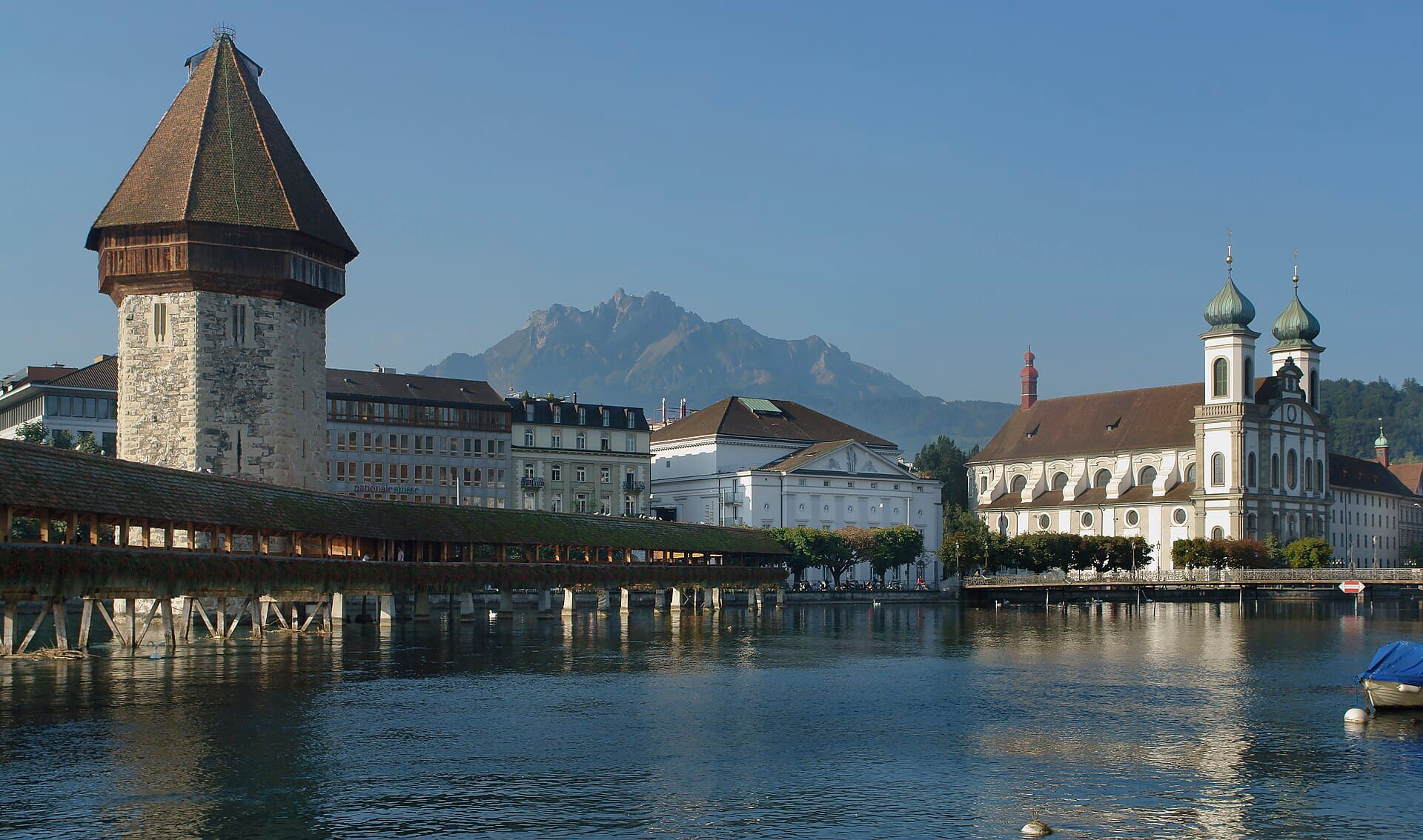
Lucerne's compact Old Town is easily explored on foot, revealing a wealth of historical sites and scenic spots. The clear landmark is the Chapel Bridge (Kapellbrücke), one of Europe's oldest covered wooden bridges. Adorned with 17th-century triangular paintings depicting scenes from Swiss history and local legends, it zigzags across the Reuss River and features the octagonal Water Tower, which has served as a city treasury, prison, and even a torture chamber. Another significant wooden bridge, the Spreuer Bridge, also features a series of 17th-century "Dance of Death" paintings.
A short walk from the Old Town leads to the poignant Lion Monument, a colossal sculpture carved into a sandstone cliff. This powerful memorial commemorates the Swiss Guards who died defending King Louis XVI during the French Revolution in 1792. Mark Twain famously described it as "the most mournful and moving piece of stone in the world."
For expansive views of the city, lake, and mountains, ascend the well-preserved medieval Musegg Wall with its nine towers. Several towers, including the Zyt Tower with its ancient clock mechanism from 1535, are open to the public seasonally. Other notable sights include the twin-towered Church of St. Leodegar, one of Switzerland's most important Renaissance churches, and the Baroque Jesuit Church with its distinctive onion domes. A stroll along the waterfront promenade offers views of Lake Lucerne and leads to the Swiss Museum of Transport, a popular attraction detailing the development of mobility.
Lucerne is a year-round destination, each season offering a different appeal. The busiest tourist season runs from June to September, with warm temperatures averaging around 20°C (68°F), ideal for outdoor activities like swimming, kayaking, and hiking. Expect larger gatherings and higher prices during these months. The shoulder seasons of April to May and October offer milder weather, fewer crowds, and more reasonable prices, making them excellent times to visit for a relaxed experience. October is often Lucerne's driest month. Winter, from December to February, transforms Lucerne into a beautiful, snow-dusted landscape, perfect for those interested in winter sports, though temperatures can drop below freezing.
Lucerne is situated in the German-speaking part of Switzerland, and while Swiss German is the local dialect, most locals in tourist areas understand and speak English. The currency used is the Swiss Franc (CHF), not the Euro. Tipping is optional but appreciated, usually by rounding up or leaving 5-10%.
The city center is very walkable, making it easy to explore major attractions on foot. For venturing further, Lucerne offers an efficient public transportation system of buses and trains. Visitors staying overnight often receive a free Visitor Card, offering discounts on local attractions and free use of buses and trains within zone 10 of the city network. For broader travel across Switzerland, consider a Swiss Travel Pass. The main train station, Lucerne Bahnhof, is conveniently located next to the lake, boat docks, and main bus station. Luggage lockers are available at the train station for convenient sightseeing.