Tempio Civico della Beata Vergine Incoronata
This Renaissance masterpiece, a beacon of civic pride, stands on a site with a surprising former life.
Full story unlocks in the tour
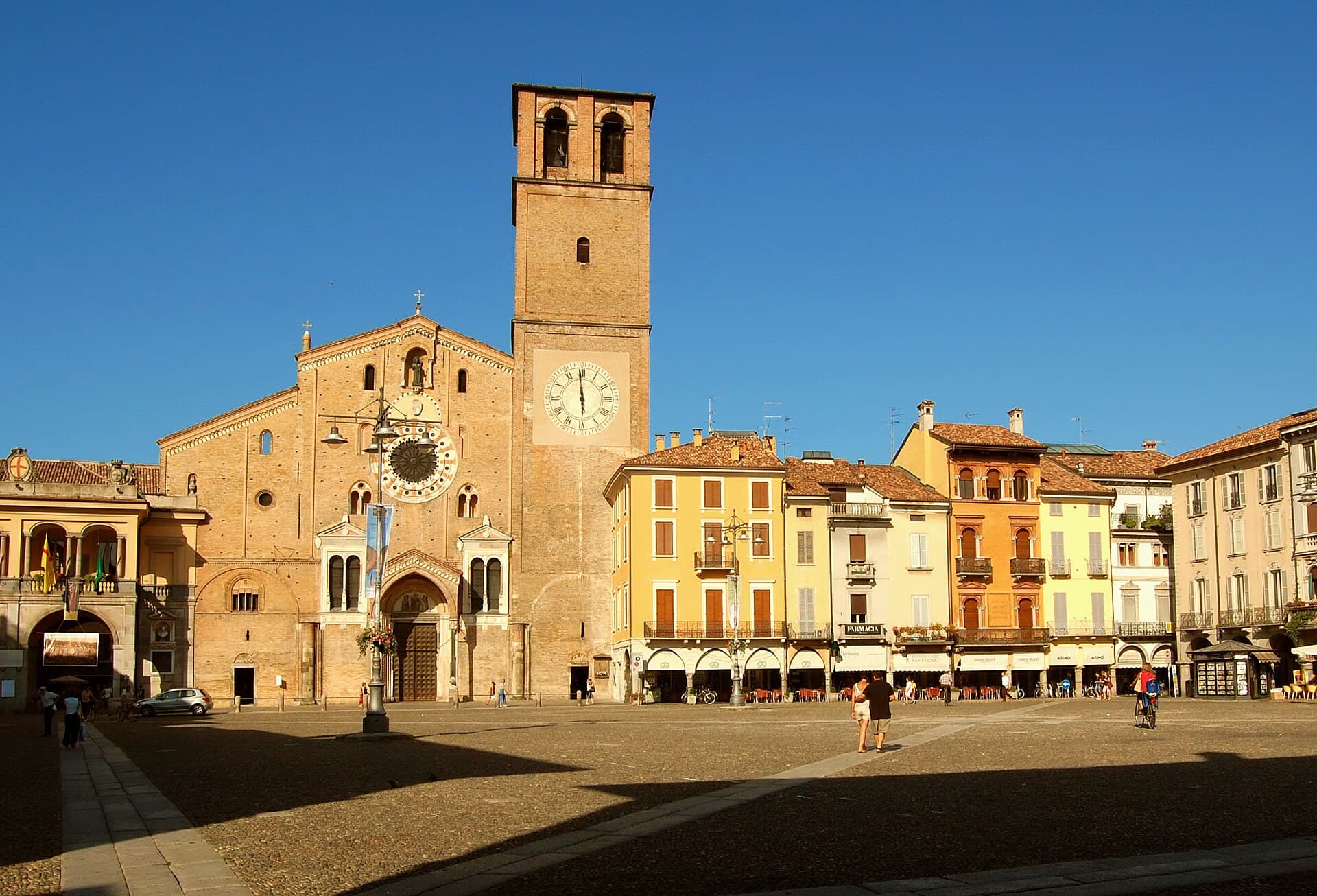 Gabriele Zuffetti / CC BY-SA 3.0, via Wikimedia Commons
“Where Lombard history echoes in arcades and Renaissance art.”
Not the postcards. The stories even locals don't know — whispered in your ear, right where they happened.
This Renaissance masterpiece, a beacon of civic pride, stands on a site with a surprising former life.
The central square of Lodi, Piazza della Vittoria, has witnessed more than just daily life and markets.
Among Lodi's unique cheeses, Pannerone stands out not only for its flavor but also for its historical role in a famous battle.
Discover every secret of Lodi
Every address, every reveal in full — in your ear, right where it happened.
You pick your stops. You walk. The voice reveals what the others miss.
No tours available yet. Check back soon — we're preparing them.
Lodi, a city in Italy's Lombardy region, offers a captivating blend of enduring history, exquisite art, and the rhythms of authentic Italian life. Situated on the right bank of the Adda River, southeast of Milan, it is a place where the past is visibly present in its well-preserved medieval center. The city, with a population of around 45,000, is a testament to centuries of evolution, from its Roman origins to its Renaissance splendor and beyond.
Often overlooked in favor of its more celebrated neighbors, Lodi provides a quieter, more intimate Italian experience. Its central Piazza della Vittoria, framed by arcades and venerable buildings, invites leisurely strolls and offers a glimpse into local rhythms. Beyond the architectural grandeur, Lodi is also a significant agricultural and industrial hub, particularly recognized for its cheese production, crafts, and cosmetics.
Visiting Lodi means stepping into a living museum, where every paving stone and fresco tells a story. It is a destination for those who appreciate the subtle allure of a city that has retained its character, offering profound cultural experiences without the throngs.
## From Roman Outpost to Renaissance Hub Lodi's story begins long before its official founding, tracing its roots to the ancient village of Laus Pompeia, a Celtic settlement that became a Roman municipium in 49 BC. Located strategically at the confluence of important Roman roads, Laus Pompeia flourished as a commercial and agricultural center.
However, this prosperity was not without its challenges. In the 11th and 12th centuries, tensions between Laus Pompeia and the powerful city of Milan escalated, leading to bitter armed conflicts. The Milanese forces twice destroyed the ancient settlement, in 1111 and again in 1158.
Following its second destruction, Emperor Frederick I Barbarossa intervened. On August 3, 1158, he refounded the city on its current site, a day still celebrated as Lodi's birth. The new Lodi quickly rose to prominence, even joining the Lombard League against Barbarossa himself, eventually securing autonomy in the Peace of Constance in 1183.
The 14th century saw Lodi fall under the rule of the powerful Visconti family of Milan, becoming a significant center within the Duchy of Milan. The city experienced a period of remarkable artistic and cultural flourishing during the Renaissance. A pivotal moment in Italian history occurred here on April 9, 1454, with the signing of the Treaty of Lodi, which brought forty years of political stability to the pre-unification Italian states.
Lodi's strategic importance continued through subsequent centuries. In 1796, Napoleon Bonaparte achieved a significant victory over the Austrians in the Battle of Lodi Bridge, paving the way for his conquest of Milan. The 19th century brought industrial expansion, particularly with the arrival of the Milan-Piacenza railway in 1861, and Lodi transitioned into a modern industrial hub, while still preserving its enduring historical core.
Begin your exploration in the heart of Lodi at Piazza della Vittoria, a grand square surrounded by arcades and historic buildings, including the Duomo di Lodi and the Palazzo Broletto. The Duomo, or Cathedral of Lodi, is a Romanesque masterpiece founded in 1158, featuring a 12th-century porch with lion sculptures and a large rose window. Its crypt, the oldest section, houses the relics of Saint Bassianus.
Just off the main square, discover the Tempio Civico della Beata Vergine Incoronata, an architectural marvel of Lombard Renaissance art. This octagonal church, designed by Giovanni Battagio in 1488, features sumptuous gold decorations, frescoes by local masters like Bergognone and the Piazza brothers, and a magnificent blue and gold dome.
Stroll through the narrow streets to admire other historic palaces like the 15th-century Palazzo Mozzanica and the 14th-century Palazzo Vistarini, both showcasing Lombard Renaissance architecture with their brick facades and decorative elements. Do not miss the Chiesa di San Francesco, a Romanesque-Gothic church from the 13th century, known for its three naves and frescoes.
For a different perspective, visit the Paolo Gorini Anatomical Collection, a unique museum offering insights into medical research. Those who appreciate nature can explore the Parco Isolabella along the Adda River or the Paradiso Fish Park, which features an underwater observatory.
Lodi experiences a moderately continental climate with distinct seasons. Summers (June to August) are hot and humid, with average daily highs reaching 30-32°C (86-90°F) in July, making it ideal for sun-seekers but potentially muggy. Winters (December to February) are cold and damp, with average lows around 1°C (34°F) in January and occasional snowfall.
The most agreeable times to visit Lodi for general outdoor tourist activities are from late May to mid-June and from mid-August to early October. During these periods, temperatures are pleasant, ranging from 19-29°C (65-80°F), offering comfortable conditions for exploring the city's historic center and outdoor spaces, despite some potential for rain.
Lodi is easily accessible, located approximately 30 kilometers southeast of Milan. It has its own train station with frequent services to Milan, and is also reachable by car via the A1 motorway.
While Lodi offers a modest selection of well-regarded hotels, many visitors choose to make it a day trip from Milan. If staying overnight, consider options like Hotel Concorde Lodi or UNA Hotel Lodi for comfortable facilities and convenient access to the city center.
When exploring, comfortable walking shoes are recommended, as the historic center is best experienced on foot. A light sweater or jacket is advisable for cooler evenings, even in warmer months, due to temperature fluctuations. The local currency is the Euro. Italian is the official language, but English is often understood in establishments catering to visitors.