La Seu Vella
Lleida's venerable Old Cathedral harbors a surprising past, extending beyond its sacred purpose.
Full story unlocks in the tour
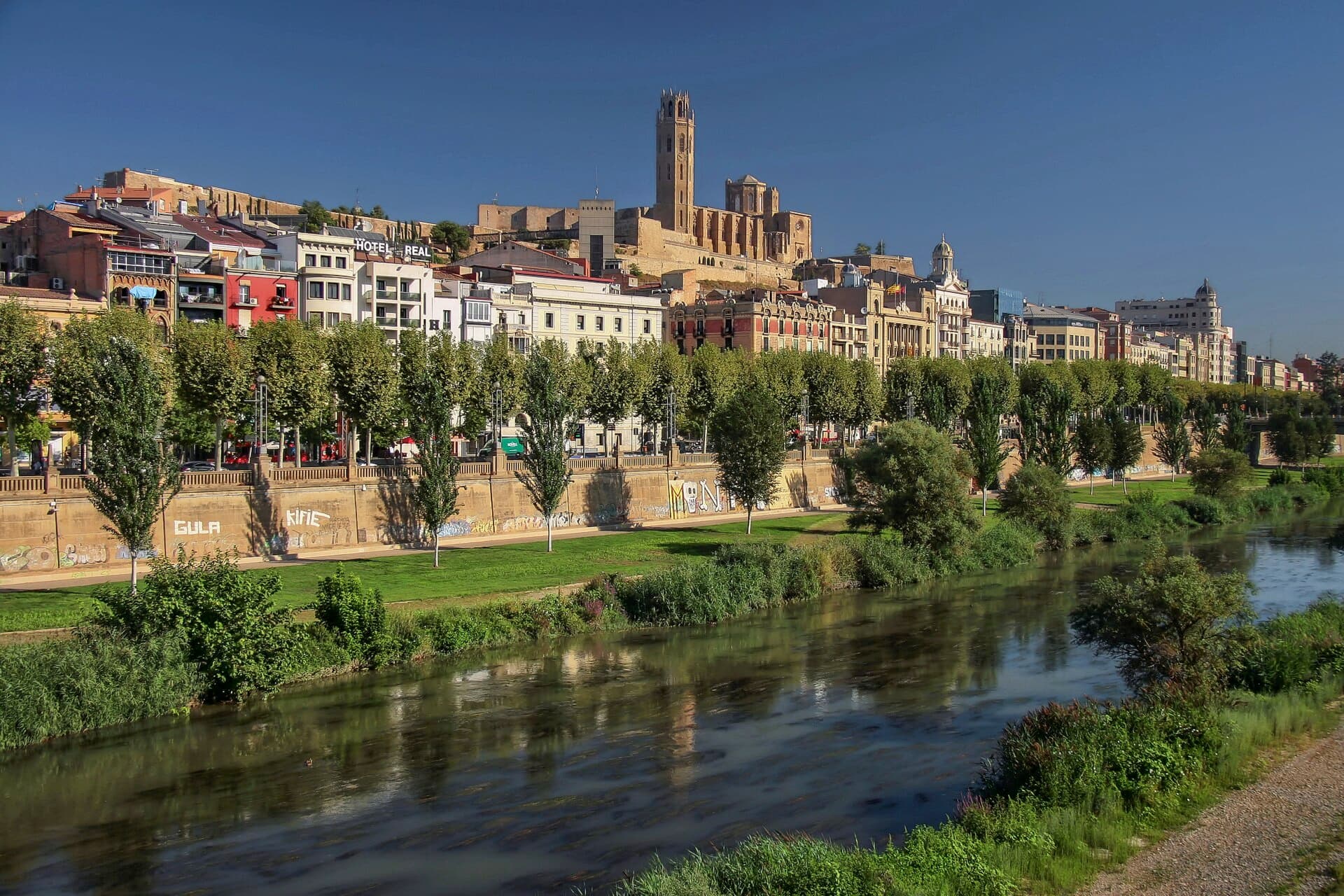 Jorge Franganillo / CC BY 3.0, via Wikimedia Commons
“Where ancient stones recount sagas and the Segre River charts its course through time.”
Not the postcards. The stories even locals don't know — whispered in your ear, right where they happened.
Lleida's venerable Old Cathedral harbors a surprising past, extending beyond its sacred purpose.
This formidable Templar castle, a medieval stronghold, safeguards a singular artistic treasure.
The placid Segre River played a decisive, and destructive, role in a celebrated ancient Roman conflict.
Discover every secret of Lleida
Every address, every reveal in full — in your ear, right where it happened.
You pick your stops. You walk. The voice reveals what the others miss.
No tours available yet. Check back soon — we're preparing them.
Lleida, known as Lérida in Spanish, is a city in western Catalonia, Spain, and the capital of the Segrià county. Situated along the Segre River, it stands as one of Catalonia's most ancient towns, with human settlements tracing back to the Bronze Age. The city presents a blend of intimate sightseeing, Catalan culture, and serves as a gateway to diverse natural vistas, from verdant plains to the rugged Pyrenees.
While less frequented by travelers than Catalonia's coastal cities, Lleida offers an authentic encounter with inland Catalonia. Its strategic position has historically rendered it a significant hub for trade and agriculture, particularly renowned for its fruit orchards, olive groves, and the globally recognized Arbequina olive. Visitors can explore its profound heritage without the throngs, enjoying a measured pace and uncovering a distinct facet of Catalonia.
## From Iberian Stronghold to Roman Ilerda Lleida's origins stretch back to the 6th century BC, established by the Iberian tribe of the Ilergetes, who named it Iltirta. It functioned as their capital and a crucial fortified point. The city gained prominence during the Roman expansion, becoming known as Ilerda. In 49 BC, it was the location of the Battle of Ilerda, a significant confrontation between Julius Caesar's legions and Pompey's legates. Under Augustus's rule, Ilerda transformed into a Roman municipality, even minting its own currency.
## Medieval Transformations and Templar Influence Following the decline of the Roman Empire, Lleida experienced periods under Visigothic and Muslim governance. In 1149, Christian forces, led by Count Ramon Berenguer IV of Barcelona, reclaimed it, ushering in a new era for the city. This period witnessed a flourishing of artistry and culture, including the laying of the first stone for the Old Cathedral, La Seu Vella, in 1203. The Knights Templar also established a notable commandery at Castell de Gardeny after their aid in the city's conquest, transforming the elevation into a fortified stronghold. In 1297, the University of Lleida was founded, becoming the third oldest in the Iberian Peninsula.
## Wars, Decline, and Modern Revival Lleida confronted numerous trials in subsequent centuries, including damage from the Reapers' War in the 17th century and the Spanish Civil War in the 20th century. During the War of the Spanish Succession, La Seu Vella was converted into a military barracks in 1707. The city endured extensive bombing during the Spanish Civil War in 1937 and 1938, with the Condor Legion attacks in 1937 notoriously targeting a school and causing many casualties. After falling to Franco's forces in 1938, La Seu Vella was even utilized as a concentration camp until 1948. Despite these adversities, Lleida has experienced continuous urban, commercial, and demographic expansion since then. The University of Lleida was re-established in 1991, and the city continues to evolve, with contemporary infrastructure such as the AVE high-speed railway line and cultural venues like the La Llotja theatre and congress centre.
Lleida's skyline is defined by the Seu Vella, the Old Cathedral, a remarkable example of Romanesque and Gothic architecture. Situated on an elevation, it affords sweeping views of the city and its surroundings. Adjacent to La Seu Vella stands the Castell de la Suda, an expansive fortress with Moorish beginnings that later served as a royal dwelling for the Crown of Aragon. On another elevation across the city, Castell de Gardeny rises, a well-preserved Templar castle featuring a residential tower and the Romanesque church of Santa Maria de Gardeny.
Walking along Carrer Major, a pedestrian thoroughfare, reveals the city's historic core with its arcades and modernist structures. The Palace of La Paeria, which houses the city council, also displays Romanesque characteristics. For those interested in art, the Lleida Museum and the MORERA Museu d'Art Modern i Contemporani present collections spanning sacred art, local chronicles, and contemporary creations. The Segre Riverfront provides an agreeable walk, showcasing the city's grand facades and connecting to natural areas like the La Mitjana park, a wetland perfect for observing local flora and fauna.
The most agreeable times to visit Lleida are spring (March-June) and autumn (September-October), when temperatures are mild and conducive to exploration. Spring brings forth blossoming landscapes, such as the peach blossom fields of Aitona, while autumn offers a display of vivid colors. Summers (July-August) can be intensely warm, with temperatures frequently surpassing 35°C (95°F), though the city center may offer some cooling breezes. Winters are cold and can be foggy, but are suitable for visiting historical sites without large crowds. If your plans include exploring the Pyrenees of Lleida for hiking or water activities, summer and autumn are ideal.
Lleida is a compact city, and many of its central attractions are readily accessible on foot. Public buses are available with tickets priced at €1.20, and taxis also present an option. The city is approximately an hour's train journey from Barcelona via the Renfe train, or a three-hour trip on the regional Rodalies train. The local currency is the Euro (€), and electricity operates at 220-240 V, 50 Hz, with round two-pin sockets.
Catalan and Spanish are the official languages, and while English may be understood, street signs and local interactions often feature Catalan. Shops typically open from 10:00 to 13:30 and 16:30 to 20:30, Monday to Saturday. Restaurants usually serve lunch from 13:30 to 15:30 and dinner from 20:30 to 23:00. For visitor information, the Turisme de Lleida Information Centre at Carrer Major 31 provides maps, guides, and assistance.