Rue de l'Enfer (Hell Street)
Les Sables-d'Olonne holds the official title for the world's narrowest street.
Full story unlocks in the tour
 Florian Pépellin / CC BY-SA 3.0, via Wikimedia Commons
“Where the Atlantic breathes adventure and art.”
Not the postcards. The stories even locals don't know — whispered in your ear, right where they happened.
Les Sables-d'Olonne holds the official title for the world's narrowest street.
In a small district, houses and walls are adorned with intricate mosaics made entirely of seashells.
Every four years, this coastal town becomes the epicenter of an extraordinary, single-handed, non-stop round-the-world sailing race.
Discover every secret of Les Sables-d'Olonne
Every address, every reveal in full — in your ear, right where it happened.
You pick your stops. You walk. The voice reveals what the others miss.
No tours available yet. Check back soon — we're preparing them.
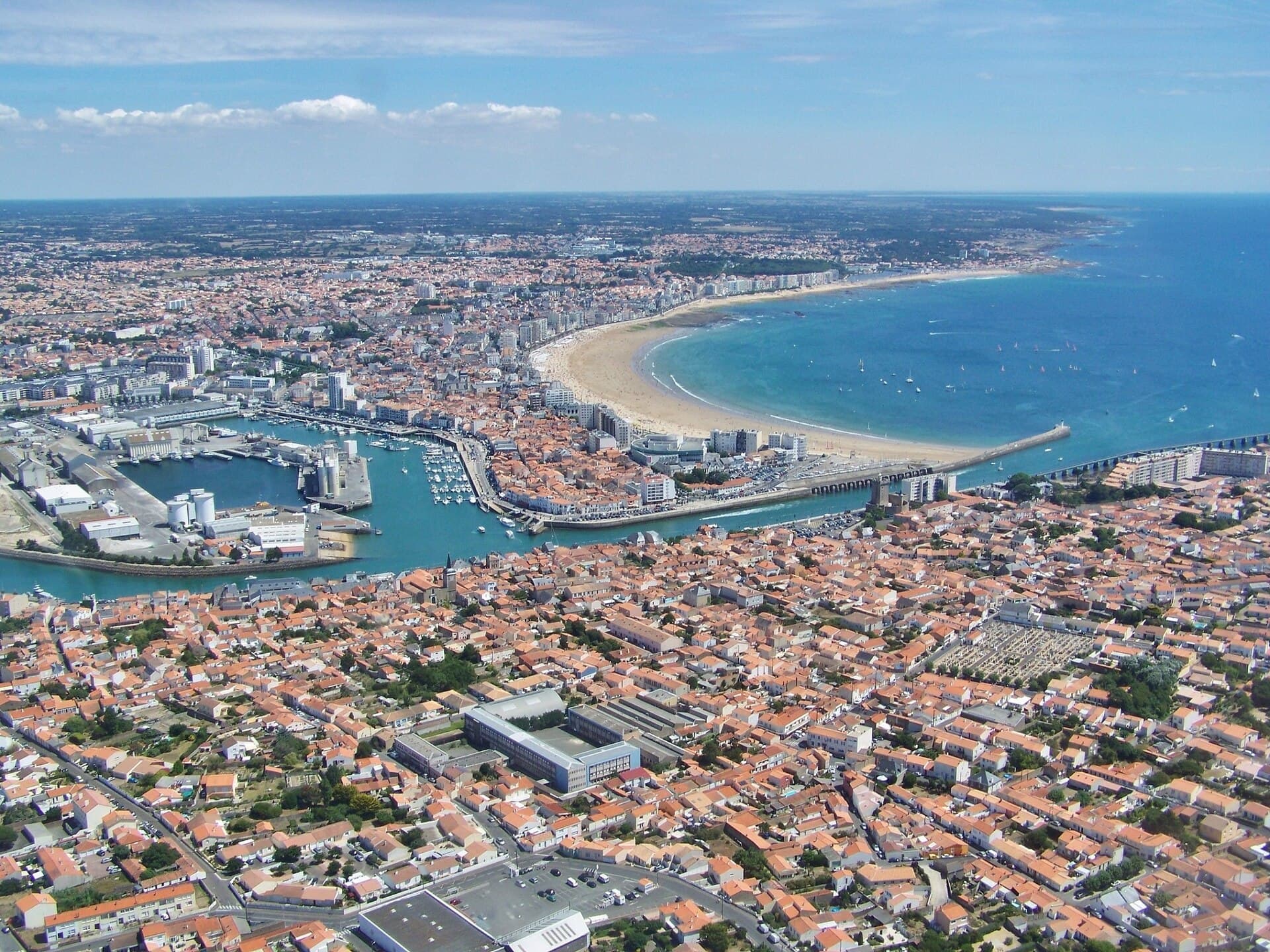
Les Sables-d'Olonne, a prominent seaside resort on France's Atlantic coast, is a place where the rhythm of the ocean shapes daily life. Located in the Vendée department, this town is celebrated for its expansive, south-facing sandy beach, Grande Plage, stretching for three kilometers. The wide seafront promenade, Le Remblai, hums with activity, lined with cafés and restaurants that spill onto the pavement. Beyond the immediate draw of the beach, Les Sables-d'Olonne offers a blend of maritime heritage, engaging architecture, and a relaxed coastal atmosphere.
The town's identity is deeply intertwined with the sea, evident in its active fishing port, commercial harbor, and Port Olona, a significant marina. It's a natural playground for those seeking active pursuits, from surfing and kayaking to cycling and hiking along coastal paths and through salt marshes. Yet, it also provides ample opportunities for repose, inviting visitors to unwind and absorb the sun. Les Sables-d'Olonne successfully combines the tranquility of a provincial town with the energy of a popular tourist destination, making it an engaging stop on the Côte de Lumière.
The story of Les Sables-d'Olonne is intimately connected to the sea and the sand from which it takes its name, meaning "The Sands of Olonne." Human presence in the Olonne region dates back to ancient times, with salt marshes and vineyards developed in the surrounding countryside as early as 2,000 years ago. The Celtic name "Ol-ona," meaning "height above water," hints at the early geography of the area, where the sea once covered much of the land, leaving only a dune cordon and a rocky outcrop, now known as La Chaume.
The official founding of Les Sables-d'Olonne is marked by a charter of liberties granted in 1218 by Lord Savary I de Mauléon to a settlement that had emerged on the sand dunes. This new port was strategically vital, as the older harbor in nearby Talmont was silting up. By the 15th century, King Louis XI recognized the town's potential, promoting the fortification of its port and the development of its infrastructure. In 1472, he separated Les Sables-d'Olonne from the jurisdiction of Olonne, establishing it as the primary port of the region.
The early economy of Les Sables-d'Olonne thrived on two key resources: salt, or "white gold," from the surrounding marshes, and fishing. The town became a major center for cod fishing off Newfoundland in the 17th century. The 17th and 18th centuries marked the zenith of its fishing port. In 1753, Les Sables and La Chaume were united as a single commune.
The 19th century brought a new era of prosperity with the arrival of the train in 1866 and the growing popularity of sea bathing. Les Sables-d'Olonne transformed into a fashionable and elegant resort, attracting the wealthy and stylish of the day. Many of the graceful buildings seen today, particularly along Le Remblai, date from this Belle Époque. The town has continued to embrace its maritime spirit, becoming the starting point for the Vendée Globe, the celebrated solo round-the-world sailing race, first held in 1989.
In 2019, Les Sables-d'Olonne became a "Ville Nouvelle" through the merger of three communes, further solidifying its position as a significant coastal center. Today, its fishing industry remains important, ranking among France's top ports for the value of its landed catch, including sole, hake, and tuna. The daily fish auction is a testament to this enduring tradition. The town also champions eco-friendly values, focusing on heritage preservation, sustainable mobility, and protecting its distinctive environment.
Begin your exploration with a walk along Le Remblai, the wide seafront promenade that borders the Grande Plage. From here, you can take a water ferry across the harbor entrance to La Chaume, the town's oldest fishing quarter, characterized by its narrow, whitewashed streets. In La Chaume, you'll find the 15th-century Arundel Tower and Saint-Clair Castle, which now houses the Sea and Fishing Museum.
Do not miss L'Île Penotte, a distinctive neighborhood where houses and walls are decorated with intricate seashell mosaics inspired by mythology and folklore. For a deeper dive into maritime life, visit the Musée du Coquillage, dedicated to shellfish with a collection of over 50,000 shells from around the world. The Museum of Modern and Contemporary Art (MASC), housed in the former Sainte-Croix Benedictine priory, displays works by artists like Gaston Chaissac and Victor Brauner.
Beyond the town center, explore Les Salines, the ancient salt marshes. You can take a guided boat tour to learn about traditional salt harvesting methods and even try collecting salt yourself. The Zoo des Sables d'Olonne is another popular attraction, home to over 500 animals from 60 different species, including rare Amur leopards and African dwarf crocodiles.
For outdoor enthusiasts, the Vélodyssée offers varied cycling routes along dunes, through forests, and past marshes, providing views of the ocean and Vendée landscapes.
Les Sables-d'Olonne enjoys a mild maritime climate throughout the year. The most popular time to visit for warm-weather activities is from late June to mid-September, with July and August being the warmest and sunniest months, averaging around 20°C. During this peak season, daily highs can reach 23°C, and there are fewer rainy days. Spring (March-May) and early autumn (September-November) offer milder temperatures and fewer crowds, making them ideal for exploring. Winter (December-February) is mild, with average temperatures around 7-9°C, and is suitable for cultural visits without the crowds.
Les Sables-d'Olonne is accessible by air, rail, and road. The nearest airports are Nantes (90-minute transfer) and La Rochelle (100-minute transfer), with direct flights from various UK cities. The town has its own train station, Gare des Sables d'Olonne, with regular services from Nantes and direct connections from Paris Charles de Gaulle Airport (CDG). Travel by rail from London typically takes around 9 hours.
Once in Les Sables-d'Olonne, the Oléane bus network provides urban transport with 8 lines. To cross the harbor entrance between the old town and La Chaume, a maritime shuttle service is available, saving a significant walk. Accommodation options range from hotels overlooking the Grande Plage to those near the yacht harbor. Many restaurants specialize in fresh seafood, reflecting the town's enduring fishing heritage.