León Cathedral
The 'House of Light' is celebrated for its stained glass, yet a lesser-known element contributes to its unique luminosity.
Full story unlocks in the tour
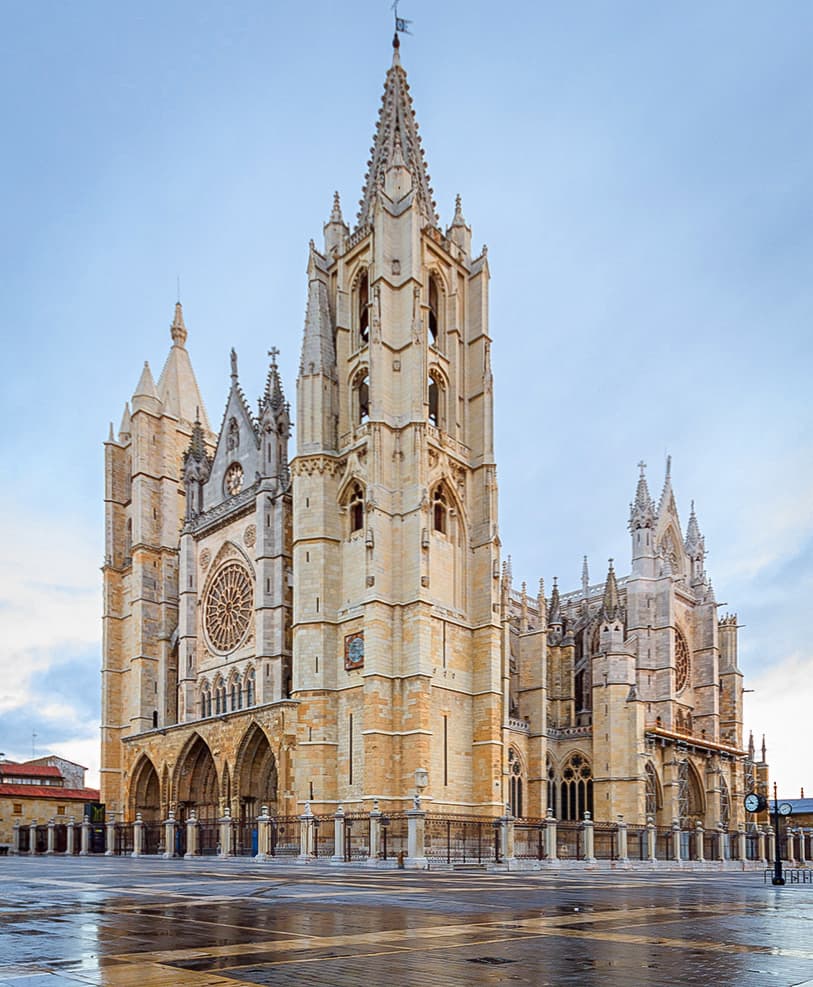 David Jiménez Llanes / CC BY-SA 3.0, via Wikimedia Commons
“Where ancient Roman foundations meet Gothic splendor and free-flowing tapas.”
Not the postcards. The stories even locals don't know — whispered in your ear, right where they happened.
The 'House of Light' is celebrated for its stained glass, yet a lesser-known element contributes to its unique luminosity.
Within the Royal Pantheon of this Romanesque basilica resides an art collection so profound, it acquired an unexpected moniker.
León's animated 'Wet Quarter' is well-known for its tapas, but a particular custom here distinguishes it from nearly every other place in Spain.
Discover every secret of León
Every address, every reveal in full — in your ear, right where it happened.
You pick your stops. You walk. The voice reveals what the others miss.
No tours available yet. Check back soon — we're preparing them.
León, a city in northwestern Spain, offers an engaging blend of Roman origins, medieval grandeur, and a lively modern atmosphere. Established as a Roman military encampment in 29 BC, its name originates from 'Legio,' referring to the legions that founded the city. Today, León stands as an important stop on the Camino de Santiago, drawing pilgrims and travelers with its deep cultural heritage and a reputation for generous food.
The city's compact historic core invites exploration on foot, with significant attractions like the Cathedral, Basilica of San Isidoro, and Casa Botines all within a brief stroll. Beyond its architectural wonders, León is known for its animated social scene, particularly in the Barrio Húmedo, where the custom of complimentary tapas with every drink fosters a convivial environment. With fewer crowds than some of Spain's more frequently visited destinations, León provides an authentic and immersive encounter with Spanish history, culture, and culinary pleasures.
## From Roman Camp to Royal Capital León's narrative began in 29 BC as a military encampment for the Roman Legio VI Victrix during the Cantabrian Wars. Its strategic importance was confirmed in 74 AD with the permanent settlement of the Legio VII Gemina, from which the city's modern name is derived. The Romans established the site to protect newly acquired territories and ensure the transport of gold from nearby mines like Las Médulas.
Following a period of political disorganization, León was repopulated around 856 by the Kingdom of Asturias. In 910, the Asturian dynasty relocated its political center from Oviedo to León, establishing it as the head of the Kingdom of León. This kingdom played a vital role in the Reconquista, the Christian effort to reclaim Spain from Moorish rule, and became one of medieval Spain's foundational kingdoms. During this era, León thrived, becoming a confluence of cultures and a significant center for trade and crafts due to its position on the Camino de Santiago.
A notable historical event occurred in 1188 when Alfonso IX of León convened the Cortes of León, which included representatives of the urban class. UNESCO recognizes this event as the earliest parliament in Medieval Europe, earning León the designation 'cradle of parliamentarism.' The city's prominence lessened after the Kingdom of León merged with the Crown of Castile in 1301. After a period of stagnation, León experienced a revival in the late 19th and 20th centuries, becoming an important communications hub with the growth of the coal mining industry and the arrival of the railroad. Today, León's profound historical and architectural legacy, combined with its function as a Way-station on the Camino de Santiago, continues to attract visitors.
Begin your exploration at the León Cathedral, a splendid example of French-style Gothic architecture, often called the 'House of Light' for its impressive stained-glass windows, which cover 1,800 square meters. An interior visit is essential to appreciate the colorful light filtering through these medieval creations. A short walk away, the Basilica of San Isidoro displays exquisite Romanesque art, including the Royal Pantheon with its remarkable 12th-century frescoes, often referred to as the 'Sistine Chapel of Romanesque Art.'
Take time to see Casa Botines, a modernist structure designed by Antoni Gaudí, one of only a few of his works outside Catalonia. Today, it houses a museum dedicated to Gaudí and an art gallery. Wander through the Barrio Húmedo, the city's old quarter, known for its lively atmosphere and the custom of complimentary tapas with every drink. For a contemporary contrast, visit the MUSAC (Museum of Contemporary Art of Castilla y León), an award-winning building with a colorful glass exterior inspired by the Cathedral's stained glass. Evidence of León's Roman past, including sections of the ancient walls, can still be seen throughout the city.
The most agreeable time to visit León for activities in warmer weather extends from late June to early September, when days are warm and sunny, though evenings can be cool. Temperatures in July, the warmest month, average a high of 79°F (26°C) and a low of 54°F (12°C). Spring (April-May) and early autumn (September-October) also offer pleasant weather with mild temperatures, ideal for discovering the city and enjoying outdoor pursuits. September is particularly recommended, as the summer heat lessens, and the city retains a lively atmosphere with festivities like San Froilán.
León is a city easily traversed on foot, particularly its historic center, where the main attractions are concentrated. The city is flat and largely designed for walking, making navigation between sites straightforward. For those arriving by train, León is well-connected by high-speed AVE from Madrid, with the train station a 15-20 minute walk or short bus ride from the historic center.
Accommodation options span from luxurious hotels like the Parador de San Marcos (a former monastery) to budget-friendly hostels. Booking in advance, especially during spring and summer, is advisable. León offers excellent value, with the complimentary tapas custom significantly reducing food costs. A full day encompassing major sights and an evening in Barrio Húmedo can be quite economical. Non-EU visitors should be aware of new ETIAS requirements for Spain starting mid-2026, along with potential tourist taxes.