Leh Palace
The imposing Leh Palace, a nine-story structure, holds more than just royal history within its walls.
Full story unlocks in the tour
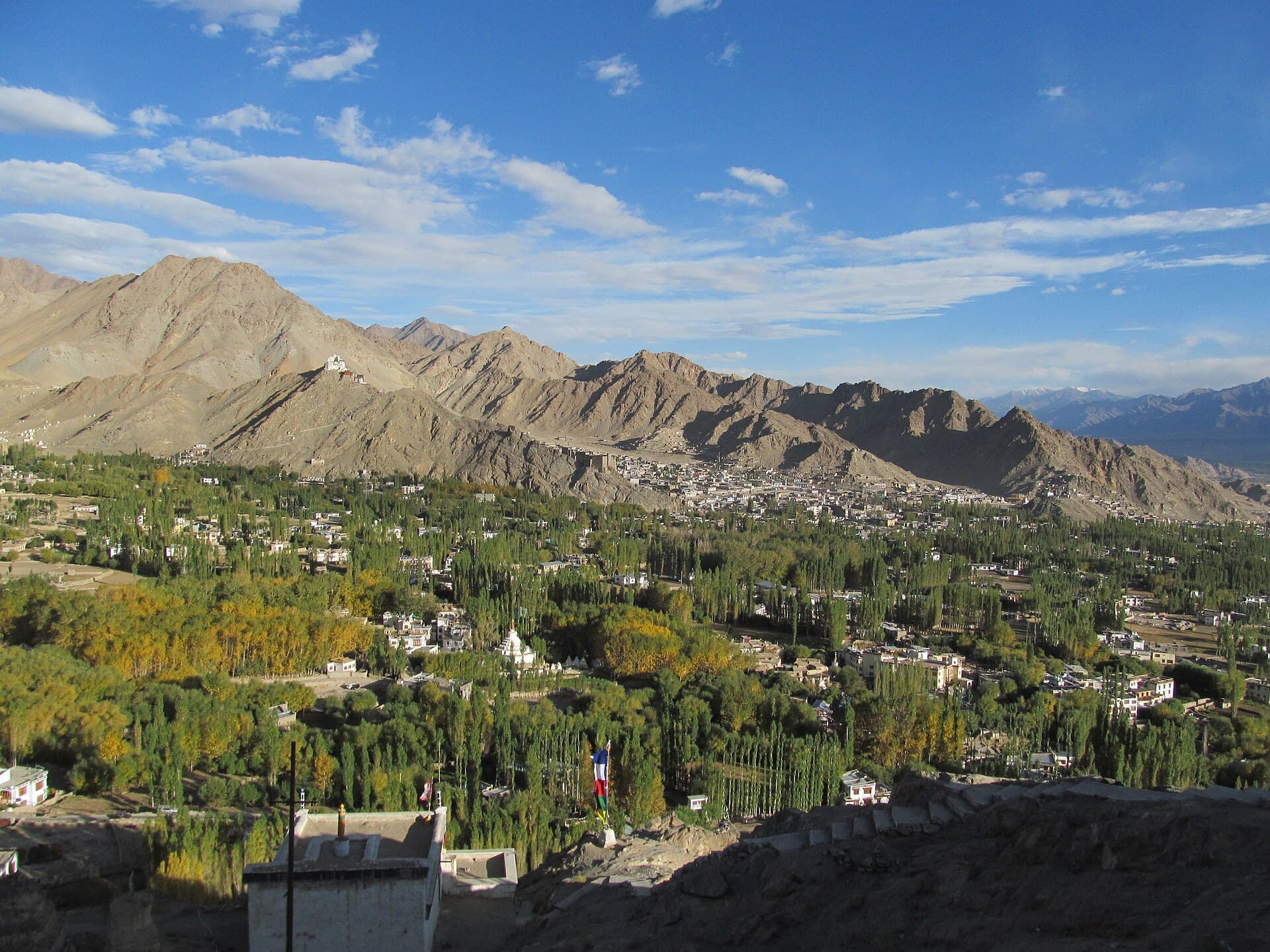 Anirvan Shukla / CC BY-SA 3.0, via Wikimedia Commons
“Where ancient traditions meet the vast Himalayan expanse.”
Not the postcards. The stories even locals don't know — whispered in your ear, right where they happened.
The imposing Leh Palace, a nine-story structure, holds more than just royal history within its walls.
Hemis Monastery, Ladakh's largest and most opulent, is said to harbor some surprising spiritual connections.
Beyond the colorful stalls and lively activity, the Leh Main Market offers a unique blend of local life and ancient trade routes.
Discover every secret of Leh
Every address, every reveal in full — in your ear, right where it happened.
You pick your stops. You walk. The voice reveals what the others miss.
No tours available yet. Check back soon — we're preparing them.
Leh, the capital of Ladakh, rests at an elevation of approximately 3,500 meters (11,500 feet) above sea level, situated within a expansive valley between the Himalayan, Karakoram, and Zanskar mountain ranges. This high-altitude desert region is known for its awe-inspiring landscapes, ancient monasteries, and a thriving Tibetan-Buddhist culture that has remained remarkably preserved. Often referred to as 'Little Tibet,' Leh offers a unique blend of spiritual tranquility, dramatic scenery, and a profound historical character that captivates visitors.
Upon arrival, the dry mountain air and significant altitude demand a slow pace for acclimatization, a crucial step before venturing into the higher reaches of the region. The town itself is a walkable base for exploration, with its intricate old town, the towering Leh Palace, and the serene Shanti Stupa offering expansive views. Leh serves as a gateway to the wider Ladakh region, a land of stark beauty, where every turn reveals a new vista of snow-capped peaks, deep river valleys, and brilliant blue lakes.
While settlements have existed in the Indus River valley since ancient times, Leh's prominence grew during the Namgyal dynasty. In the 17th century, King Sengge Namgyal moved the capital of the Himalayan Kingdom of Ladakh to Leh, marking its golden age. During this period, the iconic nine-story Leh Palace was constructed, symbolizing royal power and becoming a significant architectural landmark.
Leh was strategically positioned on ancient trade routes along the Indus Valley, connecting Tibet, Kashmir, India, and China. It flourished as a major transshipment point where goods like salt, grain, pashmina wool, indigo, and semi-precious stones were exchanged. This constant flow of merchants fostered a unique atmosphere of cultural exchange. Spiritually, Leh developed as a stronghold of Buddhism, with numerous monasteries and stupas built in and around the city, creating a distinctive architectural landscape that harmonized with the rugged Himalayan terrain.
In 1665, the first Sunni mosque was built in Leh, reflecting the city's development as a multicultural trade center. However, Leh's prosperity as a trade hub, largely managed by Sunni Muslim merchants, abruptly ended with the closure of the Chinese border in the 1950s. In 1834, Ladakh became part of the Dogra dynasty's domains, and by 1846, with the signing of the Treaty of Amritsar, Leh officially became part of the Princely State of Jammu and Kashmir under British suzerainty. The royal family eventually had to abandon Leh Palace and relocate to Stok Palace in the mid-19th century after the Dogra forces invaded Ladakh.
In 1948, Leh, along with the entire Ladakh region, became part of independent India. The Indian government opened Ladakh to foreign visitors in 1974, initiating the development of its travel industry. Leh was granted separate administrative district status in 1979, further solidifying its role in regional governance. More recently, in 2019, Ladakh was granted Union Territory status, with Leh becoming one of its joint capitals.
Leh offers a captivating blend of cultural sites and natural beauty. Begin your exploration at the Leh Palace, a magnificent nine-story structure built in the 17th century, offering expansive views of the town and surrounding mountains. Continue higher to the Namgyal Tsemo Gompa and fort, crowning the peak above the palace.
For a serene experience, visit the Shanti Stupa, a white-domed Buddhist stupa built in 1991, providing unparalleled panoramic views of Leh and the Himalayan range, especially at sunrise or sunset. Wander through the Leh Main Market, a pedestrian-friendly area where monks and locals mingle with travelers. Here, you can find pashmina shawls, Tibetan jewelry, local handicrafts, and taste traditional Ladakhi food.
Beyond the town, consider a day trip to the Hemis Monastery, Ladakh's largest and most opulent monastery, known for its lively festivals and profound history. Another impressive site is Thiksey Monastery, a grand example of monastic architecture. For a glimpse into Ladakhi rural life and ancient monasteries, explore villages in the Indus Valley such as Stok, Shey, and Alchi. Don't miss the dramatic confluence of the Indus and Zanskar Rivers, where two distinct rivers merge.
The most popular time to visit Leh is during the summer months, from May to September. During this period, the weather is pleasant with clear skies, and daytime temperatures range from 15°C to 25°C. All major roads and tourist sites, including high-altitude passes, are generally open, making it ideal for trekking, biking, and exploring. While July and August are peak visitor season, September offers pleasant weather with fewer crowds. Winter, from November to March, brings extreme cold and heavy snowfall, closing many roads, but offers a unique experience for snow enthusiasts and those seeking solitude.
Leh is at a high altitude of around 3,500 meters (11,500 feet), so acclimatization is paramount. Plan to rest for at least 24 to 48 hours upon arrival, especially if flying in, to allow your body to adjust to the lower oxygen levels. Drink at least 3-4 liters of water daily and avoid alcohol and strenuous activity during this initial period. Carry sufficient cash, as ATMs can be limited outside Leh, and many smaller shops prefer cash. Pack layered clothing to adapt to temperature swings, as mornings and evenings can be chilly, while afternoons are often sunny. Sunscreen and a hat are essential due to the intense UV radiation at high altitude. Consider travel insurance that covers high-altitude activities and emergency evacuation. Non-Indian citizens may need a Protected Area Permit (PAP) for certain border areas, which can be obtained through travel agencies in Leh.