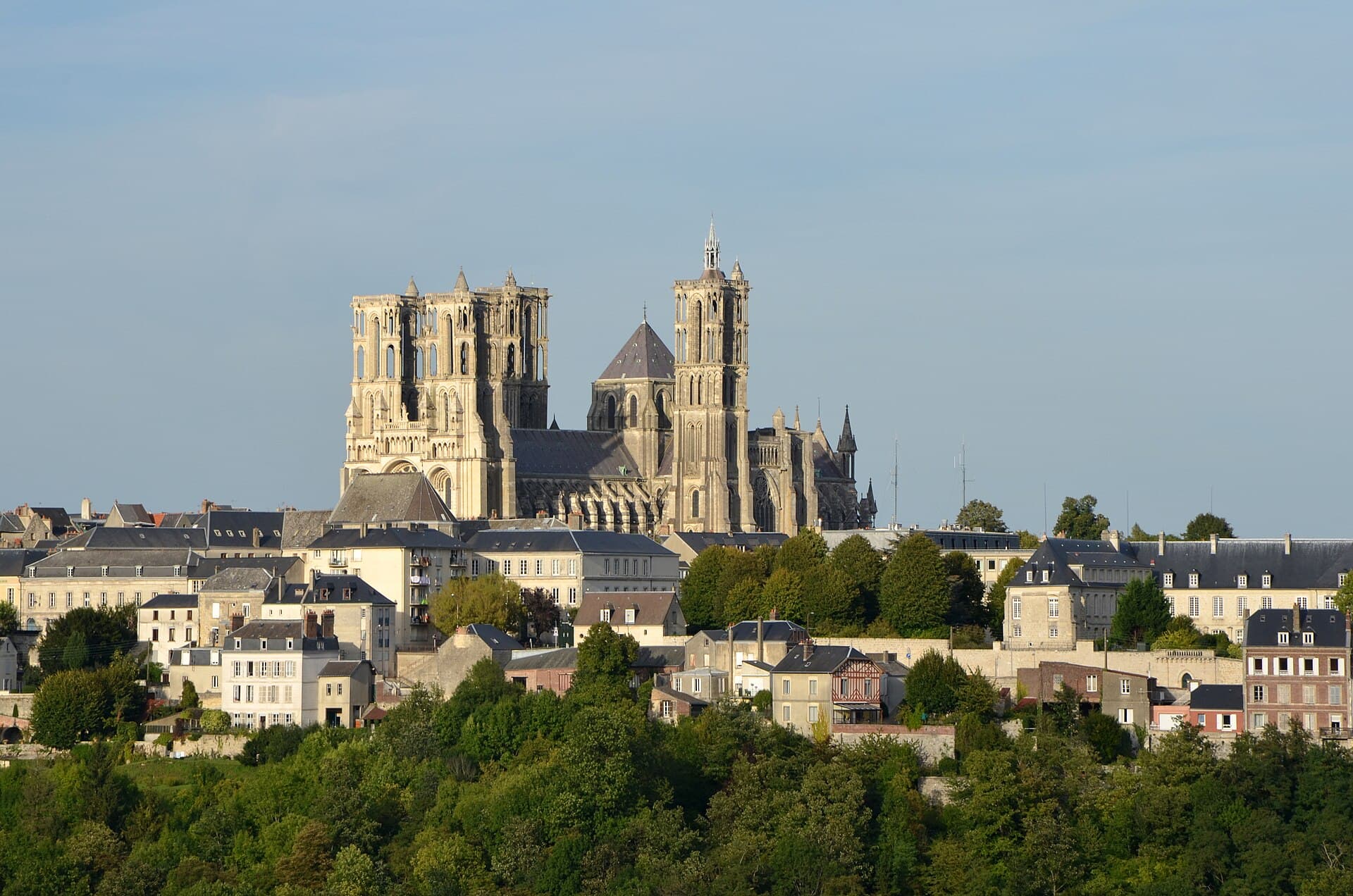
Notre-Dame de Laon Cathedral
Observe the cathedral's towers closely, and you will notice some unexpected figures carved into the stone.
Full story unlocks in the tour
 Pline / CC BY-SA 3.0, via Wikimedia Commons
“Laon: A Crowned Mountain of Secrets and Stone”
Not the postcards. The stories even locals don't know — whispered in your ear, right where they happened.
Observe the cathedral's towers closely, and you will notice some unexpected figures carved into the stone.
Beneath Laon's historic avenues lies a world with origins far deeper than one might initially imagine.
Walking the city's ancient walls provides more than just expansive views; it uncovers the narrative of an ambitious architectural plan that was never fully realized.
Discover every secret of Laon
Every address, every reveal in full — in your ear, right where it happened.
You pick your stops. You walk. The voice reveals what the others miss.
No tours available yet. Check back soon — we're preparing them.
Laon, the historic capital of the Aisne department, rises dramatically atop a 100-meter limestone hill, earning it the moniker “Montagne Couronnée” or “Crowned Mountain.” This strategic elevation has shaped its long and compelling history, making it a significant center since Roman times. Today, Laon is a quieter destination, offering a dense concentration of medieval monuments within its compact, stone-paved thoroughfares.
The upper town, encircled by 8 kilometers of well-preserved ramparts, feels like a journey back in time. Its crowning glory is the Notre-Dame de Laon Cathedral, an early Gothic architectural achievement that predates Notre-Dame de Paris and served as a model for other cathedrals, including Chartres. Beyond its architectural grandeur, Laon invites exploration of its subterranean tunnels and offers expansive vistas across the Picardy and Champagne regions.
## From Roman Fort to Carolingian Capital Laon's strategic importance dates back to the 1st century when the Romans fortified the area, then known as Laudunum. Archaeological evidence suggests the hilltop was settled as early as 3000 BCE. In the late 5th century, Saint Remigius, Archbishop of Reims, established a bishopric in Laon, elevating its status and transforming it into a prominent religious and intellectual hub until the Renaissance.
## A Royal Seat and Medieval Powerhouse During the Carolingian era, Laon flourished as a key medieval power center and a royal residence. Bertrada of Laon, mother of Charlemagne, was born here, further cementing the city's link to European imperial lineage. Louis IV of France, a great-great-great-grandson of Charlemagne, was also born in Laon. The city's ramparts were reconstructed and expanded during this period, enhancing its defensive capabilities.
## Tumult and Transformation The 12th century marked a golden age for Laon, experiencing a major economic boom that spurred intense building and reconstruction. This era saw the construction of many of its ecclesiastical sites, including the magnificent Gothic Notre-Dame de Laon Cathedral, built between 1150 and 1180 to replace an earlier structure destroyed by fire. However, this period was also marked by conflict. In the early 12th century, the local bourgeoisie revolted against the rule of the church, leading to the destruction of the episcopal palace and cathedral in 1112. The city changed hands multiple times during the Hundred Years' War and suffered damage during the French Revolution, the Franco-Prussian War of 1870, and both World Wars. Despite these tumultuous periods, Laon has consistently rebuilt and preserved its architectural heritage, with over 80 listed historical monuments today.
The most prominent landmark is the Notre-Dame de Laon Cathedral, an early Gothic architectural achievement constructed between the 12th and 13th centuries. Its distinctive towers, some adorned with sculpted oxen, are a testament to medieval ingenuity. Visitors can ascend the cathedral towers for expansive views of Laon and the surrounding regions.
Explore the medieval ramparts that encircle the upper town, offering scenic walks and views across Picardy and Champagne. Pass through well-preserved gates like the Porte d'Ardon and Porte de Soissons.
Delve into the Les Souterrains, a network of underground tunnels carved from limestone beneath the city. These passages, used for centuries for various purposes, offer guided tours revealing fossils and wartime narratives.
Visit the Chapel of the Templars, an octagonal 12th-century structure, and the Musée d'Art et d'Archéologie, which houses local and Mediterranean collections, including works by the Le Nain brothers, 17th-century painters born in Laon.
The Abbey of Saint-Martin, with its attractive cloister now converted into gardens, dates to the early 12th century. The former Episcopal Palace, adjacent to the cathedral, now serves as the city courthouse.
Laon is best visited during spring (March-May) and autumn (September-October) for mild weather and fewer crowds. Temperatures in May range from 7-18°C (45-65°F), and in April from 4-16°C (39-60°F). The summer months (June-August) offer warmer temperatures, averaging 20-25°C (68-77°F), and lively festivals. Winter brings a particular charm with festive decorations and indoor attractions, though temperatures are colder, averaging 1-8°C (33-46°F).
Laon is easily accessible by train from Paris Gare du Nord, with direct journeys taking approximately 1 hour and 38 minutes. If driving, it's about a 2-hour drive from Calais. The city is divided into an upper and lower town. While a funicular once connected them, it was dismantled in 2016. Numerous paths and stairways, known as 'grimpettes', connect the two sections, offering a pleasant walk.
Accommodation options in Laon include hotels like Kyriad Laon, Hôtel du Tramway, and Hôtel Les Chevaliers. Many small French towns, including Laon, have limited openings on Sundays and Mondays, so plan accordingly. Local markets are held daily except Mondays.